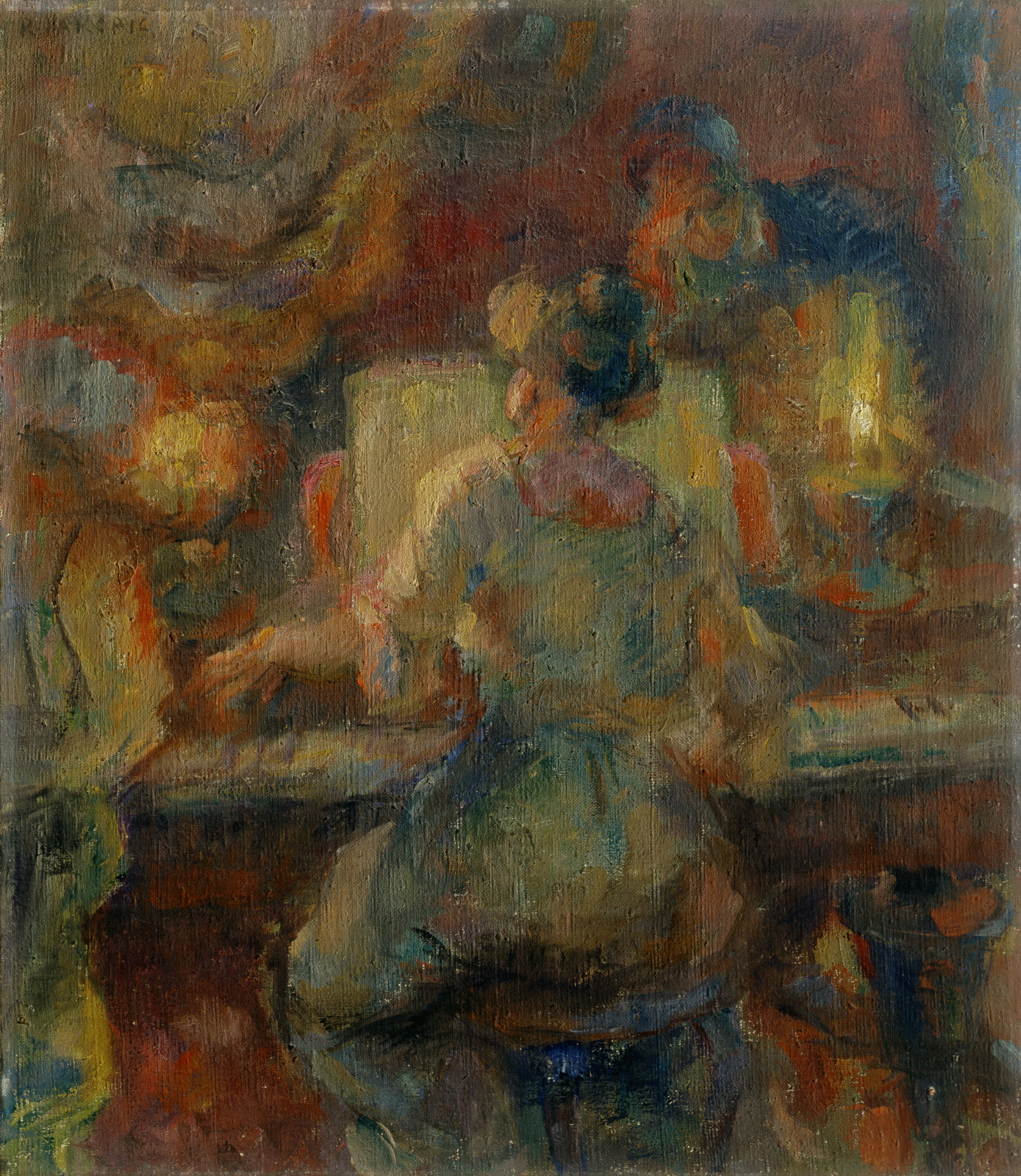
At the Piano (A Nocturne)
At the Piano forms a motif in his work at least from 1908 onwards, with the largest examples of such composition taking form in the early 1920s. This painting was constructed according to a certain principle of realism, as Jakopič included an additional source of light to the left of the modeling pianist. The golden light cast by the table lamps makes for dramatic silhouettes of the woman’s torso in the backlighting of the right light, while bright reflections on her left trace her body up her arm and shoulder up to the light’s reflection on her cheek. Her body and arms are depicted at the moment of the ecstatic motion that leans her upright torso towards the instrument.
This painting is earlier than the dramatic green and red complementary contrasts of the work we rightly call Nokturno (Nocturne). In this work, however, the painter added more elements to the composition – a listener stands opposite to the piano player with a light and sheet music between them, and a curtain on the left, as if it had been copied from a Baroque portrait. The curtain takes up a significant portion of the painting, creating a mystical feel, as if it were undulating to and fro to the melody’s rhythm. The extended left hand decisively striking the keys also became a permanent fixture. In later renditions, the leftmost light vanished, such that the shadows were more focused, subordinated to one single center, and thus they come across all the more dramatic. Jakopič said, “You need to achieve that which a person feels within themselves. /…/ I have previously tried ordering the colors in some fixed mutual relationship /…/ I feel that it is also possible to create a work of art this way, i.e. a visible expression of one’s spirituality. This style of expression could be compared to how music combines both tone and timbre. Naturally, the point of all of this experimentation is for it to accord with what you feel within. If you find that harmony, then the painting is complete.”