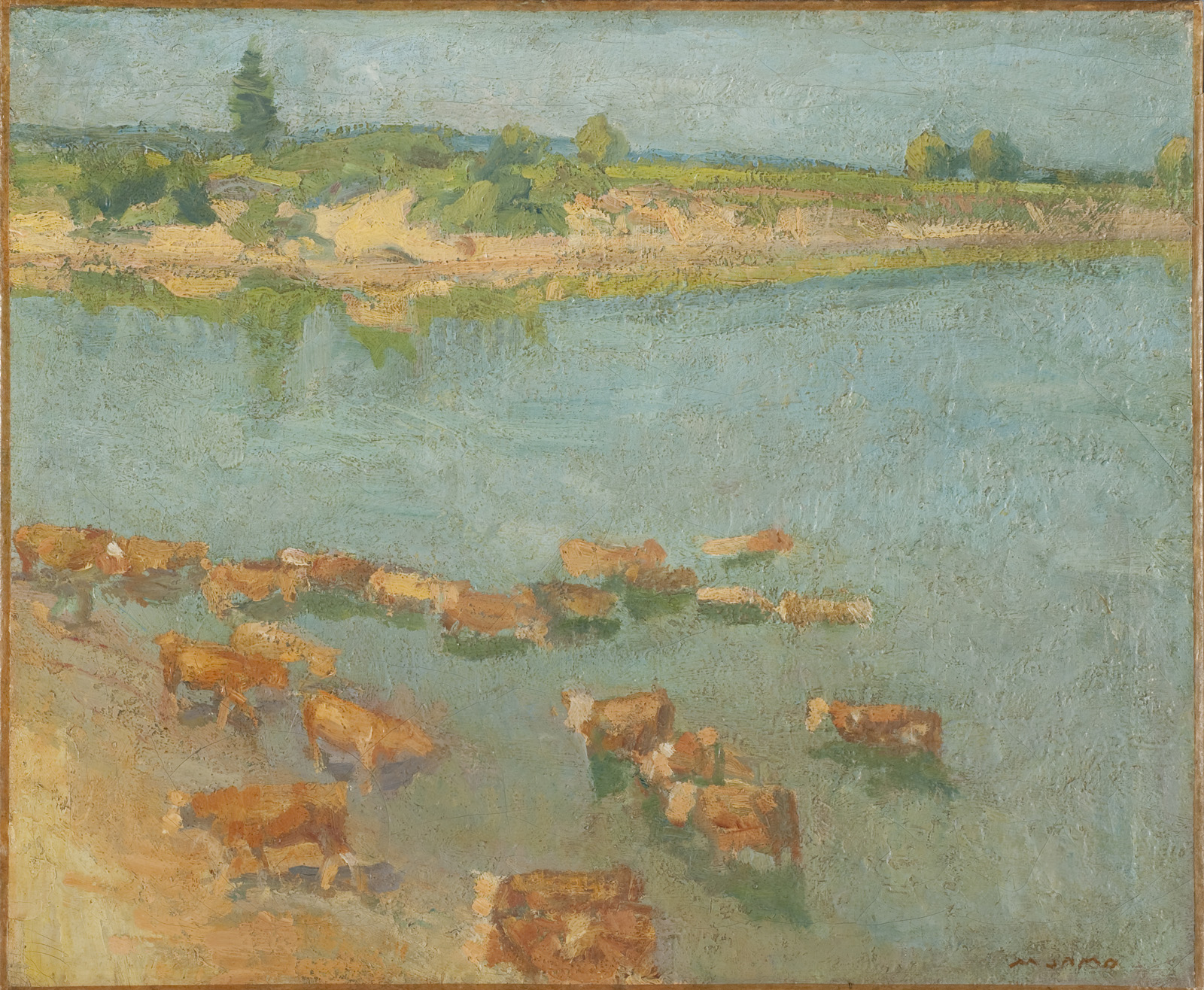
Cows by the Kolpa River
The panoramic view is one of Jama’s most vivid techniques in his landscape compositions. Starting in the late 1920s, he applied it to a herd of cattle at a watering place on Kolpa river in Bela Krajina. He produced several formats of this motif. This is among the smaller ones and, we surmise, one of the earliest. Staged like a photograph in a nearly square frame, it casts its sharp gaze directly on the animals in the foreground and beyond, giving a more dramatic feeling to a view from above. Behind the herd in the shallows, the river bends and flows towards the horizon along the opposite bank. In a habitually controlled landscape scene with the sky’s reflection and the mirroring of the river bank, Jama placed rust-colored, spotted cattle with a suggestive technique of shortening the animals’ bodies, which, when viewed closely, disintegrate into the superimposed brush strokes. Jama applied the panoramic view with a sizeable body of water as the central theme to a large work depicting the Danube in Dürnstein in 1911. There the painter set up to work at a popular scenic tourist vista. The motif of Bela Krajina is more technically demanding, as the birds-eye perspective of the flock in the foreground dramatizes a rather trivial plane scene, developed in parallel horizontal bands.