12. 7. 2020 - 2. 1. 2022
Visiting information

The online exhibition the Recluse Majority features a selection of works that are not usually on view. The pieces are arranged according to themes we found telling and useful for a better insight into different aspects of the visual arts: thus, we focus on the story (emotions, images of animals), representation (perspective) and technology (pigments and colour, inventions and discoveries). Individual works of art serve as the basis for a conversation about the theme of the chapter.
Introduction
Emotions
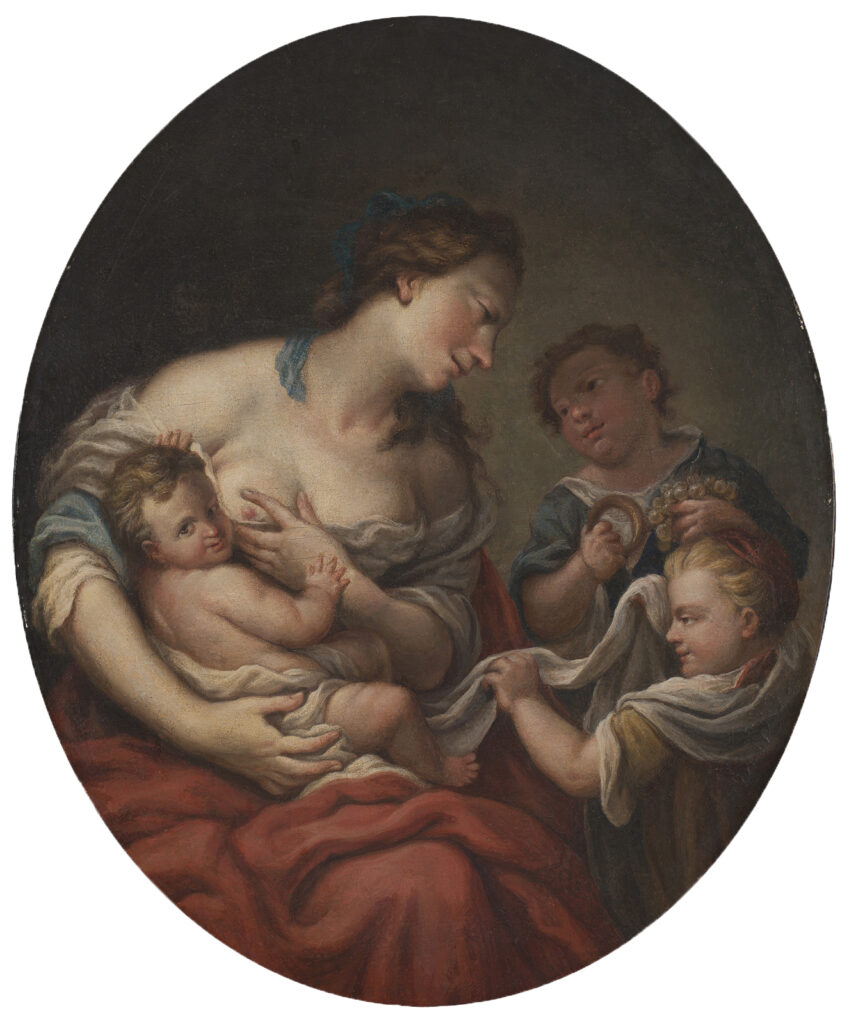
Ancient Greeks knew of different kinds of love: xenia was the hospitality towards strangers, philautia was love of oneself, storge the bond between parents and children, philia friendship, eros was sexual love, and agape the love between humans and the Divine. Agape (Caritas in Latin) or Charity forms together with Faith and Hope the three fundamental Christian virtues and is often depicted as a nursing mother with children. Painters derived scenes of romantic love from Ancient myths, book sensations like Jerusalem Delivered by Torquato Tasso (1544–1595) and, naturally, from their own life: museums abound in portraits of not just lovers, but also friends, family and children, which together mirror different kinds of affection between people.
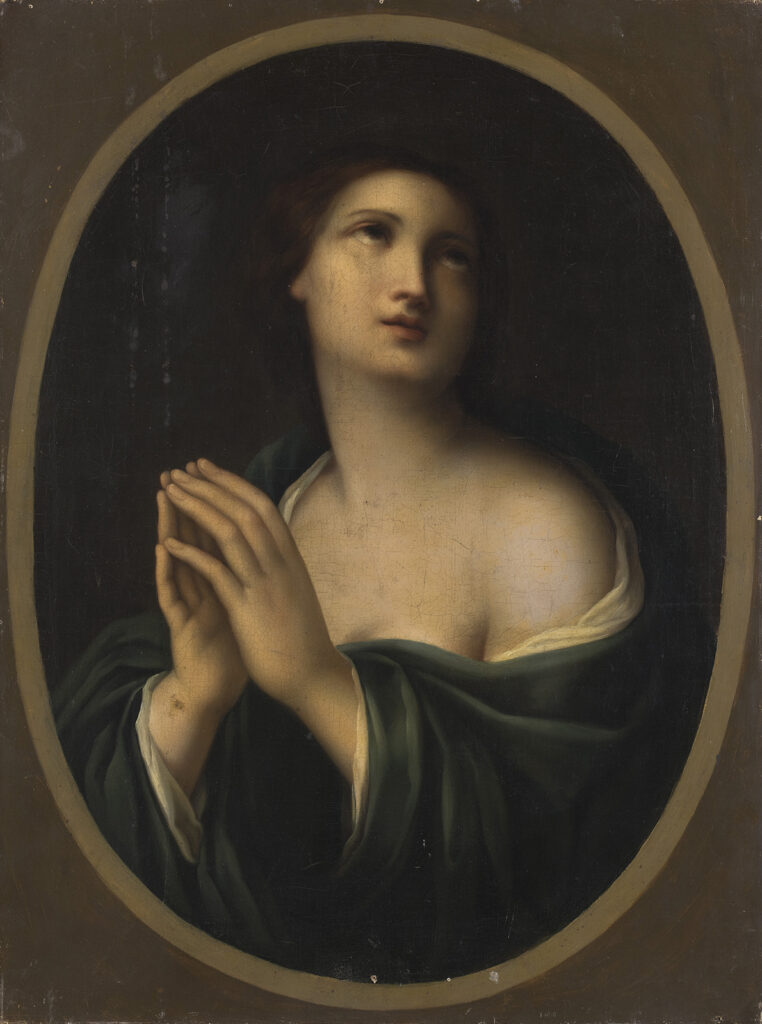
The Venetian painter Francesco Pittoni (1645–1724) was quite popular among the Carniolan patrons at the turn of the 18th century. Together with the allegory of Charity he also painted another oval picture of the same dimensions, in which he depicted the aged Athenian statesman Cimon, sentenced to death by starvation, how he is breastfed by his daughter Pero.
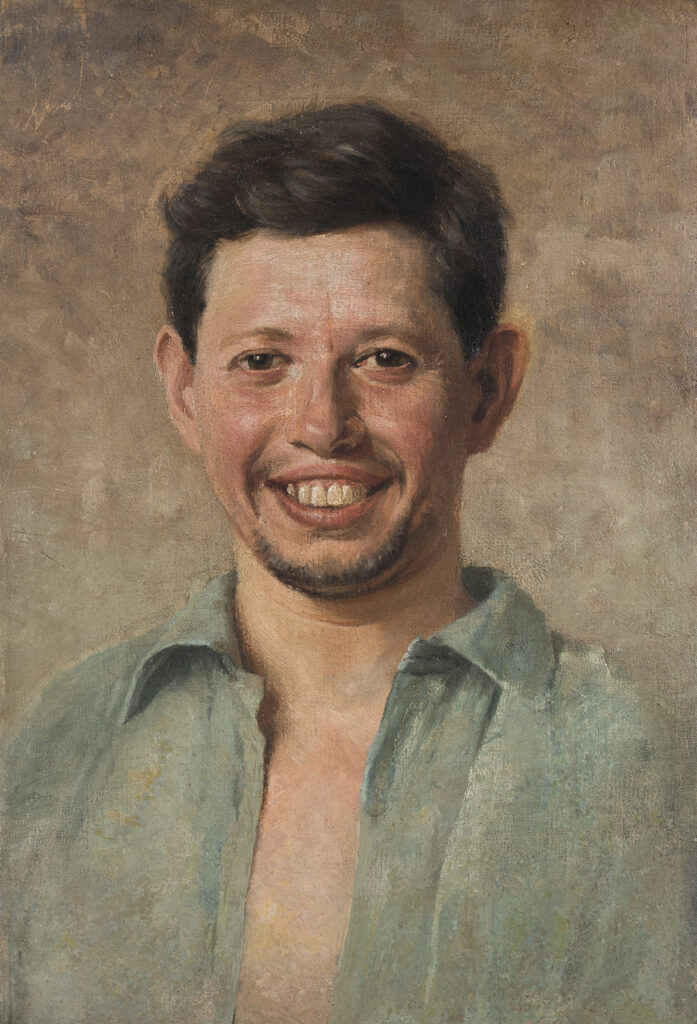
Joy is a basic emotion which was distinct from happiness and pleasure in art theory also. Henri Testelin (1616–1695), building on ideas by Le Brun, prescribed for the depiction of simple joy half open and smiling eyes, full cheeks, corners of the mouth drawing a little upwards and lively lips and complexion. It seems that Anton Gvajc (1865–1935), painter and teacher of drawing, made full use of the traditional academic approach when he painted the 35-year-old sculptor.
Joy and pleasure went along with the scenes of dancing, from maenads on Ancient Greek vases, where the dancers accompanied Dionysus, to merry companies of the 17th century, and to the maidens from Bela Krajina (White Carniola) on picture Circle Dance by Matija Jama (1872–1947).
Full of joy are also putti – small children with wings, may they be adorable protagonists, aides to heroes or simply retinue of celestial scenes. One was not to overindulge in smiles and joy; in Plato’s ideal state, comedy would be regulated, and in art after the Renaissance, when the facial expressions were still overwhelmingly restrained, the unleashed joy and laughter were reserved for the images of the pauper, the profligate, the crooks and the mentally ill. Luckily, we think differently nowadays – what would we then make of the audience (and the performers!) of stand-up events?
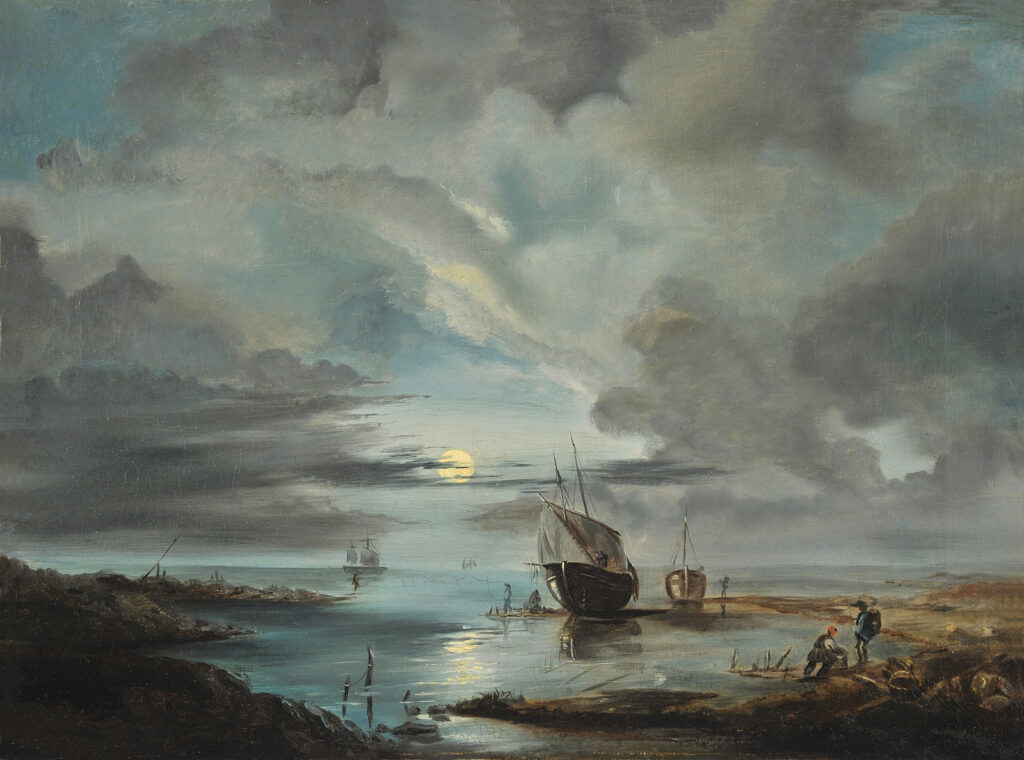
Romanticist artists of the first half of the 19th century demonstrated how landscape and different weather phenomena can bring out emotions that are difficult to put to words, like wonder, amazement and contemplation of deep existential questions. Carl Gustav Carus (1789–1869), a doctor and friend of Romanticist masters Caspar David Friedrich and Johann Wolfgang von Goethe summarized the contemporary thought in his Nine Letters on Landscape Painting, proposing that the sublime scenes of the seasons, clouds and the sea guide us to experience our own weakness and insignificance and to see the unity of everything around us, thus calming our inner storms.
Cecilia von Plettenegg (1821–1855) most likely copied the seascape from an 18th-century original. Her interest in art came from her parents and she passed it to her husband Edvard Strahl (1817–1884) and her young son Karl. After the death of Knight Karl Strahl (1850–1929), the family collection from their mansion at Stara Loka went to auction, where the National Gallery took use of the offered pre-emption right and lower prices to buy many of the works; pictures from the Strahl collection represent one of the cores of the Permanent Collection.
Hope (Spes in Latin) is crucial for our well-being, so Zeus did not just punish the rebellious humans with evils, but also denied us hope, which remained trapped in Pandora’s jar. Dante drew on theological tradition when he wrote “Hope is the certain expectation of future glory; it is the result of God’s grace and of merit we have earned.” (Divine Comedy, Paradiso, 25, 67–69) As one of the chief Christian virtues, hope is often personified by a woman with an anchor, a symbol of the security of God’s promises to Man (“This we have as an anchor of the soul, sure and firm, which reaches into the interior behind the veil,” Hebrews 6:19).
The motif of the 19th-century painting above was popular in oil and in print. It is probably derived from one of the images of Mary Magdalen by Guido Reni (1575–1642). The sinner who repented before Christ is often depicted as a beautiful and scantily dressed young woman with gorgeous hair praying and hoping for salvation.
Despite their proverbial cynicism, many artists were optimists. Ivan Grohar (1867–1911) had his hard life cut short by poverty and incurable disease, but saw hope in the world and the beginning of his thought “the future has to be brighter, that is our solace … and believe, friend, that this beautiful faith is oftentimes the only thing that encourages us not to give up” serves as the motto of the National Gallery. Creativity is essentially linked to the idea that the world can change and Gerhard Richter (*1932), one of the most important contemporary masters, characterized art as the highest form of hope.
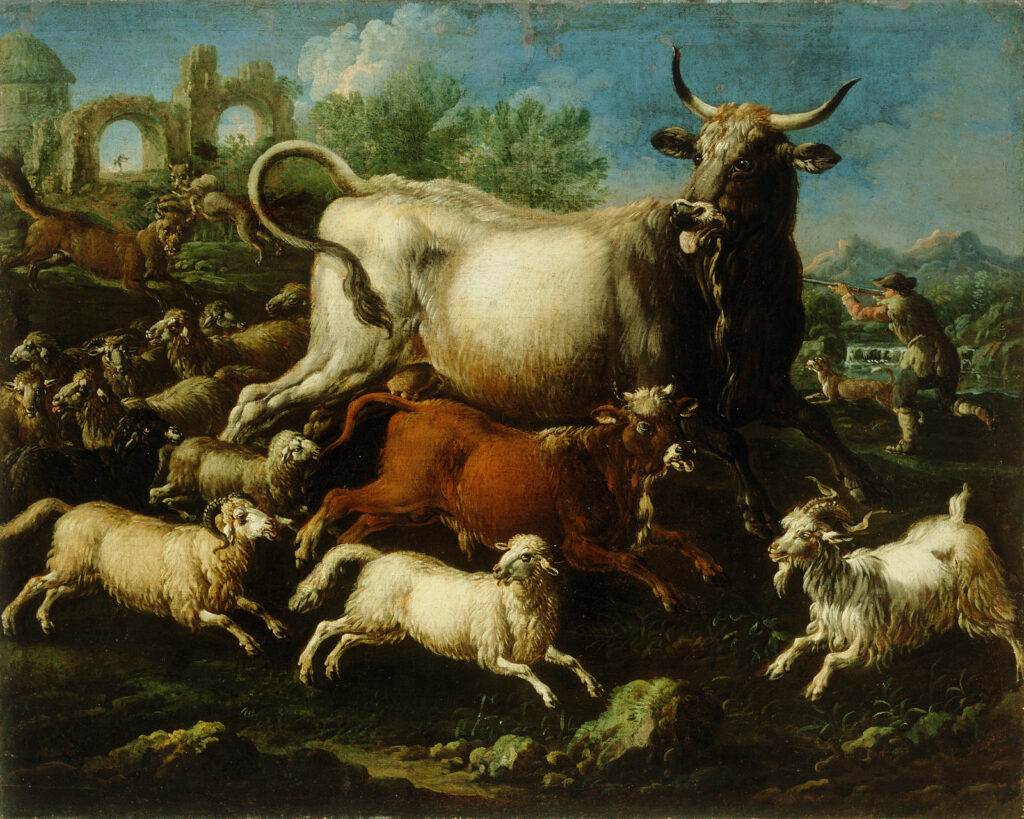
Fear is a natural response to a threat or danger – in the picture, a varied herd flees in panic before the wolves that threaten from the left, while on the right we see a hunter preparing to defend the animals. Fear or even terror are often depicted in scenes of battles or natural disasters (like fires, storms) and in the Last Judgement, when demons drag despairing sinners into Hell. Fear is also evoked by scenes of suffering, nightmares and death, from images of evil spirits to memorials to the horrors of war.
Paired with A Frightened Herd is A Herd at Rest, where the animals lie on the meadow. Art is rich in companion pieces, in which otherwise related works differ in an important variable that transforms the entire scene, such as youth/old age, virtue/sin, good governance/bad governance. Sometimes, these series make case studies of different morphologies and circumstances, but often they carry a moralistic message, since they present an ideal, worthy of emulation (exemplum virtutis), and a frightful warning of the consequences following bad decisions.
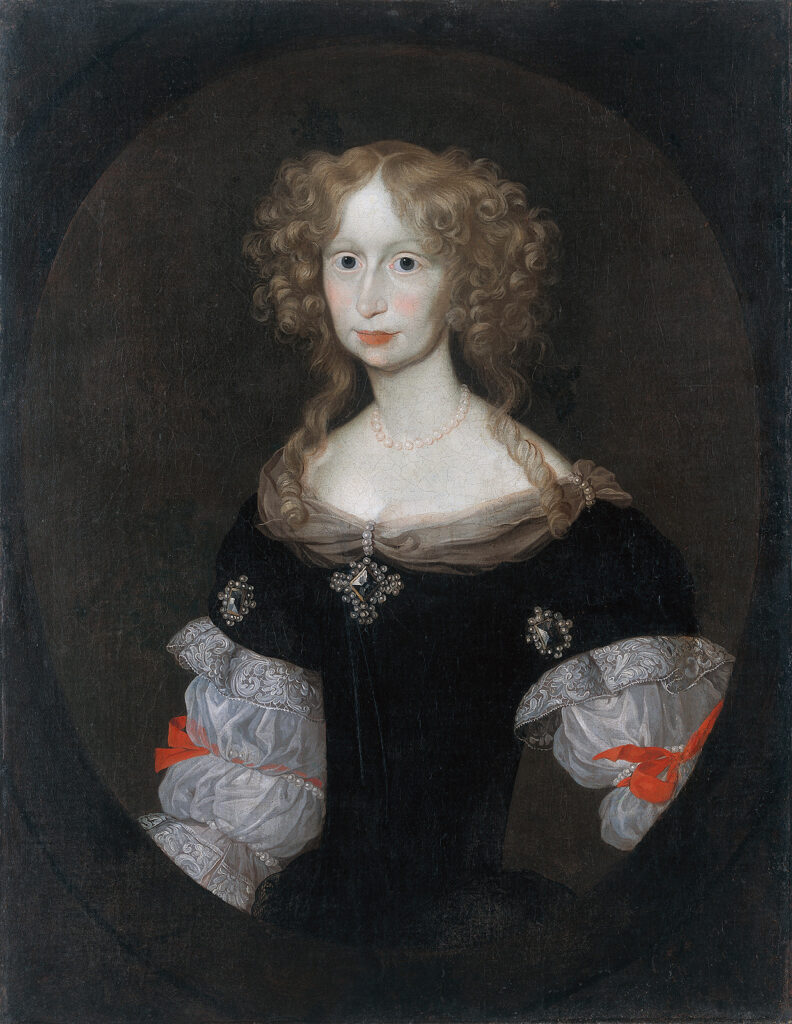
Almanach was an itinerant artist, most likely from Flanders, and very popular with the Carniolan aristocracy in the 3rd quarter of the 17th century. Among the portraits attributed to him is also a picture of a fragile noblewoman with large and sad grey eyes.
Melancholia, a sense of sadness and pessimism, is one of the four ancient temperaments. In the Ancient World, melancholy was associated with creativity and it accompanied people like Hercules, Achilles and Plato. In the Middle Ages, it became sinful and Dante placed the “accidiosi”, in whom we recognize the melancholic type, into the fifth circle of Hell (‘We had been sullen in the sweet air that’s gladdened by the sun; we bore the mist of sluggishness in us: now we are bitter in the blackened mud.’ Divine Comedy, Inferno, 7, 121–124).
In the 19th century, melancholy is joined by weltschmerz and angst, or anxiety. Weltschmerz, the painful realization that the world is not ideal, was a popular theme with the Romantics. Angst, confrontation with existential questions on the purpose and meaning of suffering, was explored by Expressionist artists, from Edvard Munch (1863–1944) to Slovenian Fran Tratnik (1881–1957). Melancholy regularly accompanies artists: among Slovenian artists, for example, Ivana Kobilca (1861–1926) and Hinko Smrekar (1883–1942) lived with it.
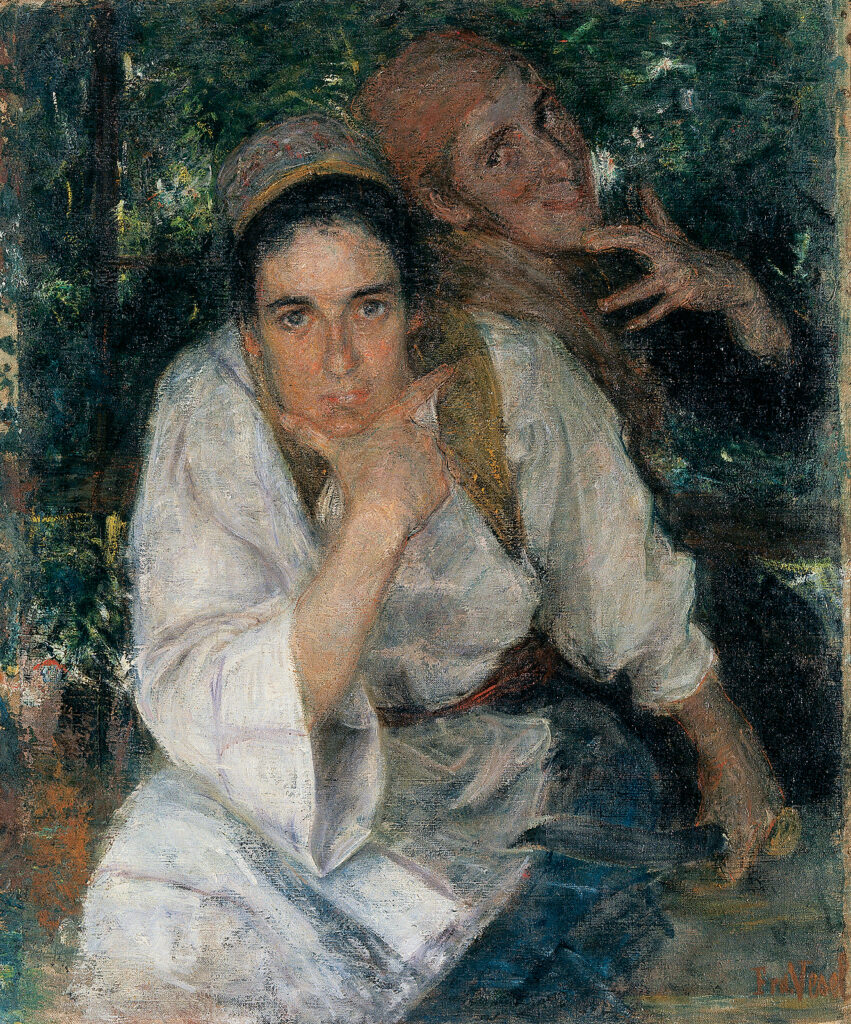
The driving force of revenge are strong emotions, like hatred, anger, humiliation, outrage over the suffered injustice. Priestess Medea, prince Hamlet and count Monte Cristo are known and regularly depicted antiheroes, whose vengeance brought doom to their enemies and their own persons. In the Holy Scripture, the law of retaliation is part of the books of Moses (“Limb for limb, eye for eye, tooth for tooth!” 3 MZ 24, 20). In Ancient Greece, it was the Erinyes, goddesses of the Underworld, who took revenge on people. In one way or another, artists responded to crimes committed against them: Artemisia Gentileschi (1593–1656), one of the most capable painters of the 17th century, was probably responding to her rape when she produced a number of images where powerful women prevail over men.
Ferdo Vesel (1861–1946) painted a person with a dagger in his left hand and his companion in a way that blurs the line between the real and the symbolic. The figure in the background could be a comrade, who is edging him on, maybe a demon whisperer or perhaps he represents the wounded id demanding vengeance.
Fortitudo, Latin for strength and will to face fear, pain or a moral dilemma, was admired in all cultures. The differences come from the types of courage which can be physical or spiritual.
Among the paragons of moral courage in the West, the highest praise is of course reserved for Jesus, and to a long line of saints after him, who chose martyrdom over the renunciation of their principles. The personification of courage is most often a young woman with a tamed lion, and fortitude is one of the four cardinal virtues, together with prudence, temperance and justice.
In the centuries when physical courage represented a strategic advantage, art featured conquerors, such as Alexander the Great or the biblical Joshua. In history painting, artists reserved the grandest of canvases for important battles that shaped their national or geo-political space.
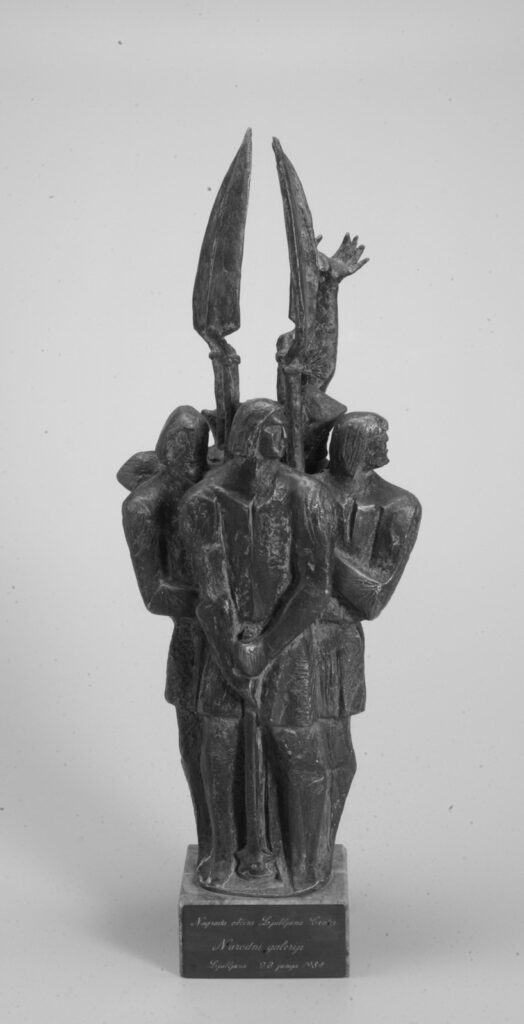
To commemorate the 400th anniversary of the Slovenian-Croatian peasant revolt, a monument by Stojan Batič was placed on the Castle Hill in Ljubljana and small-scale replicas of it were used by the municipality for city awards. After the First World War, when the Slovenian lands were no longer controlled by Austria, the peasant revolts were seen to foreshadow the French, or the Communist, revolution. Although the revolts were mostly bloodily suppressed, they carried in them the same message as Črtomir, a rebel leader in the famous Slovenian epic Baptism on the Savica by France Prešeren, who asked his fellow soldiers to face the enemy for the final time: “Less fearful is the night in black earth’s womb / Than days of slavery here beneath the sun.”
Animals
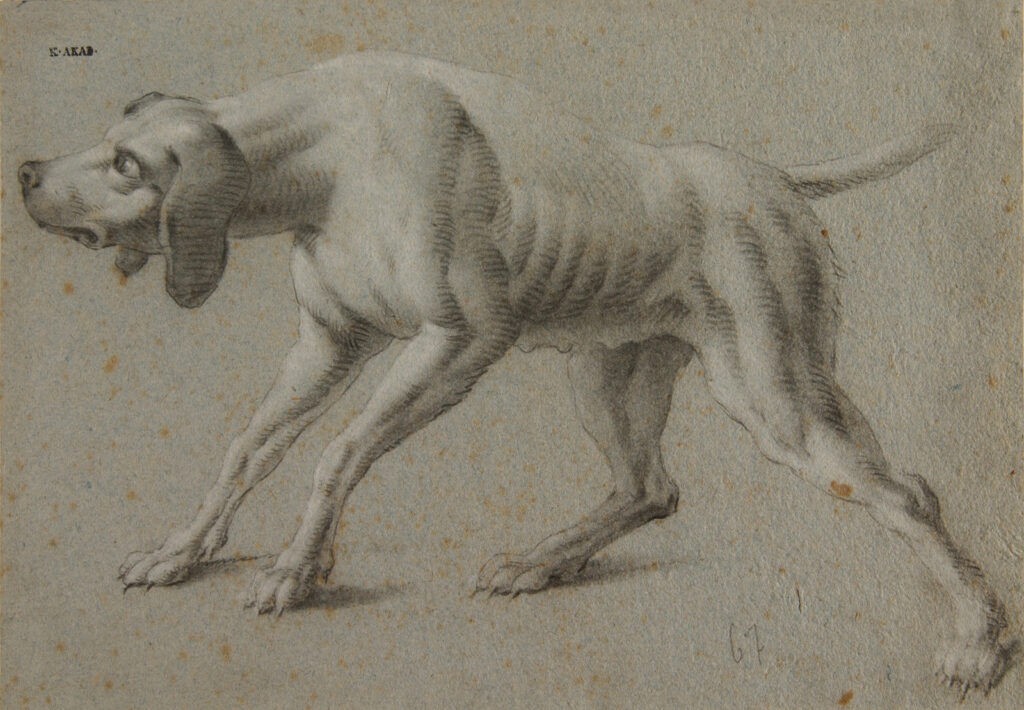
Which servant is more attached to his master, asked Columella (4–c. 70 AD) in his book on Roman agriculture while discussing canines. Pliny the Elder (23/24–79 AD) praised their reason and memory, while Ovid was so fascinated by Actaeons’s hunting dogs that he separately named each one of more than thirty in the pack which went on to tear apart its unfortunate owner, when Goddess Diana turned him into a deer. Wolves were domesticated around 14 thousand years ago and the opinion of dog’s characteristics has not changed to this day. Because they are so close to humans and love to reciprocate kindness, they regularly accompany people in portraits, where artists used them to complement the owner’s personality.
Franc Kavčič (1755–1828) most likely drew the dog from an older source. It appears similar to a Weimaraner, a hound breed from Germany. Amongst more than two thousand of Kavčič’s drawings, we find sheep, goats, cows and horses.
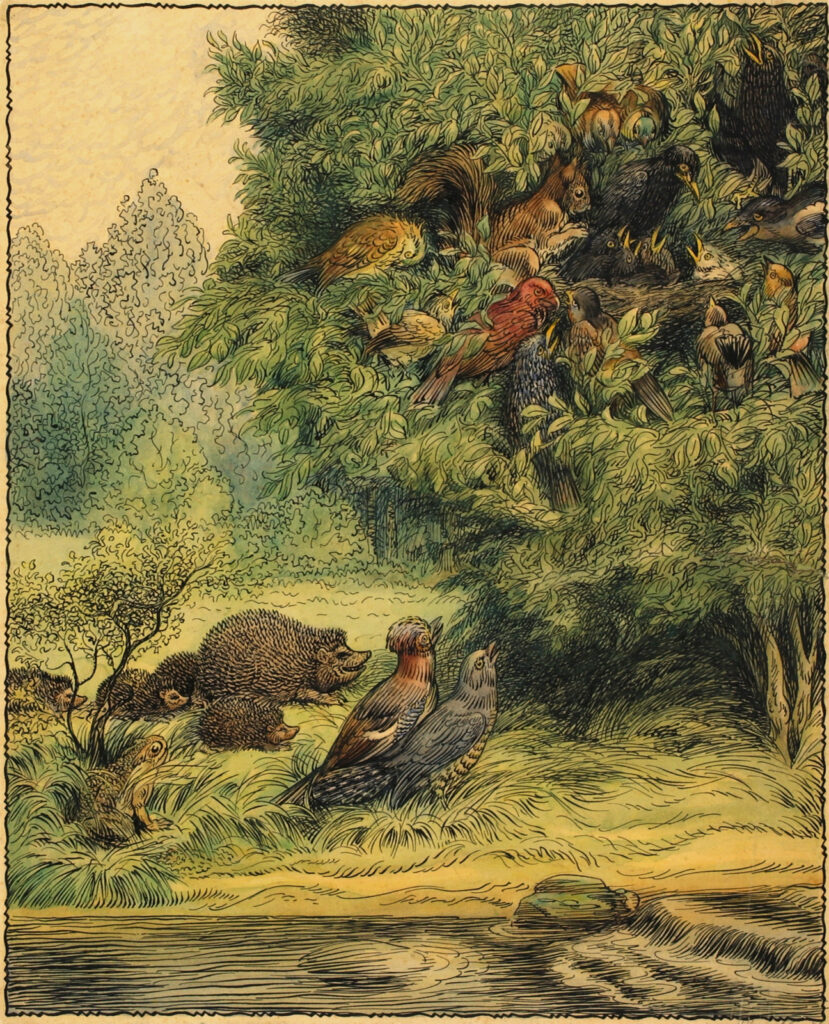
Animals of the forests and meadows come with many meanings in the visual arts. When appearing together, they could listen to Orpheus while playing a lyre, or accompany Adam and Eve in the Garden of Eden. Individually, their symbolism is diverse: a frog alludes to fornication due to its rapid reproduction, a hedgehog and a squirrel, for example, are symbols of prudence, since they prepare for winter, but can also signify greed and selfishness. According to a legend, St Francis of Assisi (1181/82–1226) gave a sermon to the birds, encouraging them to praise God for giving them the freedom of wings and food and shelter in nature. Today, forest animals mostly appear in works for children.
Smrekar’s illustration accompanied the fairy tale Little White Brother (Beli bratec) by Marija Jezernik (1879–1974). In it, a proud family of blackbirds hatches a youngling of the wrong colour who has to find his place in the hostile world. The little one is mocked by other birds, mother hedgehog and squirrels, only the old toad advises his mother, how he can be helped …
Blackbird (Turdus merula) is one of the most recognizable birds in Slovenia. The female often makes her nest in the shrub, where she lays up to five eggs. Both parents take care of their offspring and diligently bring worms and insects to the young.
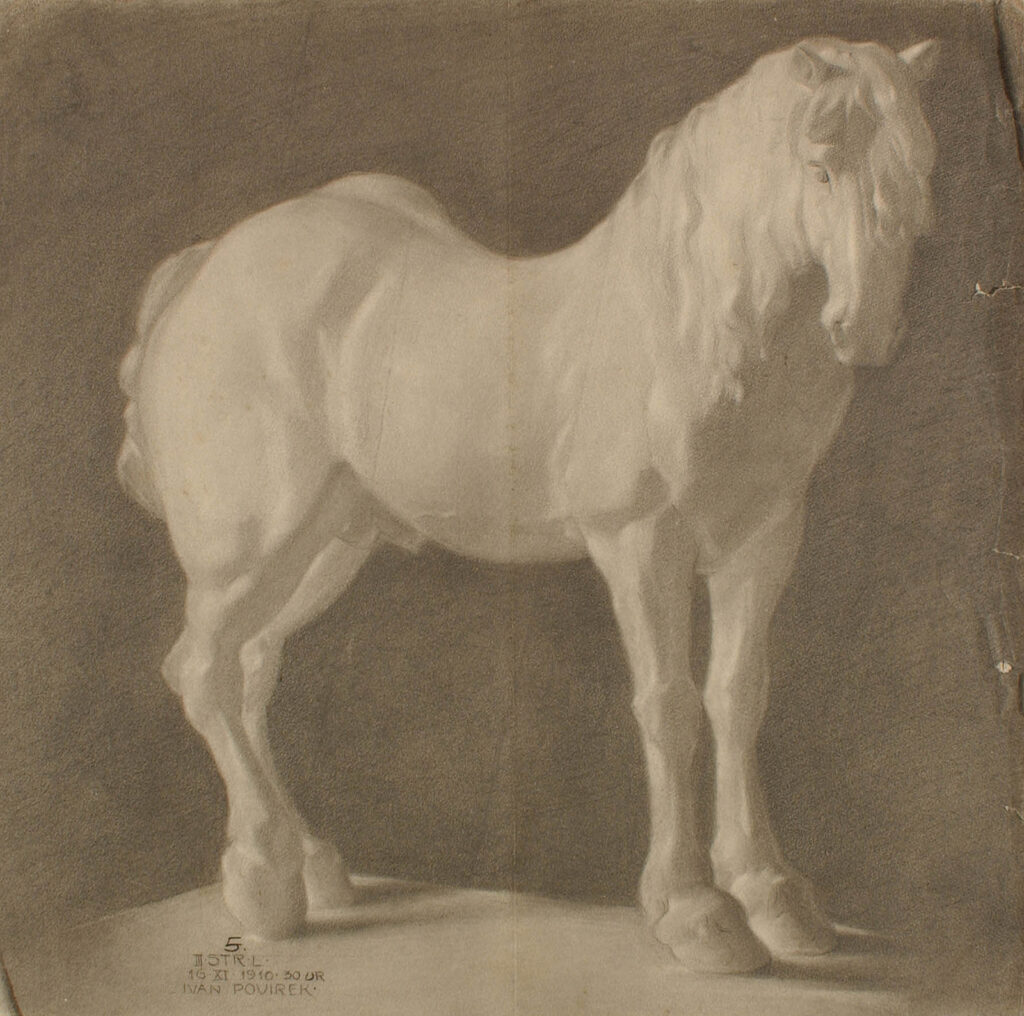
The horse is associated with divine, economic and military power: it can draw a chariot of god Helios across the sky, carry the cargo for Martin Krpan, the strong, sober-minded hero from an iconic Slovenian story, or help with conquests, either harnessed to a chariot of Ramses II or carrying Napoleon Bonaparte. Horses were domesticated around 5000 years ago in Central Asia. They represented strategic advantage for Eurasia and Northern Africa over the Americas and Subsaharan Africa, where zebras, belonging to the same genus, could not be domesticated.
Equine symbolism is multi-layered and often opposing: it can be ridden by Jesus as he enters Jerusalem instead of a donkey or carry one of the four figures of the Apocalypse; it can denote prestige or unbridled sexual lust. Depiction of horses was of great challenge in equestrian statues, mainly due to complicated statics.
Ivan Povirek (1892–1920) was eighteen when he drew the study of the horse during his schooling in Ljubljana. He became infected with tuberculosis during the First World War and died aged only twenty-eight. The depicted horse looks like a Friesian because of its shape, but it is more likely a stallion of the native Slovenian cold-blooded breed.
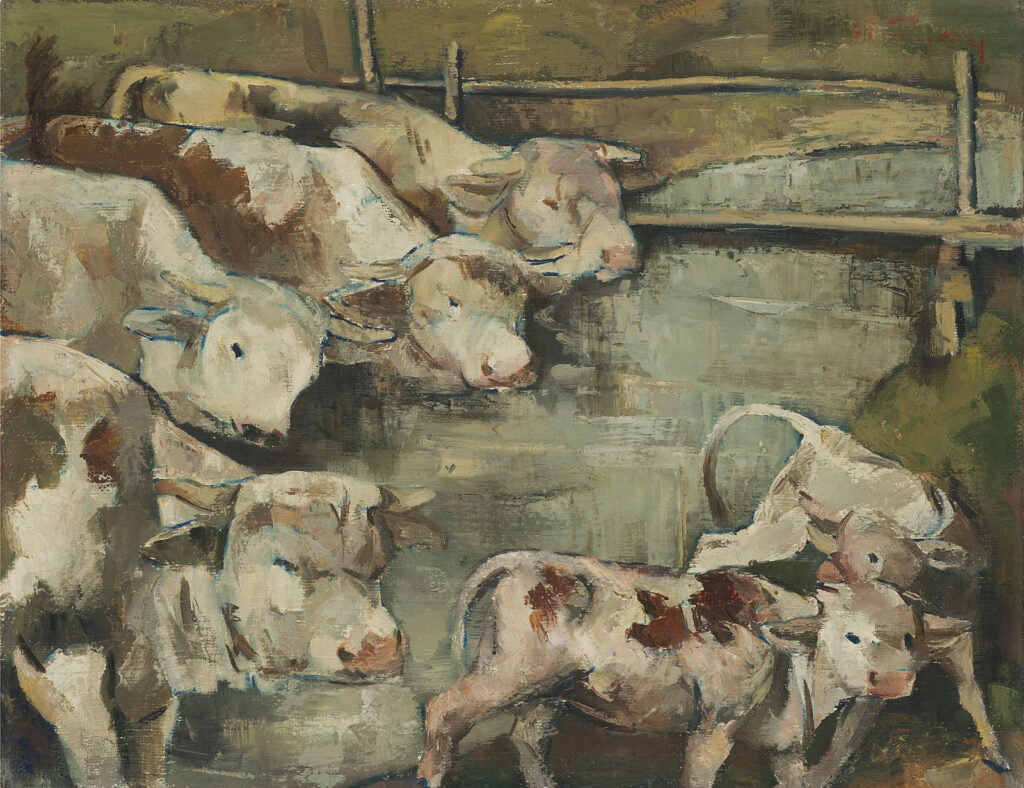
Cattle was domesticated around 10 thousand years ago in the Middle East and Southern Asia and was linked to wealth in all ancient cultures. Unlike a mine, water source or field, this property was movable and you could retreat with it from your greedy neighbours; one of the possible translations of the Sanskrit word for war (“gavisti”) is also “a desire for more cows”. As loot and possession, cattle features in the books of Moses, while its Christian patron saints are St Anthony the Great and St Wendelin. Homer brought to attention the large and warm brown eyes of cows and gave the goddess Hera the epithet of “cow-eyed”. Today, however, this remark would not be regarded a compliment – expressions such as cow and cattle are still considered derogatory and (falsely!) allude to the animals’ low intelligence, clumsiness and submission. The hierarchy has remained unchanged since Ancient Rome: Quod licet Iovi, non licet bovi – Gods may do what cattle may not.
Lajči Pandur (1913–1973) taught in Maribor after the Second World War and was a leading painter of Panonia in Slovenian art. In the present picture he depicted Simmental cattle. His art reflected the changes the motif underwent during the 19th century, as cattle in art became a signifier of a more simple, honest and primal rural world that was pushed aside by the industrial revolution and urbanisation.
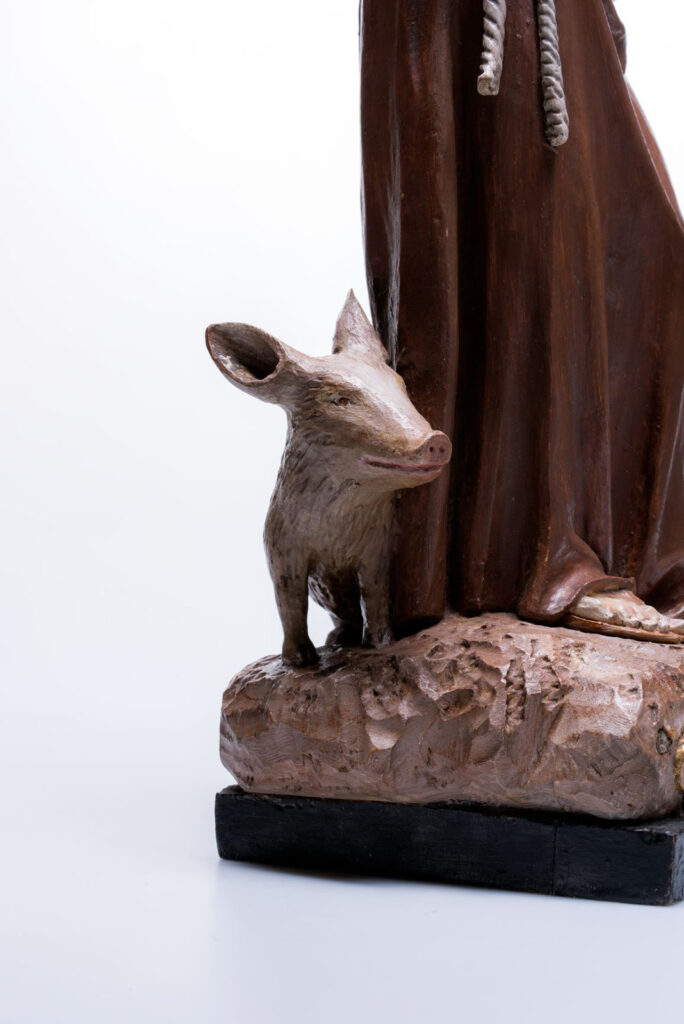
Today, the pig, and especially a piglet, symbolises prosperity and luck and is admired for its intelligence, but in the iconography of many religions it mostly holds negative connotations. The pig was associated with lust and gluttony and was seen as a handy vessel of evil spirits – when Jesus exorcised demons from a man in Gerasenes, he drove the Legion into a herd of swine that then drowned in a lake.
The pig was granted a more positive role as an attribute of St Anthony the Great, a popular Early Christian monk and patron saint of stock farmers and butchers. In certain towns in Slovenia, the saint’s feast day is commemorated with traditional auction of pork legs and salami, with the proceeds going to local churches.
The saint and the kind piglet beside him were carved by Jakob Žnider (1862–1945), a Slovenian sculptor with a small oeuvre, in which the statue of St Anthony represents his earliest known work.
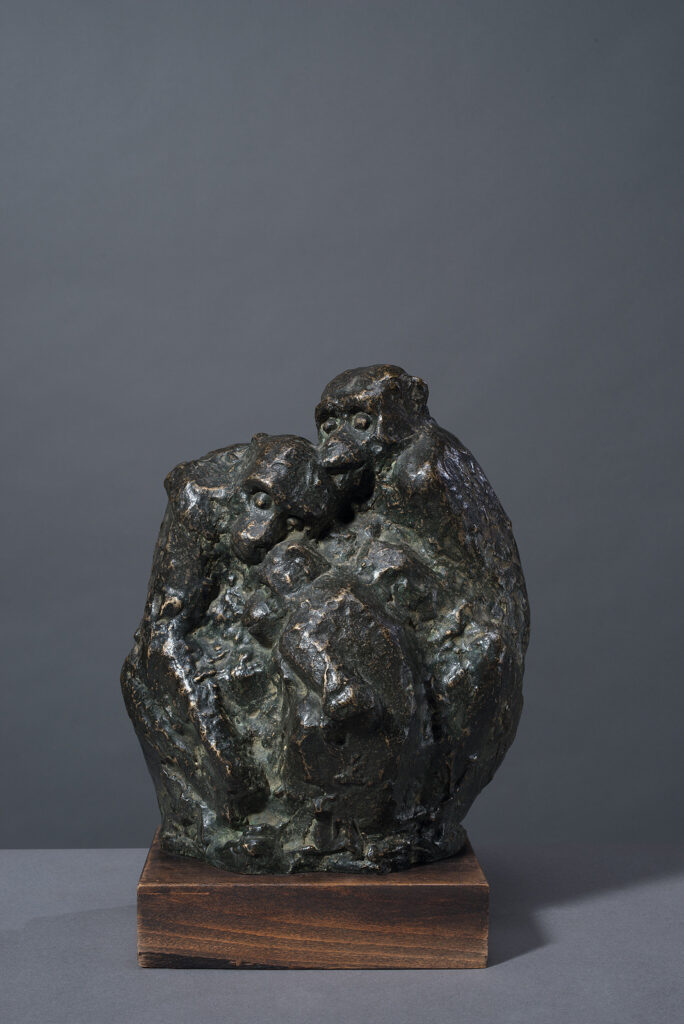
In the Modern Age, monkeys lost their association with the devil and became interesting precisely because of their similarities to humans. Flemish and Dutch artists in the 16th and 17th centuries introduced the so-called singerie (singe is French for monkey), a motif in which monkeys, attired in human clothes, imitated our behaviours, mostly as a comical or a moralistic commentary. Thus, they could play Boules, cook, get a haircut, or party. Sometimes, monkeys replaced art critics, which seems like a sarcastic painters’ response to an unfavourable review.
Zoological revelations and genetic research in the second half of the 20th century brought apes and humans even closer and Janez Boljka (1931-2013) depicted the chimpanzee family in a humanistic light. The artist was interested in animal motifs already during his studies and he devoted himself to simian motifs at several occasions, much like to bulls and rhinoceroses.
Chimpanzees (Pan troglodytes) bond through physical contact and grooming. Every evening, they build a tree nest out of branches where they spend the night. The female spends the night hugging her offspring that almost always differ in age.
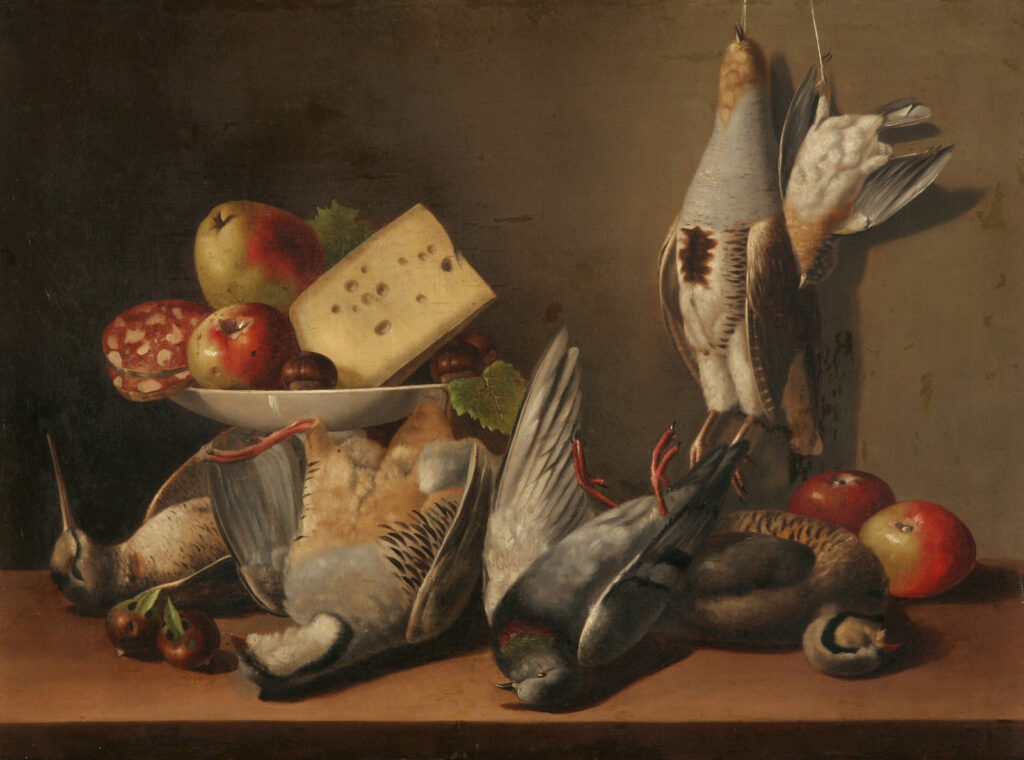
Fowl was part of the dominion humans received at the Creation and besides the symbolism of, for example, eagle, dove, peacock and stork, birds were also connected to symbolism of food and kitchen – no Abrahamic religion forbids the consumption of their meat. A table featuring turkey or peacock (often just for decoration) is of course a sign of wealth and prosperity. In art, maids and street vendors who plucked birds or put them on a roasting spit often alluded to sexuality. An arrangement of dead game was also a sign of aristocratic leisure and trophy hunting, which gave these pictures a different undertone than the one we sense today, especially in the light of a 30-percent drop in the number of wild flocks that the West has experienced in the last few decades.
Malacrea (1813–1886) was a Trieste still life painter who used to paint a series of pictures on a long piece of canvas, cutting off whatever the customer wanted.
The birds in the painting used to be hunted, but are today protected by law, with the exception of partridge. From left to right we see a woodcock, a rock partridge, stock dove, another rock partridge, while a grey partridge and a robin hang from the upper corner.
Woodcock with a long and straight bill probes the forest floor for worms, insects and their larvae, and for snails and seeds. It winters in Sub-Saharan Africa.
Rock partridge nests in the Julian Alps and in the Littoral. It is quite rare in Slovenia and migrates from the mountains to lower regions in winter.
Stock dove is a pigeon that nests in a hole in trees, which separates it from other pigeons. It can raise up to three generations of offspring each year. In winter, a part of the population moves to the Mediterranean.
Grey partridge lives in the open fields, where it mostly evades predators by running. Like other pheasants it is not an agile flyer and usually flies close to the ground.
Robin is recognizable by its orange breast. We can often spot it on the ground, looking for insects and other food as it jumps around on both legs. In winter, it migrates over shorter distances.
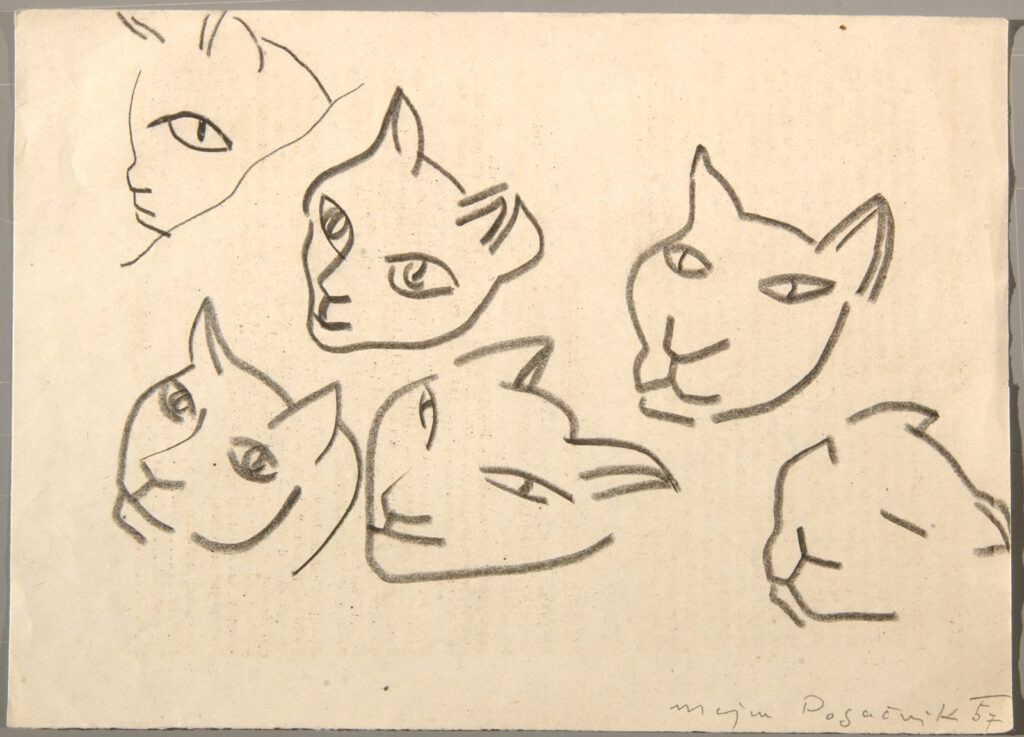
Cats approached humans more than 9500 years ago and have remained at our side ever since, on their own terms, of course. In Ancient Egypt they were crucial for defence against snakes and accompanied goddess Bastet, while in Ancient Greece and Rome they were associated with Artemis or Diana, the goddess of the hunt.
In the Middle Ages, cats were familiars of witches, and the bull of Gregory IX, which described the role of a black cat in a Satanic ritual, brought additional infamy. In the Modern Age, cats became more popular; they were symbols of focus and rebellion. In the scenes of kitchens and laden tables they often circle around fish and remind us of the importance of caution. In the 19th century, their role as pets grew and in the second half of the century several European painters specialized in their adventures.
Marjan Pogačnik (1920–2005) was an exceptional printmaker who was connected to the National Gallery through his uncle Ivan Zorman, the museum’s first director. Pogačnik bequeathed more than 800 of his works to the Gallery.
Perspective
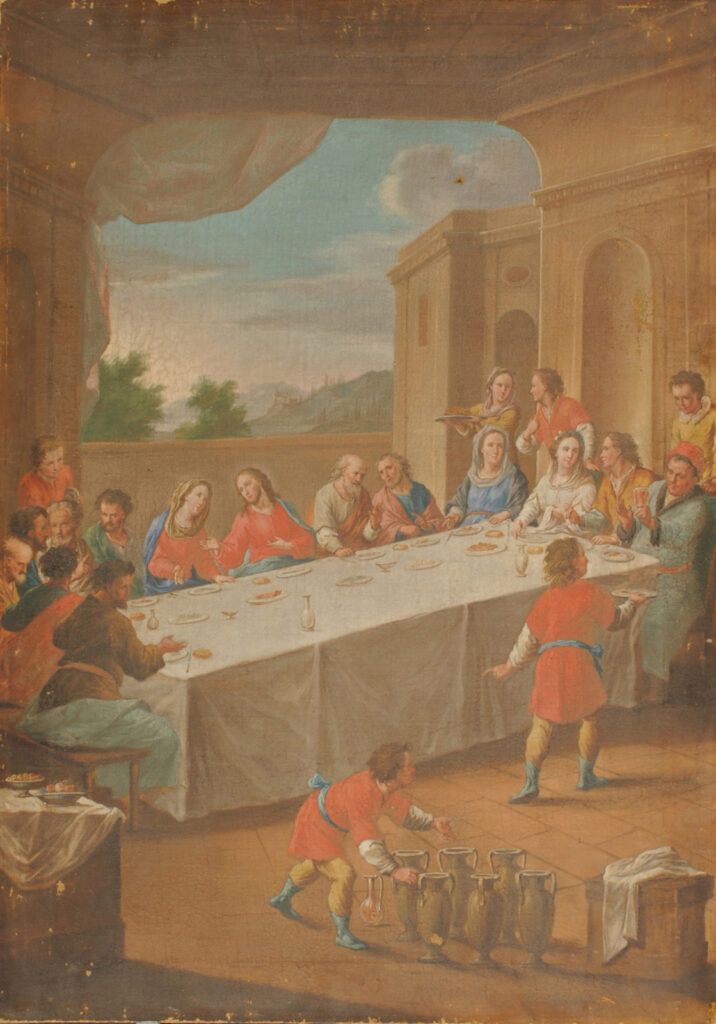
The scene is unfolding as if on a stage: the grand hall even has a curtain drawn in the background, opening to a phantasy landscape. The pictorial space is created by the architecture with niches in the wall and vaulted ceiling, the tiled floor and of course the diagonally positioned table. Foreshortened is also the servant attending the table: he is putting his leg forward and we also notice the shadow cast to the right of his legs.
Behind the large table we see Jesus in the centre with Mary and some of his disciples, while the bride and the groom head the celebrations. When the hosts ran out of wine, Jesus ordered six waterpots to be filled with water. When they were brought to the elders, good wine poured from the containers. This was the beginning of public miracles by Jesus and the scene featured prominently in the visual arts, usually as a large setting with a multitude of people and rich architecture.
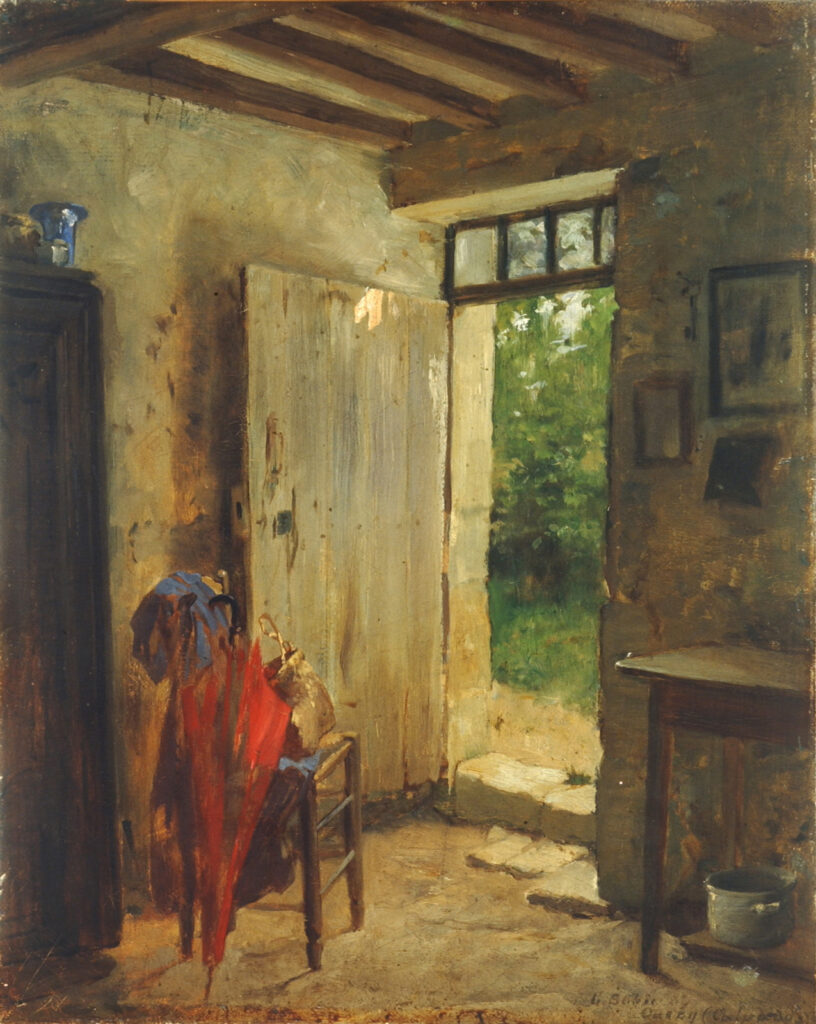
Šubic prepared a study painting of space and light for his picture Before the Hunt. The meeting of two walls with the open door functions as the axis, parallel to which he placed the side of the closet on the left and the legs of the chair in the centre and the table on the right. The prominent red umbrella seems to lean on the chair under a slight angle because the end is not in line with the legs of the chair. Pictorial depth is also created by parallel wooden beams on the ceiling. The preparatory study does not depict the hunter and the dramatic light rushing into the cabin. The painter, however, made use of the shadows: the right wall stands in semi-dark and directs attention to the green outdoors, while on the left, the shadow helps indicate the third dimension of the open door and at the same time skilfully separates it from the wall, painted in the same bright brown.
Jurij Šubic was living in Paris, when in 1882 he spent five rainy autumn weeks in Normandy and painted a number of interiors and vistas. The landscape of the region and its orchards attracted many French writers and painters.
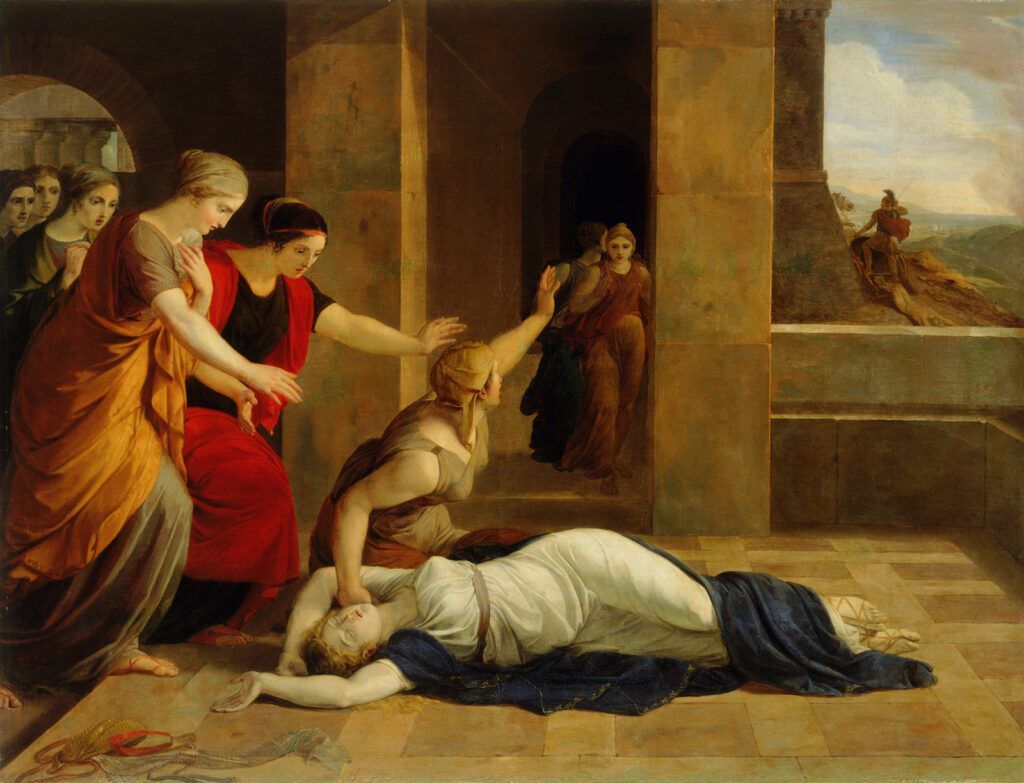
The figures are placed inside an architectural space defined by tiled balcony, two symmetrical pilasters and a corridor in the centre, leading into dusky distance. Maidens are rushing towards the fallen princess; the first three to reach her are most despairing, with gestures that indicate the pictorial space. The maiden besides the princess raised her hand, resulting in foreshortening. She is looking to her left, where we see a soldier moving away.
Andromache was the wife of Hector, the heir to Troy. Hector was killed in the field before the besieged city by Achilles, who spent twelve more days desecrating his body. When Andromache saw what the Greek champion was doing to her husband, she fainted in horror.
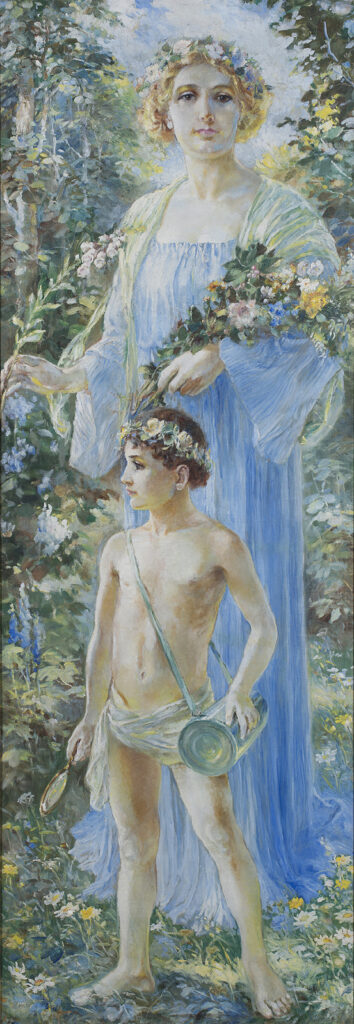
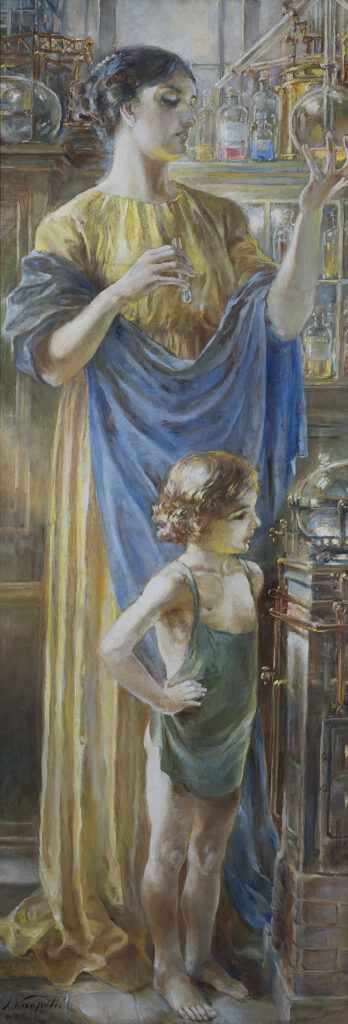
The painter created a sense of space by overlapping objects: barely dressed little boy stands in front of the main character, while in the back a green grove of trees rises on both sides. The tall woman in a long blue dress carries herbs in her arms and in her right one holds a foxglove – an otherwise extremely toxic plant that can be used in medicine and as such it indicates the woman’s dexterity. The boy in front of her is carrying a cylindrical container over his shoulder and a magnifying glass in his right hand – he was probably looking for insects.
The picture and its pair (Allegory of Chemistry) was made for the doors of the Sušnik (now Central) Pharmacy on the Prešeren Square, Ljubljana. This explains its distinctly vertical format.
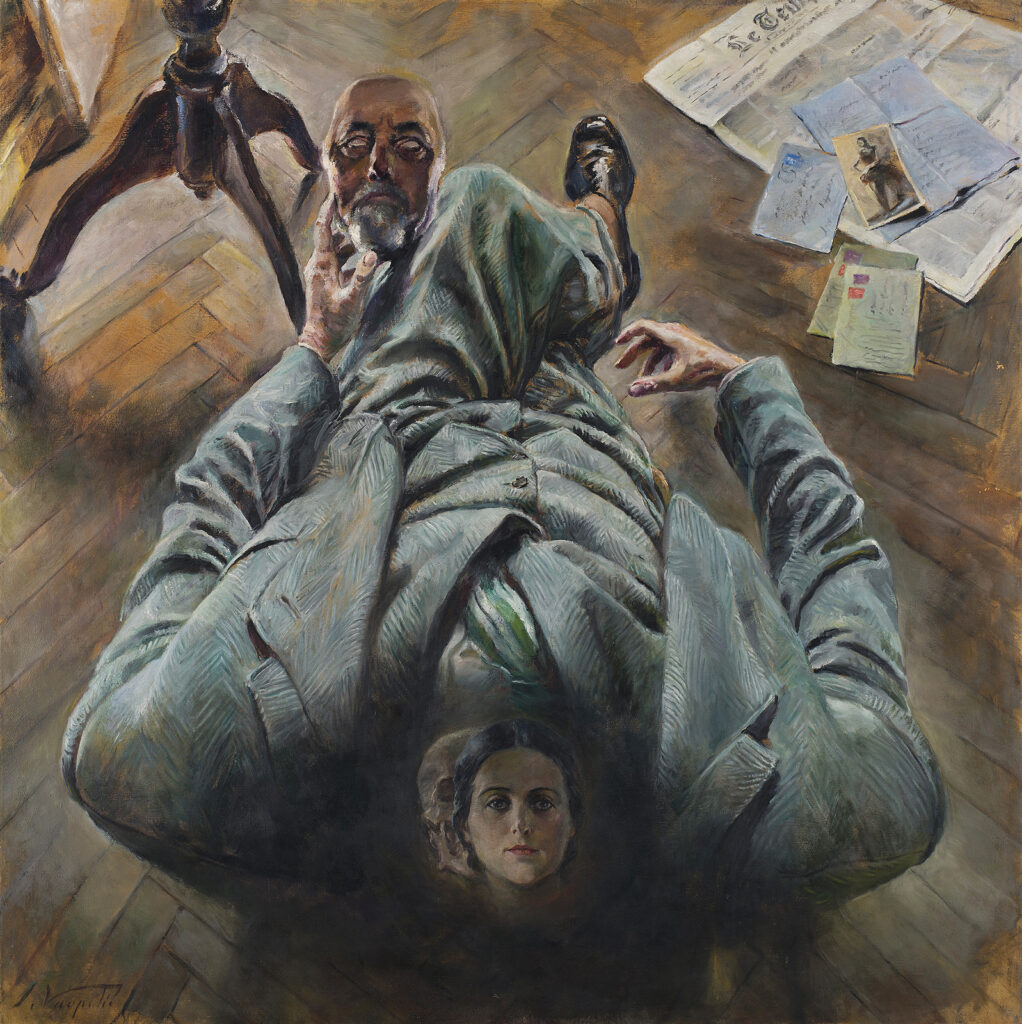
One of the most unusual pictures in the Gallery holdings was probably influenced by photography. On the floor we see a lying and headless male figure. In his left hand, he is holding his face, while in front of his neck hovers a female face with a blank expression, and a skull behind it. The perspective, also, is special: the body, which we observe up close and from an elevated position, seems like it is simultaneously lying on and hovering above the floor. The man’s broad shoulders lead to narrow hips and crossed legs – the shoulders and the bent knee form the vertices of an equilateral triangle. Besides the linear perspective of the body, we observe the curving of the space, which travels from the lower edge of the picture up the body, rising again towards the legs of the table and the newspaper with a letter on the right.
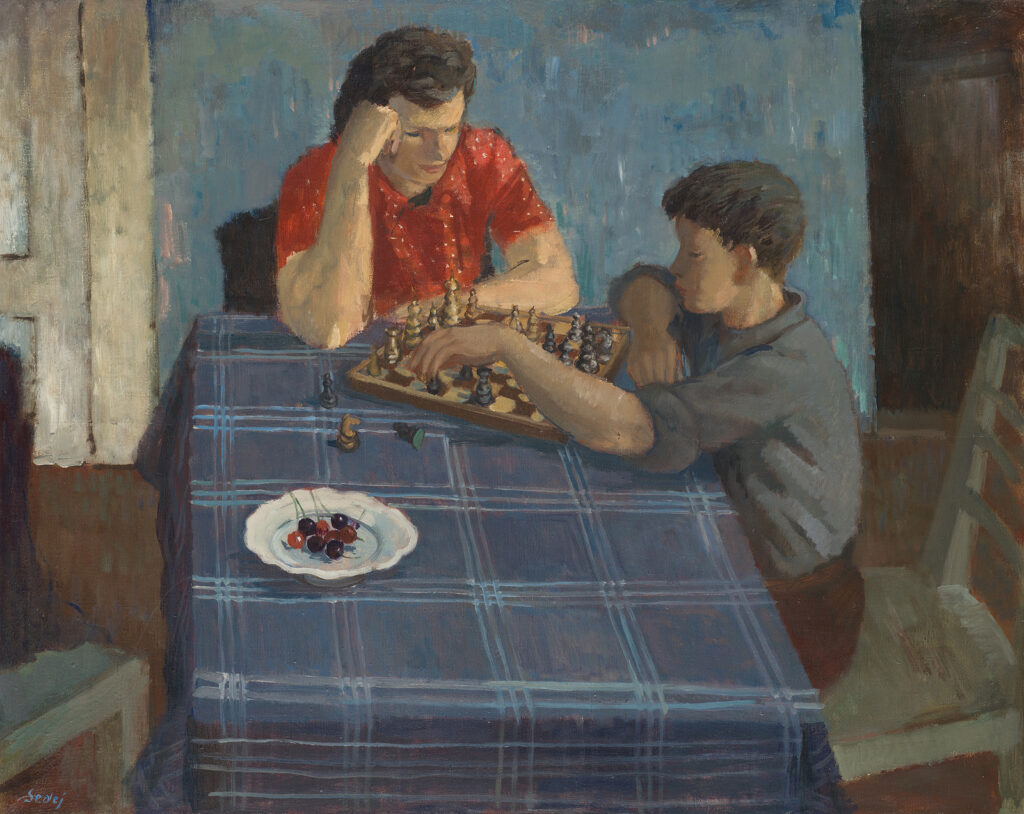
The scene is dominated by a large table with a blue tartan tablecloth which guides the eye from the lower edge towards the players and the chessboard slightly askew. The boy is on the move; he is moving a piece with his left hand, while his right forearm, foreshortened, is on the table. The chairs on the left and right help define the depth of the unmarked floor. The sense of depth is created by colours, too: the red blouse of the woman and the white bowl with cherries attract our gaze, which can sense the distance from the viewing point because of the tablecloth. In contrast to the main scene, the background is flat.
Maksim Sedej (1909–1974) used his family as models already before the Second World War. The synthesis of the three- and two-dimensional treatment of space and figures in the picture is the legacy of modernist masters from the late 19th century, like Édouard Manet (1832–1883), Paul Cézanne (1839–1906) and Pierre Bonnard (1867–1947).
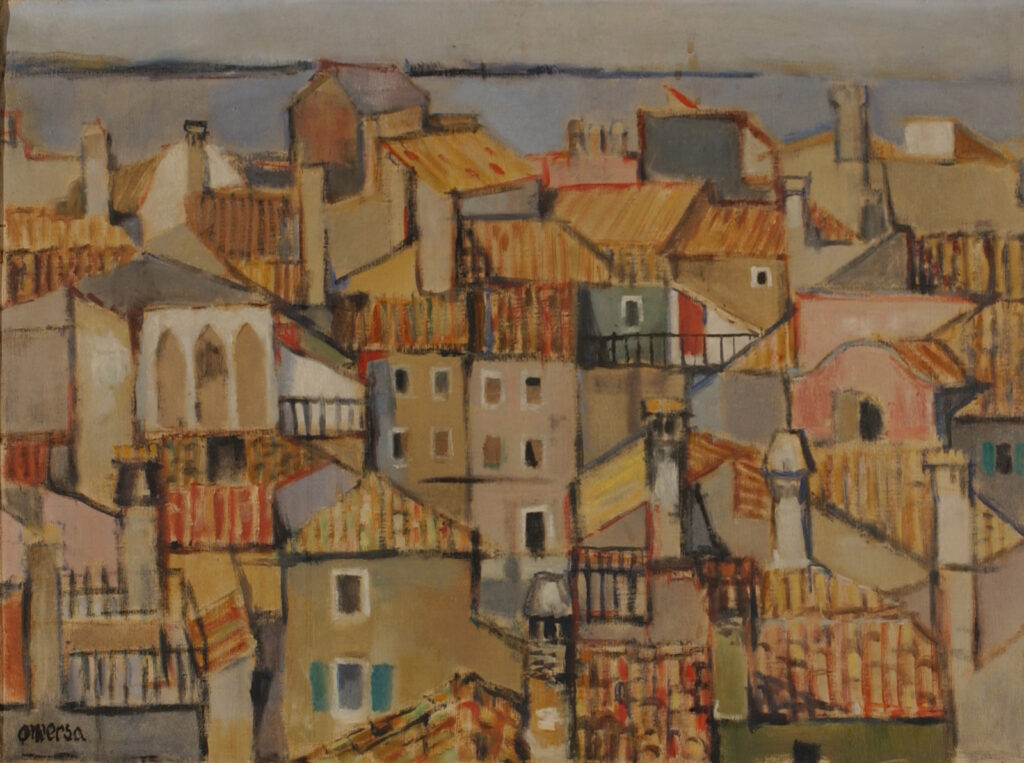
The houses and roofs mostly look flat, but we can sense the third dimension because of the overlapping, or some balustrades and walls and because of vanishing details – as we move closer to the blue horizon, the roofs and houses lose elements like windows and tiles and transform to uniform colour surfaces.
Omersa (1911–1981) was professor at the Academy of Fine Arts in Ljubljana. Like other artists in the 20th century, he thoroughly adapted the principles and laws of perspective to his vision.
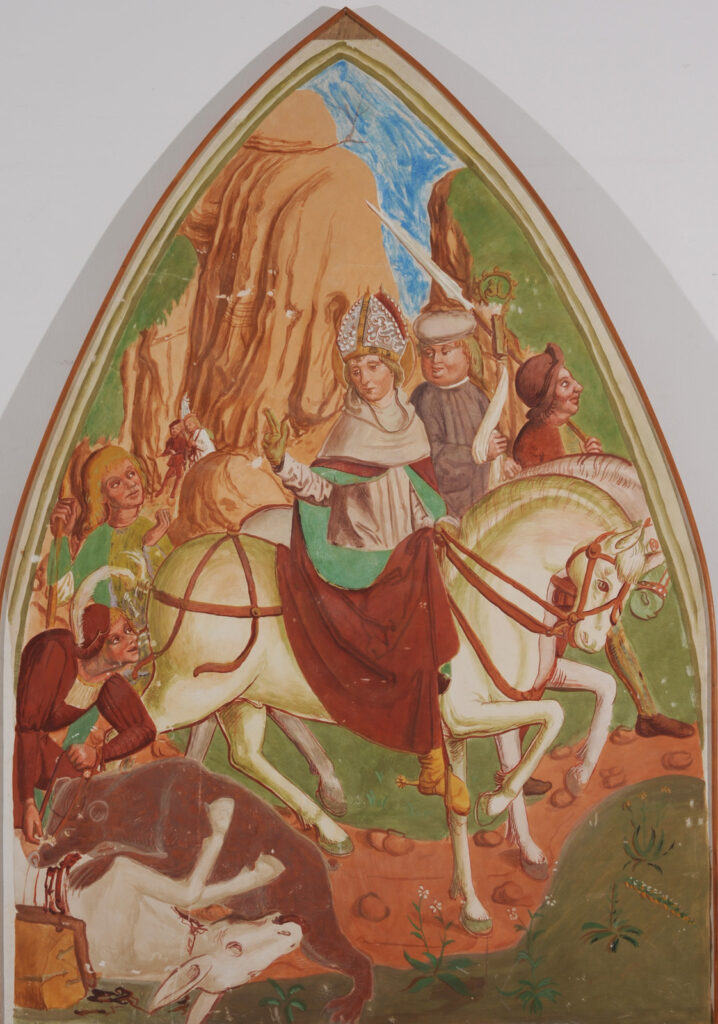
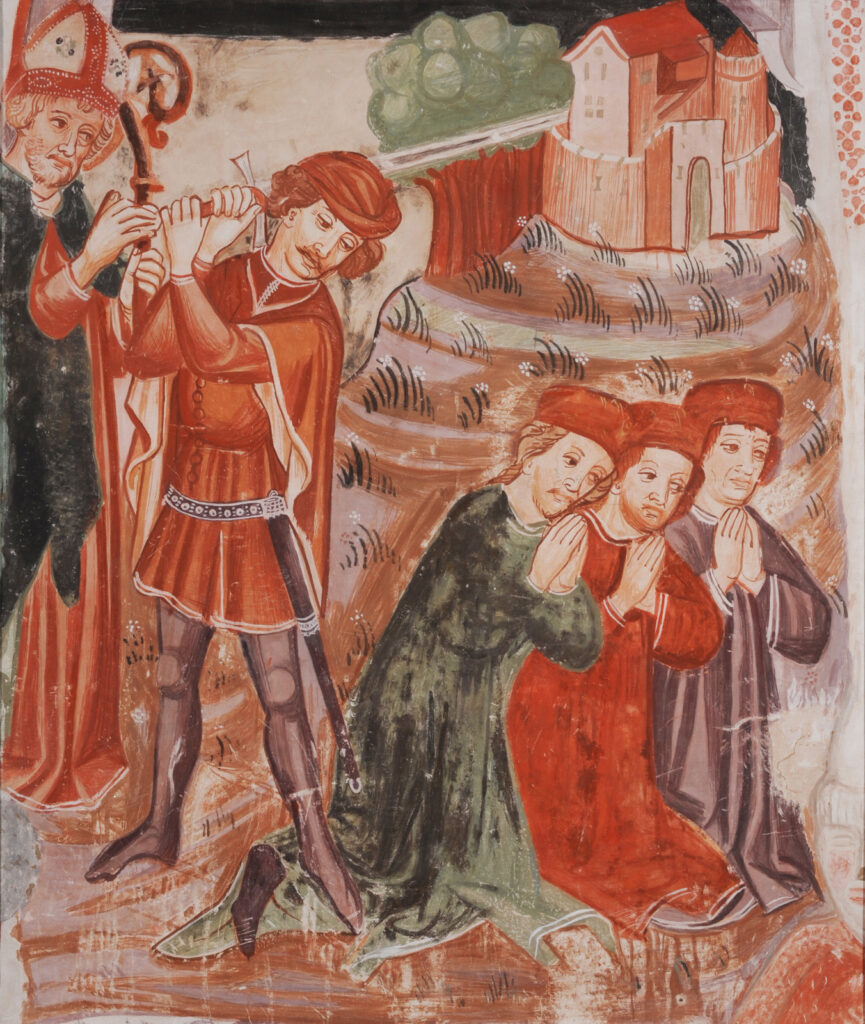
The scene is divided into the space in front and behind the bishop on his horse. In the foreground, a young bear is attacking an animal and the bishop has raised his hand in blessing, while the servant is putting a collar on the beast. A sense of space is achieved through the positioning of the figures and their overlapping: first, we see the white mule, followed by the brown bear and a servant, and then the bishop’s horse. The background is organised diagonally: along the winding road walk the bishop’s attendant and a soldier with a spear, while on the left, the road runs towards the pass upper right, with increasingly smaller human figures along it.
St Corbinian was the patron saint of the Freising Diocese in Bavaria which held much territory in the Slovenian lands and was therefore of crucial importance: it was in manuscripts from Freising that the oldest Slovenian texts were found. According to a legend, the bishop was on his way to Italy, when his retinue was attacked by the bear that killed their mule. The saint tamed the animal and punished it by loading it with freight which it then had to carry to Rome.
Pigments and Colour
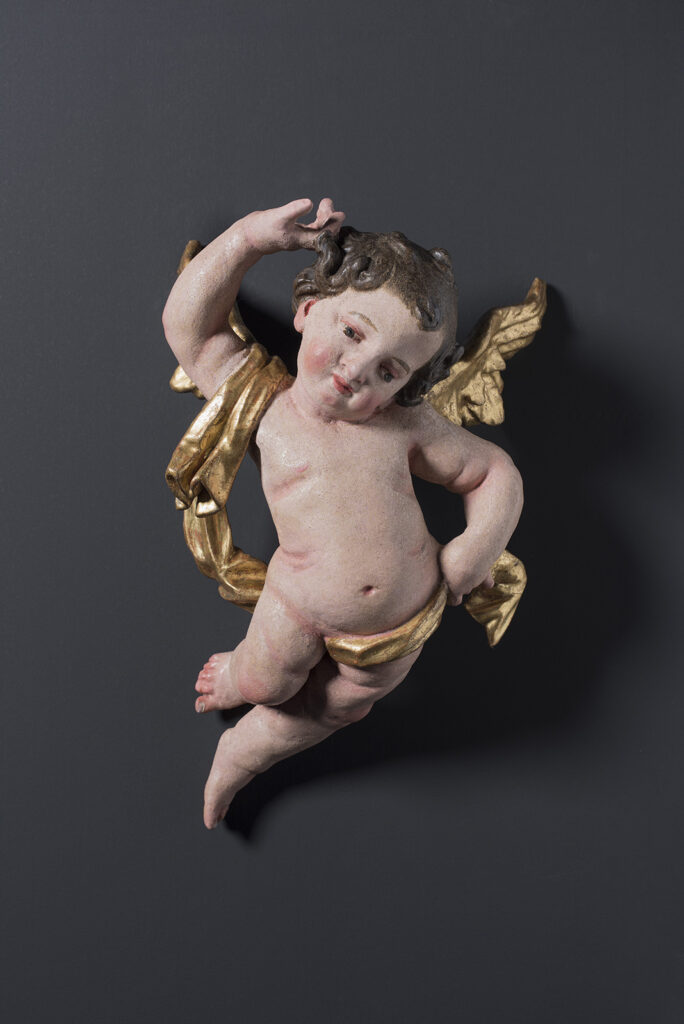
For gilding works of art extremely thin gold leaves are used. Master artisans can beat ten grams of gold into up to 1200 leaves.
Already in Egyptian art, wooden sculptures were often gilded. Each period varies in composition, colour and different treatment of ground layers, colours of gold leaf and the balance between burnish and matt surface appearance. Water gilding can be burnished. The ground layer, called poliment, binds the gold leaf and its main component, bole, allows burnishing to a highly reflective shine.
In Europe, gilding has been present on carved religious sculptures from the 9th century on. The leaves were first put on a white ground. The red Armenian bolus started to be used as ground more often after 1300 and became dominant during the Baroque period. Around 1400, black bolus became fashionable. Ground under matt surfaces usually contained yellow ochre.
Development of gilding techniques flourished especially during the Baroque, when gildings also significantly changed. Artisans began to use different alloys of gold and materials that imitated it. Better goldbeating techniques, different poliment colours and application of paint glazes to gold and silver helped with effects that even more attracted the observer.
In Slovenia, there are many extant gilded altars and sculptures from the 17th and the 18th centuries. One of these is the Putto, whose wings and drapery wrapping around his hands and loins are water gilded on red ground and burnished.
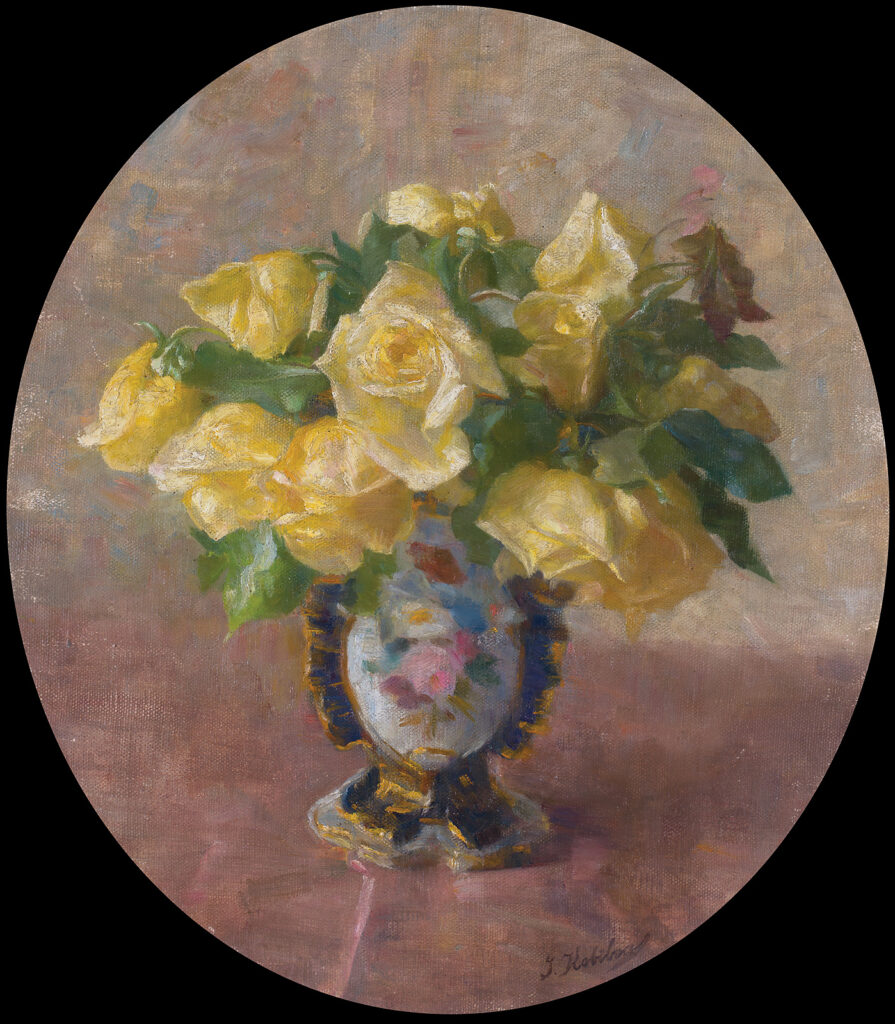
Among the first pigments used by humans was yellow ochre. Ancient Egyptians and other cultures of the time extracted a shinier auripigmentum/orpiment from arsenic ore. They were both used until the beginning of the 19th century. In the 13th century, Europeans started to make litharge (massicot) and called it the royal yellow. Later, Indian yellow was imported to Europe and the procedure for Naples yellow (lead antimonite) was rediscovered. Modern chemistry brought about numerous yellow pigments: chrome (1816), cadmium (since 1829, 1840), lemon (1830) and cobalt yellow (1852).
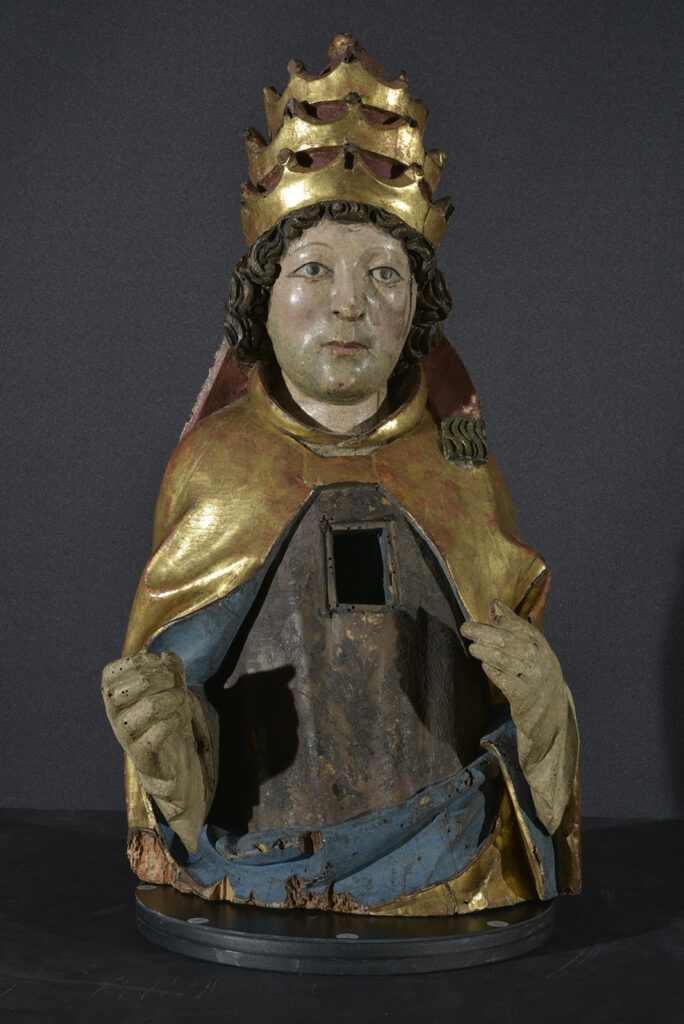
Gilded coats with matt blue lining were typical of sculptures between the second half of the 15th century and the 16th century. In the Middle Ages, the most widespread of blue pigments was the azurite, which was also used on this reliquary. Azurite is the oldest known natural blue pigment. It was extracted from the namesake mineral, which was common in Europe, in contrast to very expensive natural ultramarine, which required a very time-consuming process and semiprecious lapis lazuli, imported from today’s Afghanistan.
(Ancient) Egyptian blue is still regarded as the first synthetic blue pigment, although its recipe was lost in later centuries. Only modern scientific methods revealed its chemical composition and reconstructed how to make it. Due to its long-lasting and typical luminosity under infrared light, the 5200-year-old pigment is interesting for high-tech usage, for example in biomedicine, telecommunications and as fingerprint powder on difficult surfaces.
For wall paintings in the Middle Ages, artists mostly used earth pigments that remained stable in basic lime binder. Among them was red ochre, the oldest red pigment already present in prehistoric cave paintings. Women of the Himba tribe in North-western Namibia and the Hamar people in Ethiopia apply red ochre to their hair and skin to this day for aesthetic as well as hygienic reasons.
Among red pigments, the Persians and Ancient Egyptians used madder, red lead and cinnabar. In the 8th century, artificial vermilion was introduced and remained the most important red pigment until the discovery of cadmium red in 1907. The basis for vermilion was mercury and in Idrija (western Slovenia), one of the largest mercury mines in the world, the ore was processed into pigment, as well (mercury (II) sulphide). In the local factory, established at the end of the 18th century, they were producing 13 shades of vermilion until the end of the First World War and exported it all the way to China.
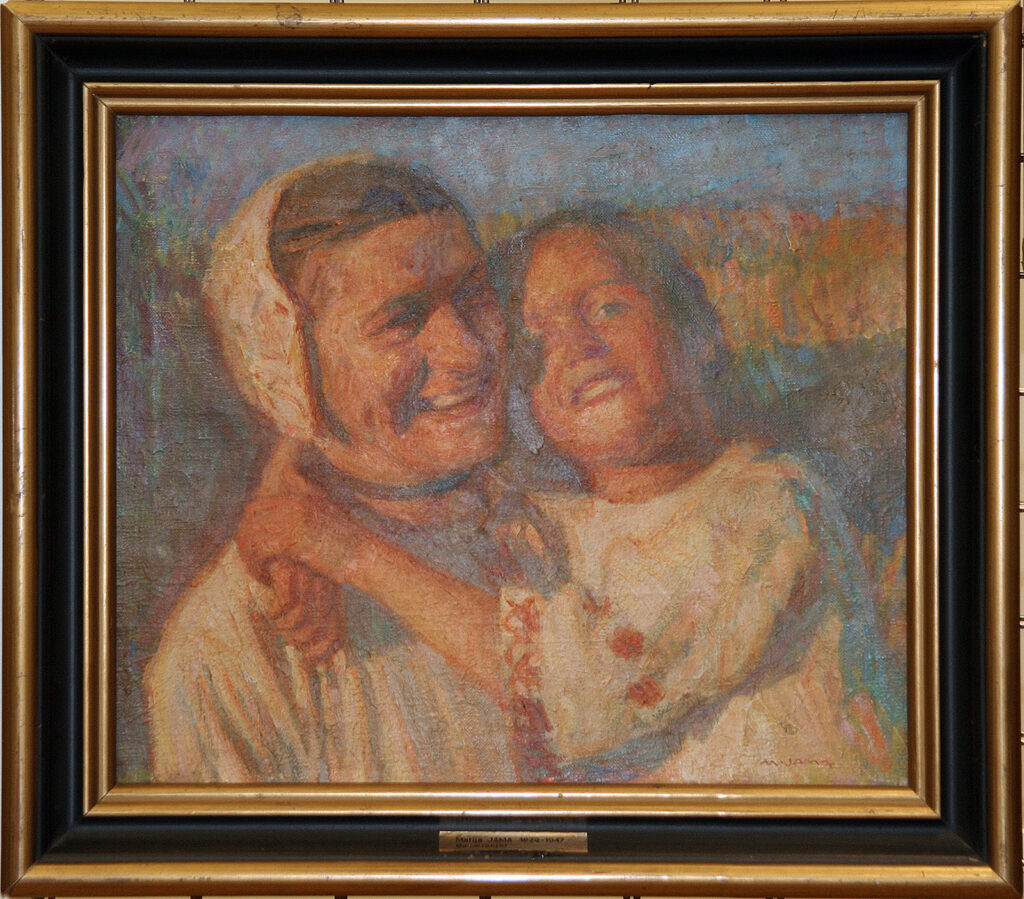
White pigments used in prehistory were natural white pigments: chalk (calcium carbonate) and gypsum (calcium sulphate). Until the invention of zinc white in 1834, artists could choose only lead white apart from natural whites; lead white was already known and described by Ancient Greeks.
Lead white was also used by Matija Jama (1872–1947) in this picture. The pigment is toxic and not in use today. As a substitute function the non-toxic zinc and since 1921 also excellent titanium white.
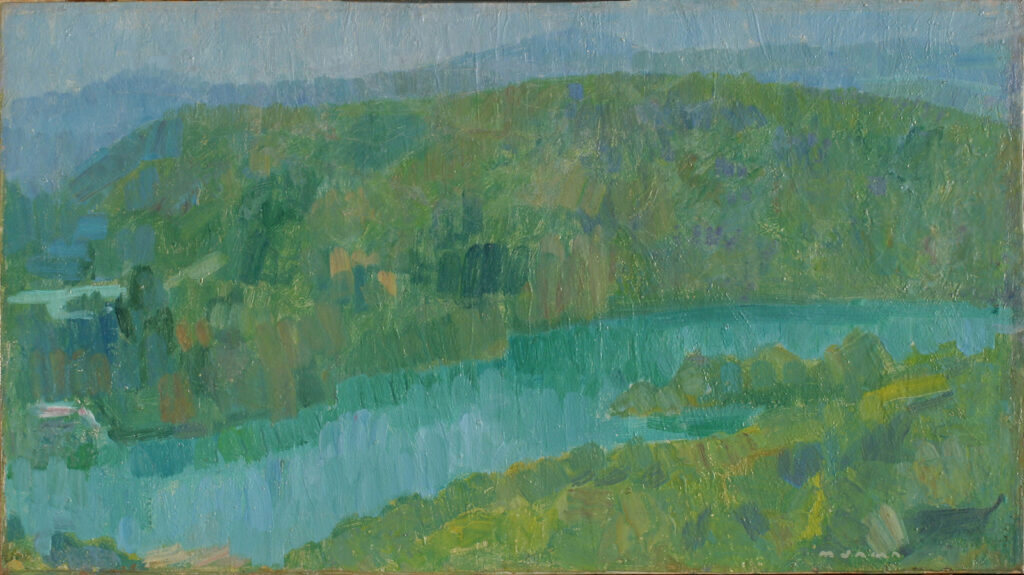
Among green pigments in use since Antiquity are natural green earth and malachite, used mainly by the Ancient Egyptians, and artificial Verdigris (bronze disease; copper acetate). Transparent copper resinate was introduced to European painting in the 15th century. Discoveries in chemistry from the beginning of the 18th century brought about new generation of green pigments: cobalt green, emerald green (copper acetoarsenite), chromoxide, viridian (chrome green).
The impressionists revived the use of green colour. The depiction of green landscapes was also partially influenced by the metal paint tubes, which enabled painting outdoors, and by discoveries of new and brighter green pigments.
In his picture of a landscape with a river, Jama used only Verdigris as green pigment, which he mixed with chrome yellow and yellow ochre for transparency. For darker tones, he added Prussian blue and ultramarine. Verdigris is the least stable of green pigments and turns to brown when exposed to air. The oil medium, however, protects it from atmospheric influences, which explains why this picture, around a century old, shows no traces of browning.
Violet colour was named after the flower and is similar to scarlet and magenta (fuchsia). The scarlet colour is a mix of red and blue colours, while violet has a specific wave length (380–420 nm). The violet paint was made by mixing red and blue, while the first true violet pigment was cobalt violet, invented in 1859.
Tyrian purple or scarlet red dye was produced in Ancient times from secretion of certain sea snails. An efficient way of laboratory synthesis of the pigment was developed only in 2010. Later on, it was replaced by madder and carmine.
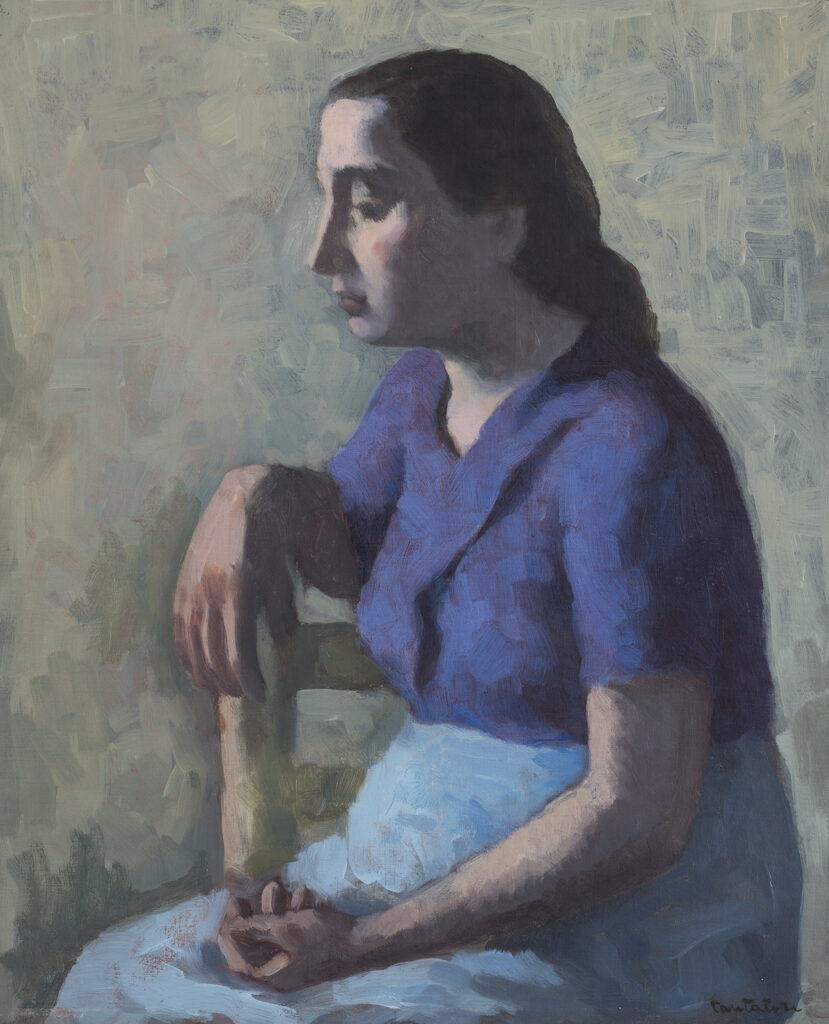
From prehistory onwards, man has been using charcoal for drawing. Charcoal is also the basis for black pigments, which are produced by charring different natural materials. From charred grape vines and stems the artisans produced vine black, from elephant tusks comes ivory black, from animal bones bone black.
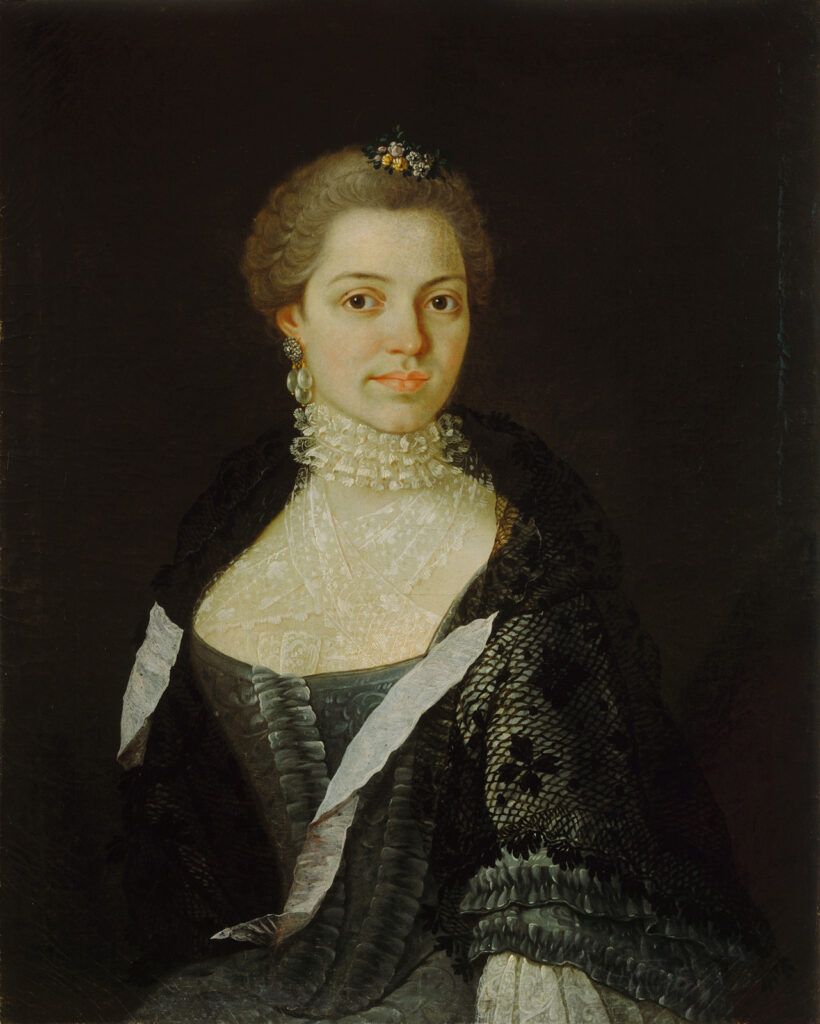
Bone black gives the deepest black to the pictures. Rembrandt van Rijn (1606–1669) used it for clothes in his portraits, making them stand apart from the often-times black background. Fortunat Bergant (1721–1769) used carbon black for the painting of the baroness, both for the background and for her dress; the pigment was made either from plants or from animals.
In 2014, one of the blackest materials was produced in a laboratory. Vantablack can absorb up to 99.96 percent of visible light. VANTA is not a pigment, but a material made of countless vertical carbon tubes much thinner than human hair. In art world, the conceptual artist Sir Anish Kapoor (*1954) acquired exclusive right to use Vantablack S-VIS in a spray.
Inventions and Discoveries
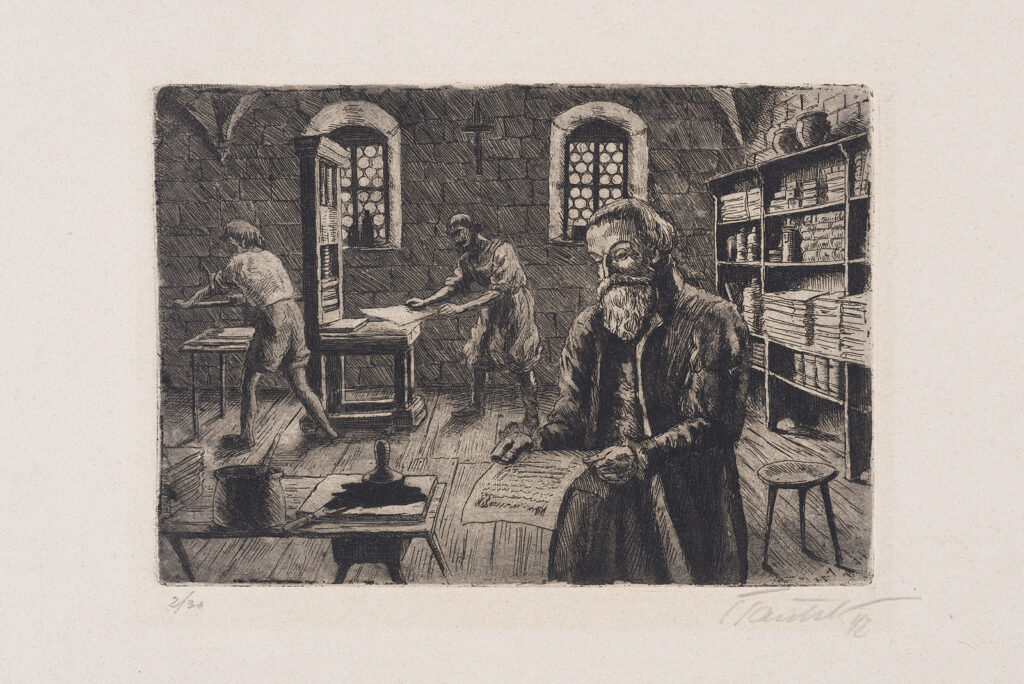
Saša Šantel (1883–1945), painter, printmaker and musician, imagined for his print the founder of Slovenian Protestantism as he is inspecting a freshly printed page of one of his books. The development of print impacted the visual art with lesser force than it did the literary and religious spheres, but changed it nonetheless. Printed images circled Europe in booklets, books or as individual sheets and featured copied scenes, original scenes or the ones based on an original. The prints came to the Slovenian lands mostly from Flanders, where printing workshops followed a strict Jesuit programme, making scenes uncontroversial.
Art prints were more accessible to average people due to lower cost and helped artists expand their market. Woodcuts were followed by copper engravings and etchings, and at the end of the 18th century also lithography. Mass reproduction also changed the attitude towards the questions of originality, copying and copyright. The first legal protection of copyright in the Slovenian lands was introduced by the Austrian Monarchy as the Austrian Law for the protection of literary and artistic property, which came into force in 1846.
Allegory of Chemistry was together with the Allegory of Herbal Medicine made for the doors of the pharmacy in today’s Prešeren Square in Ljubljana.
The development of chemistry changed art, too. By the end of the 18th century, new pigments were created, like Mars red (synthetic red ochre) and cobalt green. Additional and improved versions of old dyes and pigments entered the market during the following century, also. The main reason for accelerated development had nothing to do with art. The research was mainly supported by a large demand in the textile industry, where they received new dyes first. Artists used special pigments which in general differ from dyes by being insoluble and due to significantly lower demand needed more time to enter widespread use.
After the First World War, a myriad of new synthetic polymer materials were invented – especially important are acrylic paints, which have been available since the 1950s onwards and enable a different approach to painting due to quicker drying.
Chemistry also has an incredibly important role in modern conservation-restoration procedures and contributes materials and research methods from other, more market-oriented fields. Synthetic materials, such as acrylic resins, are often a better alternative than natural materials. By taking samples, we can study the chemical composition of all layers of a work of art, since better understanding of the physical properties of an artefact help guide protocols of its conservation.
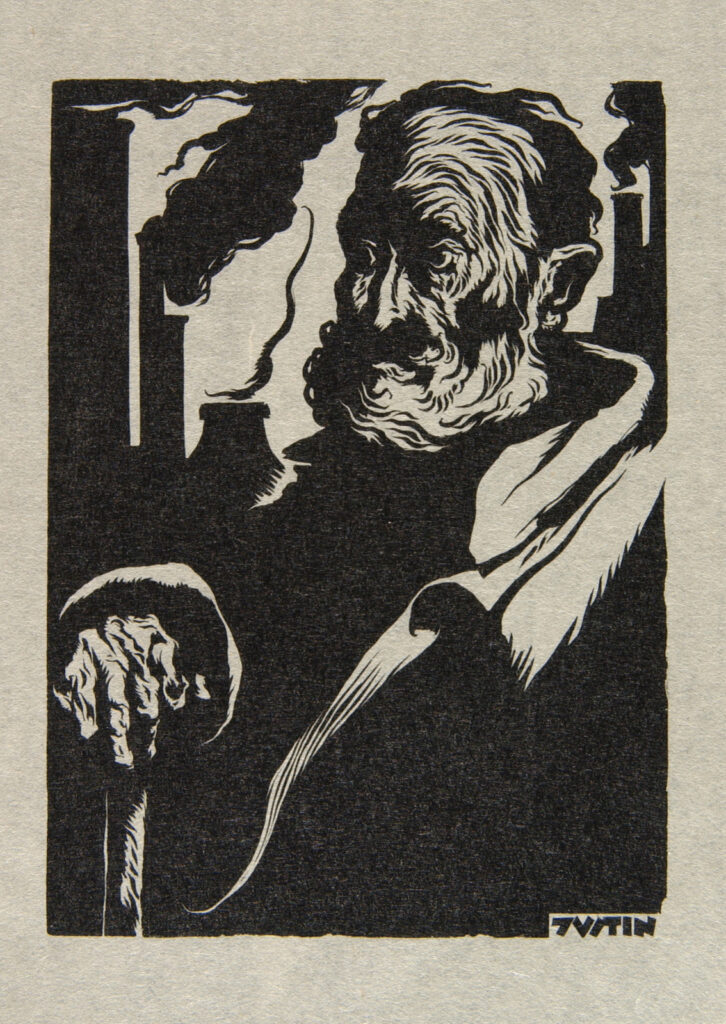
Gabrijel (Elko) Justin (1903–1966) generally made woodcuts and worked as a technical editor of the Jutro daily. In the print, we see an old man in front of a row of working factory chimneys.
Industrialisation and urbanisation are traditionally linked to air pollution, which greatly affects the cultural heritage. Fuel exhaust in traffic, coal power plants, and industry produce large quantities of solid particles as well as some of the more harmful gases and chemical compounds: sulphur dioxide, nitrogen dioxide, ozone, which all accelerate decomposition of materials and thus degradation of cultural heritage. Air pollutants play a very important role in air corrosion. The most dangerous is the sulphur dioxide, which becomes especially aggressive when combined with catalysts, like soot, dust, and oil particles. In Ljubljana, the chemical changes of bronze are quite visible on the Prešeren Monument in the centre of the city; near it, the Robba Fountain once stood, before it was moved to the National Gallery of Slovenia – stone also degrades more quickly under the influence of acid rain.
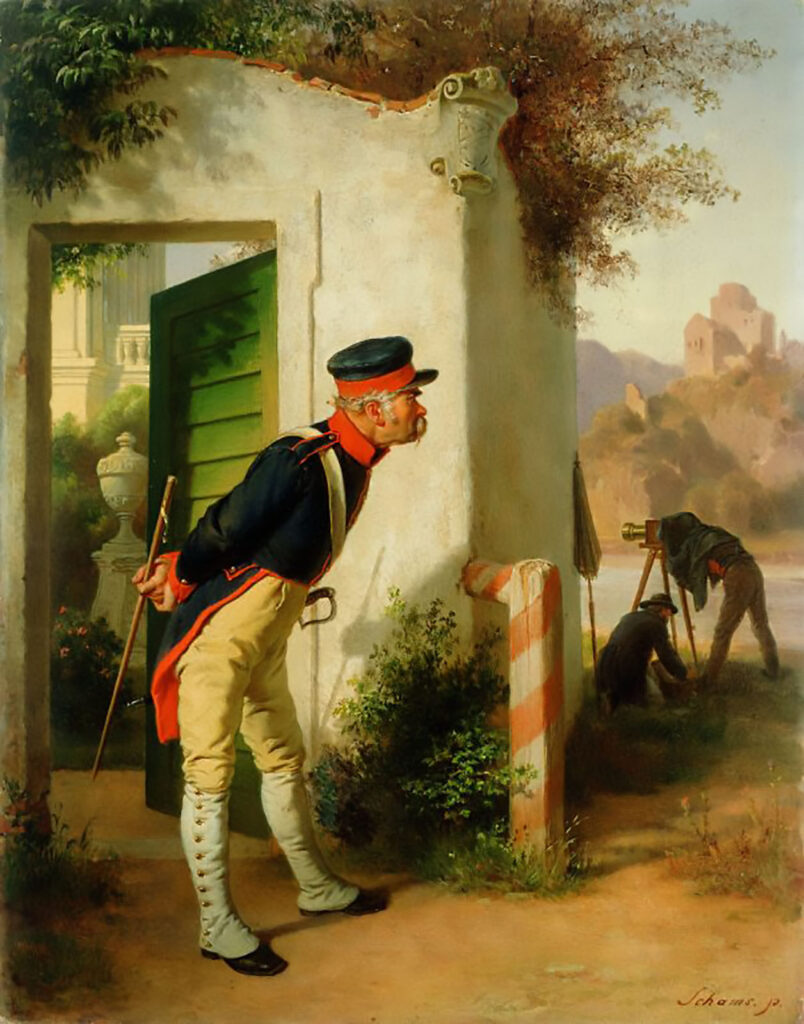
Schams depicted the meeting of two worlds: on the left, we see a representative of the old order, protecting the closed and meticulously tended garden, while on the right we see modern photographers, exploring the natural, unpredictable world outside the enclosure.
Photography transformed the visual arts in several ways. Coupled with postcards it encouraged tourism and helped artists and publishers by having reproductions of the works of art circle the world. Photography played the role of a sketch, for example for Ivana Kobilca (1861–1926) and Ferdo Vesel (1861–1946), who used it in Munich, where they shared a studio and their lives, to study the human figure and composition.
Photography helped the impressionists with complicated scenes: thus, Ivan Grohar (1867–1911) painted his Sower according to a photograph that was taken in the vicinity of the church at Suha near Škofja Loka by Avgust Berthold (1880–1919).
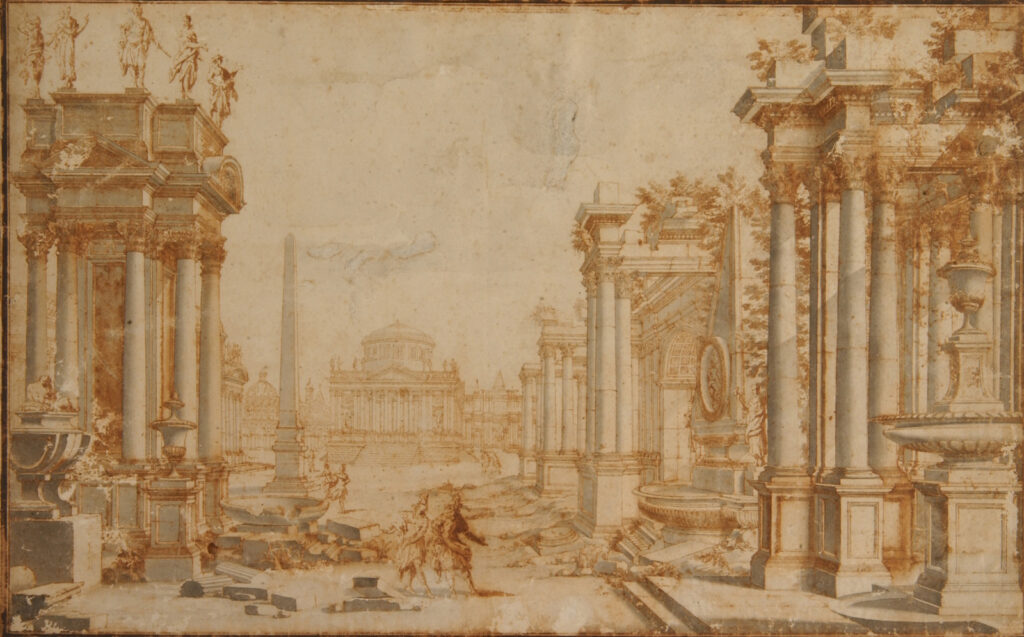
Ferdinando Galli-Bibiena (1657–1743) was Italian Baroque architect, designer and painter who alongside with other family members worked for aristocrats and designed gardens, scenes for court parties and opera. At the end of the square in the picture, behind the elegantly dilapidated and overgrown facades and the obelisk, stands a mighty building that looks similar to Villa Rotonda by Andrea Palladio (1508–1580), one of the most influential architects of all time.
Since Renaissance, architecture and the visual arts have been connected to the principle of musical proportions or aesthetics of surfaces and volumes that was based on Ancient Greek philosophy and mathematics and the Renaissance texts by Leon Battista Alberti (1404–1472). Principles of proportions are also a theme in Palladio’s Four Books on Architecture (1570).
The universe is supposed to move according to a predefined order, manifesting itself in the “music of the spheres”, and like composers with musical intervals, so did architects and artists in their creations use proportions, such as 1:2, 2:3, 3:4, including multiplications and permutations, sudh as 4:6:9 or 9:12:16. According to Pythagoras (570–495 BC) and his successors, numbers used like this acquired not just symbolic, but also divine and mystic meanings. The explanation seems unusual to us, but a look at the proportions of photographs made by our smartphones are a reminder that the central ideal about aesthetics remains unchanged.
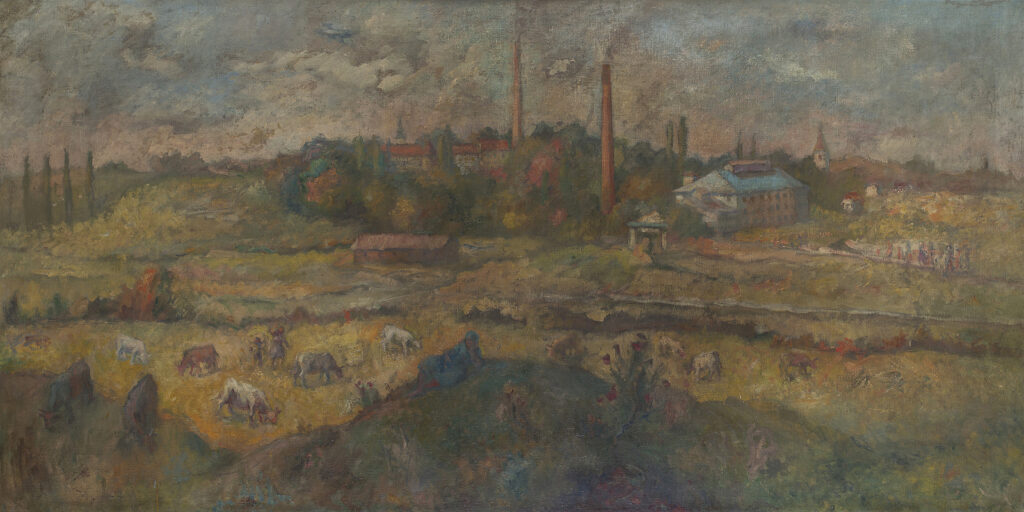
Slovenian Impressionism was connected to industrialisation on two levels. Among the supporters of the impressionists were, for example, the merchant and businessman Leon Souvan (1877–1949), who rearranged and expanded the park around the family mansion Volčji Potok, economist Fran Windischer (1877–1955), one of the founders of the National Gallery of Slovenia; and later on also Fran Bonač (1880–1966), who established a cardboard factory in Količevo.
The other level is seen in this picture from 1929. That year, Rihard Jakopič (1869–1943) was invited to Oroslavje by the Sotla River, where Milan Prpić built a textile factory beside his mansion. Jakopič painted the monumental image that merges the old world of the villa, the village and idyllic rural landscape with a new industrial reality. This reveals the double nature of Slovenian Impressionism: the images are stylistically advanced, while tree groves, brave workers and thoughtful maidens are remnants of a more simple past retreating before the modern era.
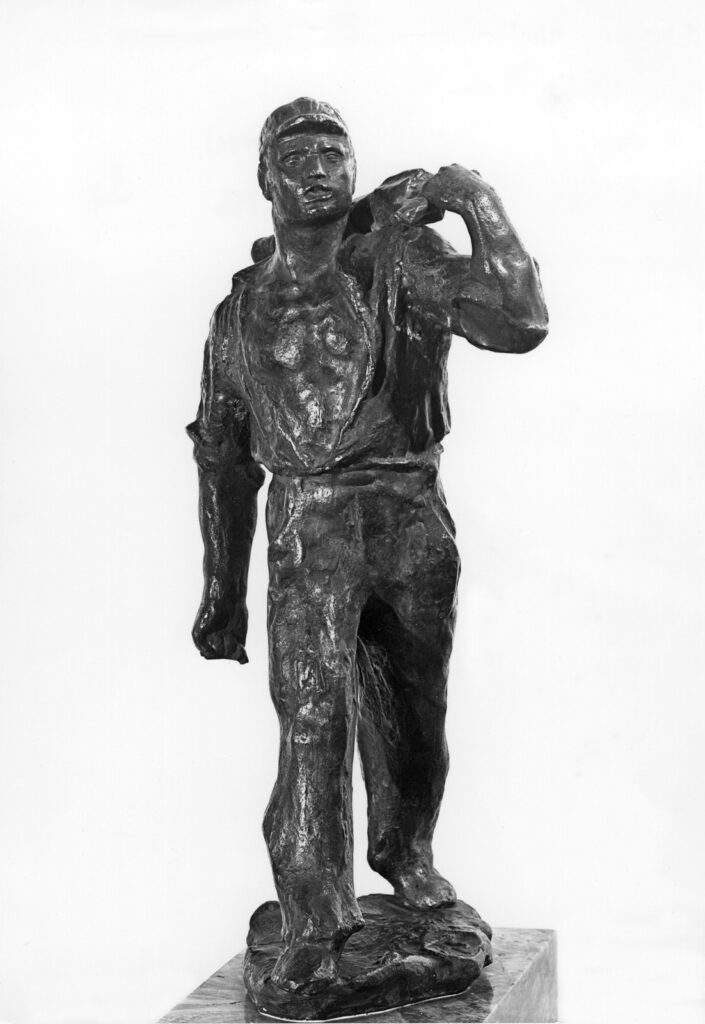
After the First World War, especially during the economic crisis in the beginning of the 1930s, Slovenian artists began to depict hard lives of wage workers under the influence of the Zagreb art group Zemlja. After the Second World War, the new authority used the motif of a worker, now supposedly respected and triumphant, as a symbol of the new social contract: the Communist Party will stay in power and in exchange take care of economic development. The renovated and expanded squares became sites for monuments in line with the political slogan: “Let the heroes of war be followed by the heroes of labour.” The sculpture of the Miner is a smaller version of two identical monumental sculptures by Alojzij Kogovšek; one cast is in Ljubljana’s Tivoli Park and the other in Velenje, a town in north-east of Slovenia. The Velenje Miner was the first public monument in the city and a reminder of the nearby lignite mine, which together with the home appliances factory Gorenje was crucial for the rapid development of the city.
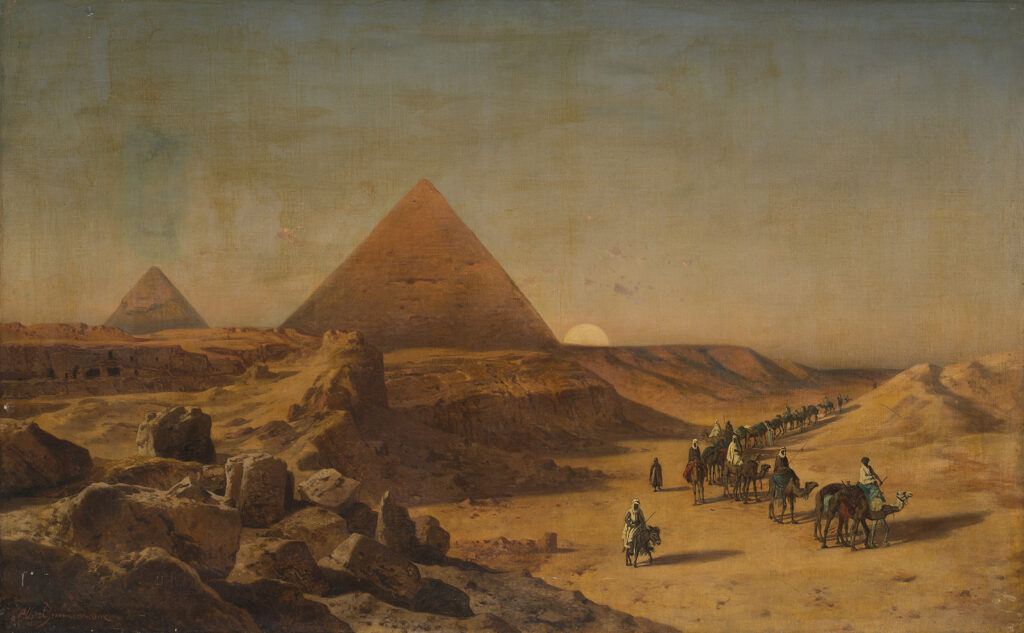
The Ancient world of the Middle East and Northern Africa was for thousands of years the birthplace of influential innovations. Some survived the passing of time, while others were forgotten, only to be re-discovered centuries later. In Mesopotamia, the pulley probably first appeared and also the wheel in the form of the potter’s wheel. The pyramids in Egypt were built with the help of ramps and levers. Mesopotamia and Egypt were among the four cradles of human literacy (together with China and Mesoamerica), and the Egyptian hieroglyphs formed the basis for the Phoenician alphabet, from which the Greek one also developed. The earliest phases of glassmaking most likely began in northern Syria and Mesopotamia and spread to Egypt. Also old is the Egyptian faience and synthetic pigment Egyptian Blue alongside it, which was popular until Roman times but forgotten later on.
The picture of the caravan coming from the pyramid complex was donated to the national collection by Jožef Schwegel (1836–1914), a diplomat, economist and writer, who served in the Middle East; among other positions he held was the consulship in Alexandria and Istanbul.