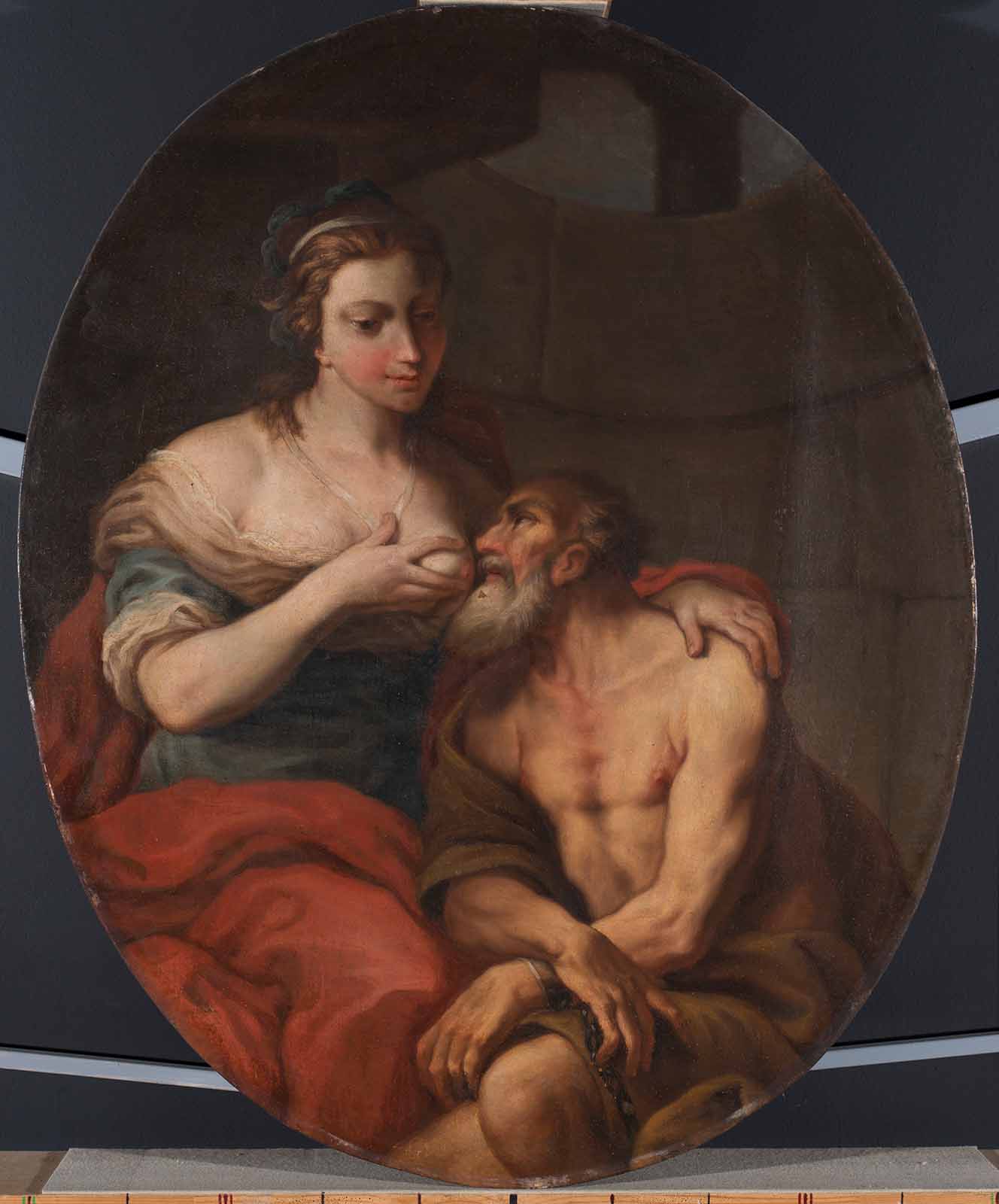
Caritas romana (Cimon and Pero)
The oval, which the National Gallery purchased at auction in Milan together with its pendant Christian Love (NGS 3530), originates from Haasberg, a baroque country house in Planina near Rakek, which was destroyed by fire during the Second World War. The house changed hands several times over the course of its long history and its noble owners included the Eggenberg, Cobenzl, Coronini and Windisch-Graetz families. The last of these withdrew to Trieste during the Second World War and sold several paintings from the house to local antiques dealers.
Caritas romana is the work of the Venetian painter Francesco Pittoni, who also worked for a time for clients in the county of Gorizia and, judging from the large number of paintings that once adorned the house in Planina, probably for clients in Carniola too. For the time being, however, extant sources do not permit us to identify with certainty the original owner of this painting or who commissioned it. Given their dating, the two works could have come to Haasberg at the time of the Eggenbergs, or with one of the subsequent owners.
The subject of the painting is an incident from ancient history that is recorded by Valerius Maximus in his work Facta et dicta memorabilia (Memorable deeds and sayings). The anecdote tells of
an Athenian statesman and general (Cimon), an opponent of democracy, whom the Athenians had sentenced to death by starvation. Each day his daughter, Pero, would visit him in his gaol cell and feed him with milk from her own breast. The story and the motif call to mind virtues such as compassion, gratitude, loyalty and filial piety. The motif was a very popular one in the seventeenth and eighteenth centuries, particularly in Italian and Dutch painting.