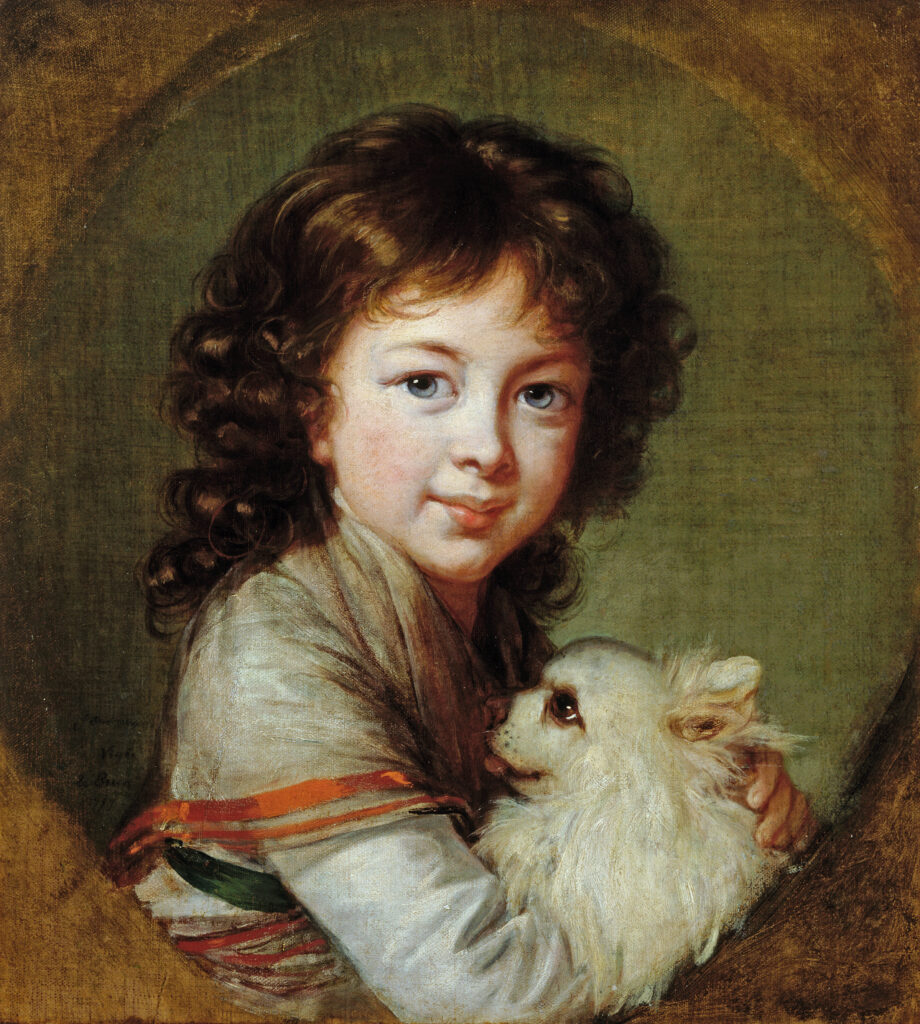

Born 1755 in Paris, died there in 1842. She was the daughter of the painter Louis Vigée and showed exceptional talent very early in life. She studied with her father and with Joseph Vernet but learned most by copying the works of the great masters of the past. In 1776 she married the painter and art dealer Jean-Baptiste-Pierre Lebrun; she soon became one of the most prominent artistic personalities in Paris and enjoyed the favour of Queen Marie Antoinette. When the revolution broke out Élisabeth Vigée-Lebrun came under fire because of her close contacts with the court; she therefore left France and travelled first to Italy (to Bologna, Rome, Naples, Florence, Venice and Milan), then to Vienna, to Berlin, and finally to St. Petersburg, where Catherine II and Paul I were her patrons. Then she went to Germany and in 1801 returned to Paris, where, with the exception of some short journeys abroad, she remained until her death. Élisabeth Vigée-Lebrun is known above all for her female portraits, which retained an exceptional artistic level until about 1815. In these portraits a knowledge of the great portrait art of the 16th and 17th centuries is combined with the exquisite sensitivity, typical of the 18th century, and a refined elegance.
Lit.: Élisabeth Louise Vigée Le Brun: Souvenirs de Madame Louise-Élisabeth Vigée Le Brun I-III, Paris 1835/37; Joseph Baillio: Élisabeth Louise Vigée Le Brun: 1755-1842, Fort Worth 1982; Mary D. Sheriff: Élisabeth Vigée-Lebrun and the Cultural Politics of Art, Chicago 1996.