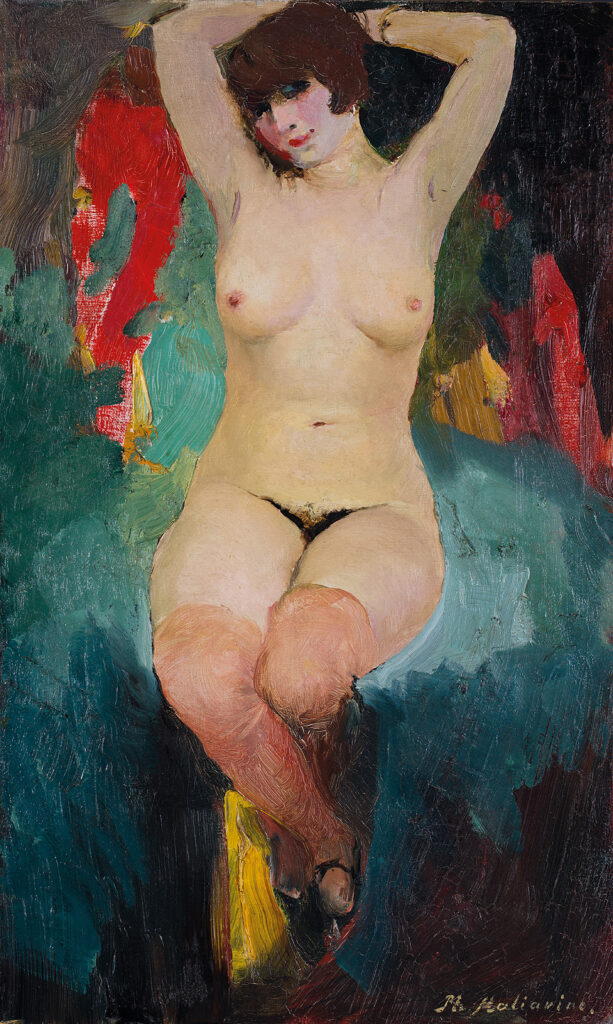

Handbooks and lexica list various places where the painter is said to have been born and where he died. They also give different dates for his birth and death. The latest research suggests that Maliavin was born in 1869 in Kazanka (Samara province, today’s Orenburg) and that he died in 1940 in Nice. From 1885 to 1891 he was painting icons in the monastery of Saint Pantelejmon on Mount Athos, from 1892 to 1899 he studied painting with Ilija E. Repin at the academy in Saint Petersburg. The portraits of his fellow students Igor Grabar, Elisaveta Martinovna and Konstantin Andreievich Somov date from this time. In 1895 Pavel Tretjakov bought his paintings Peasant Girl Knitting and A Girl with a Book for his gallery. Maliavin depicted motifs from Russian peasant life, peasant girls and old women. In 1900 he went to France. He lived in Paris where he exhibited Laughter at the World Exhibition and won the gold medal (the painting was bought by the Museo d’Arte Moderna in Venice in 1901). In the same year he returned to Russia, married Natalija Novak-Savić, bought a property near Ryazan and settled there. In Paris he had begun painting decoratively in the modern manner with light strokes. In his portraits the faces remained realistically and plastically calm, but he brought liveliness to the clothing of his sitters, the backgrounds and objects in his paintings with a play of restless disintegrating splashes of colour (Self-portrait, Russian Girl). In France he signed Ph. Maliavine. Between 1908 and 1910 he again lived in Paris, then he returned home. He painted a portrait of Lev Davidovich Trotsky, and in 1920 he drew about twenty sketches for a portrait of Lenin in the Kremlin. In the same year he also painted Anatoly Vasilievich Lunacharski. In 1918 he propagated the fine arts under the patronage of the Ryazan Commissariat for Education and in 1920 he participated in the Federal Conference as a representative of the Association of Russian Artists. In the autumn of 1922 he went to Paris with his family, where he exhibited in the Galerie Charpentier in 1924, in the Salon d’Automne 1923–25, and also in New York, Chicago, Washington, Philadelphia, Pittsburgh and many European centres. In 1933 he accompanied his exhibition to Yugoslavia, England, Czechoslovakia and Sweden. Maliavin was also a graphic artist. A Portrait of the Artist’s Father is kept in the Narodni muzej in Belgrade, other works are in galleries and museums in Saint Petersburg, Moscow, Prague, London and elsewhere.
Lit.: N. Aleksandrova, Filip Andrejevič Maljavin, Moskva 1966; O. A. Živova, Filip Andrejevič Maljavin (1869-1940); Žizn’ i tvorčestvo, Moskva 1967; Alla Korobtsova, Philip Maliavin, Masters of World Painting, Leningrad 1988.