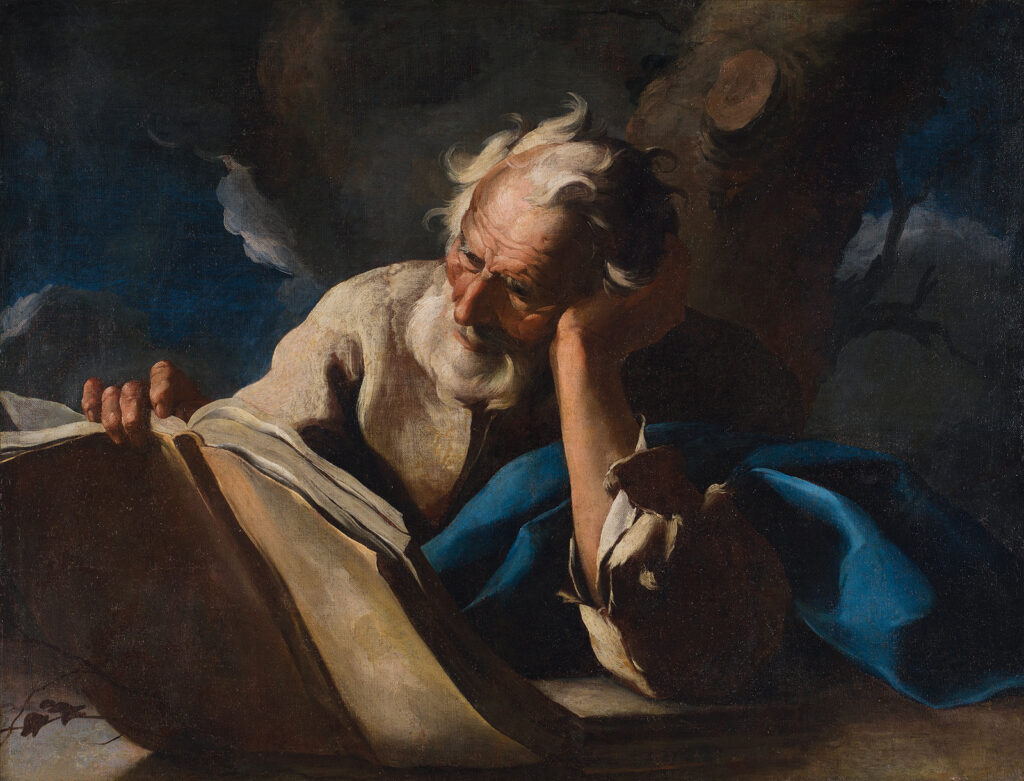

Born 1677 in Carona above Lake Lugano as son of the sculptor Marco Antonio. Died between 1755 and 1759 (the exact date is not known because the registers of deaths for these years have not survived in Carona). He studied in Genoa, Bologna, Venice and perhaps also in Rome. He modelled his work on various schools and masters of the 17th and 18th centuries: the Genoese (his teacher Bartolomeo Guidobono; Giovanni Andrea Carlone), Venetian (Tiepolo, G. G. Pittoni, G. B. Piazzetta), Lombard (Pietro Antonio Magatti), the Caravaggio circle in the Ticino (in particular Giovanni Serodine) and the painters of the Federician circle in Milan (Giovanni Battista Crespi, called il Cerano, Pier Francesco Mazzucchelli, called il Morazzone, the early works of Francesco del Cairo). Petrini is famous as a master of lonely figures, which he portrayed very plastically, emphasising them with strong contrasts of light and shade. Characteristic for him are oblong paintings with waist-length figures of secular and ecclesiastical dignitaries, above all astronomers, philosophers, mathematicians, evangelists, Church Fathers, etc. With these paintings he introduced a new motif to the Lombard painting of the first half of the 18th century. Petrini painted frescoes and oils, he also undertook decorative works of various kinds, e.g. the painting of ceilings and antependia with floral motifs. Most of his works are in the environs of Lugano, in Bergamo, Pavia and in various places in Piedmont.
Lit.: Edoardo Arslan, Giuseppe Antonio Petrini Lugano 1960 [ex. cat.]; Settecento, Vol. I-II, Torino 1990 (biogr. Simonetta Coppa); Giuseppe Antonio Petrini, publ. Rudy Chiappini, Milano 1991 (Lugano, Villa Malpensata) [ex. cat.].