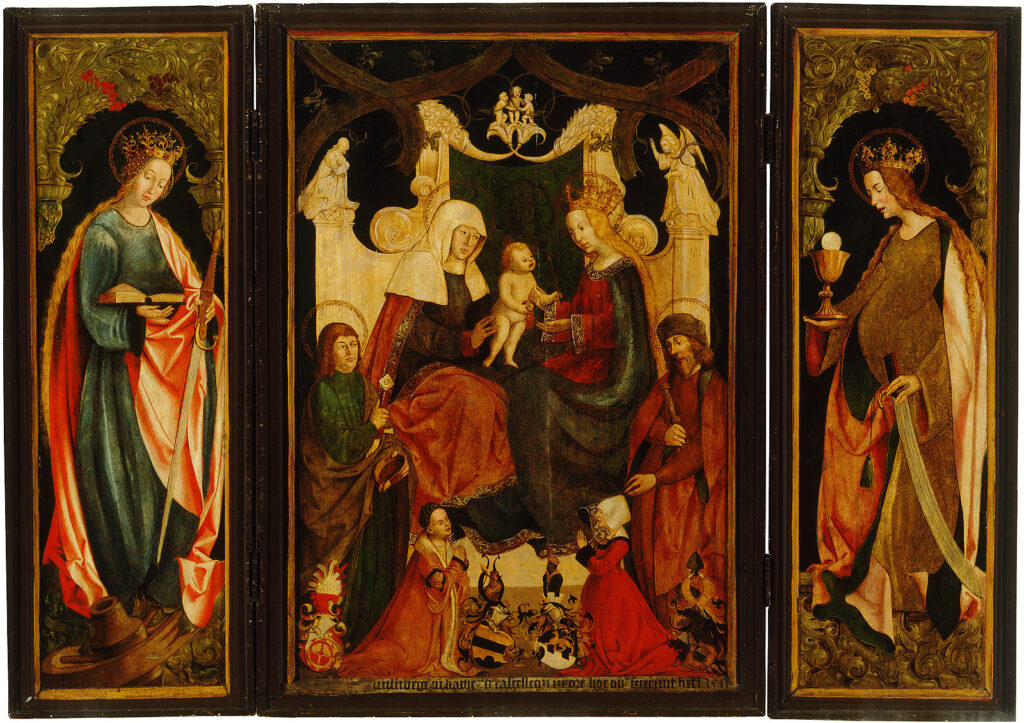

The most important Tyrolean painter among the followers of Michael Pacher, Reichlich was born around the year 1460 in the environs of Brixen/Bressanone, probably in Neustift (Novacella), and is first mentioned in 1494 in the register of citizens of Salzburg. In Salzburg he probably worked with Michael Pacher, who in 1484 had received a commission for a new high altar in the former church of the Virgin Mary there, which is now the Franciscan church. After Pacher’s death in 1498 Reichlich set up on his own, and although he was a citizen of Salzburg he retained links with the Tyrol. In 1489 he painted a panel of the Adoration of the Magi for the Wilten monastery (Innsbruck, Ferdinandeum), in which we can see stylistic links with Friedrich Pacher. In 1499 he produced two panels, which have not survived, for the Styrian abbey of Saint Lambrecht and Saint Ann with the Virgin Mary and the Child for canon Christoph von Thurn in Brixen (Brixen, Diözesanmuseum). On a commission from Florian Walduf he created an Altar to the Virgin Mary for the parish church in Hall, and in 1506 an Altar to Saint Stephen and Saint James for Neustift (Munich, Alte Pinakothek and Neustift). In 1508 the emperor Maximilian entrusted him with the renovation of the murals at Runkelstein Castle. An Altar to the Virgin Mary for Neustift (Munich, Alte Pinakothek) is dated 1511. Among his undated works mention should be made of the panels in the Österreichische Galerie in Vienna. By 1520 Reichlich was probably already dead, because the altar which he had undertaken for Heiligenblut was finished by a “Wolfgang Maller”. Reichlich’s earlier works show the influence of the school of Friedrich Pacher, later he followed the stylistic tendencies of Michael Pacher. In many ways his work also shows similarities with the paintings of the Master of Uttenheim. He adopted Italian stylistic ideas – in composition and staffage figures from Vittore Carpaccio, in perspective solutions from the Mantegna school, and it would appear that he was even familiar with the painting of the Umbrian circle. He also painted portraits. He usually signed his works with the initials M. R.
Lit.: Nicolo Rasmo, Triptih Marxa Reichlicha v Narodni galeriji v Ljubljani, ZUZ, n. v. III, 1955, pp. 246-251; Elfriede Baum: Katalog des Museums mittelalterlicher österreichischer Kunst, Wien-München 1971, pp. 123-124; Lukas Madesbacher: Marx Reichlich und der Meister des Angrerbildnisses, Innsbruck 1994 [dissertation, typescript].