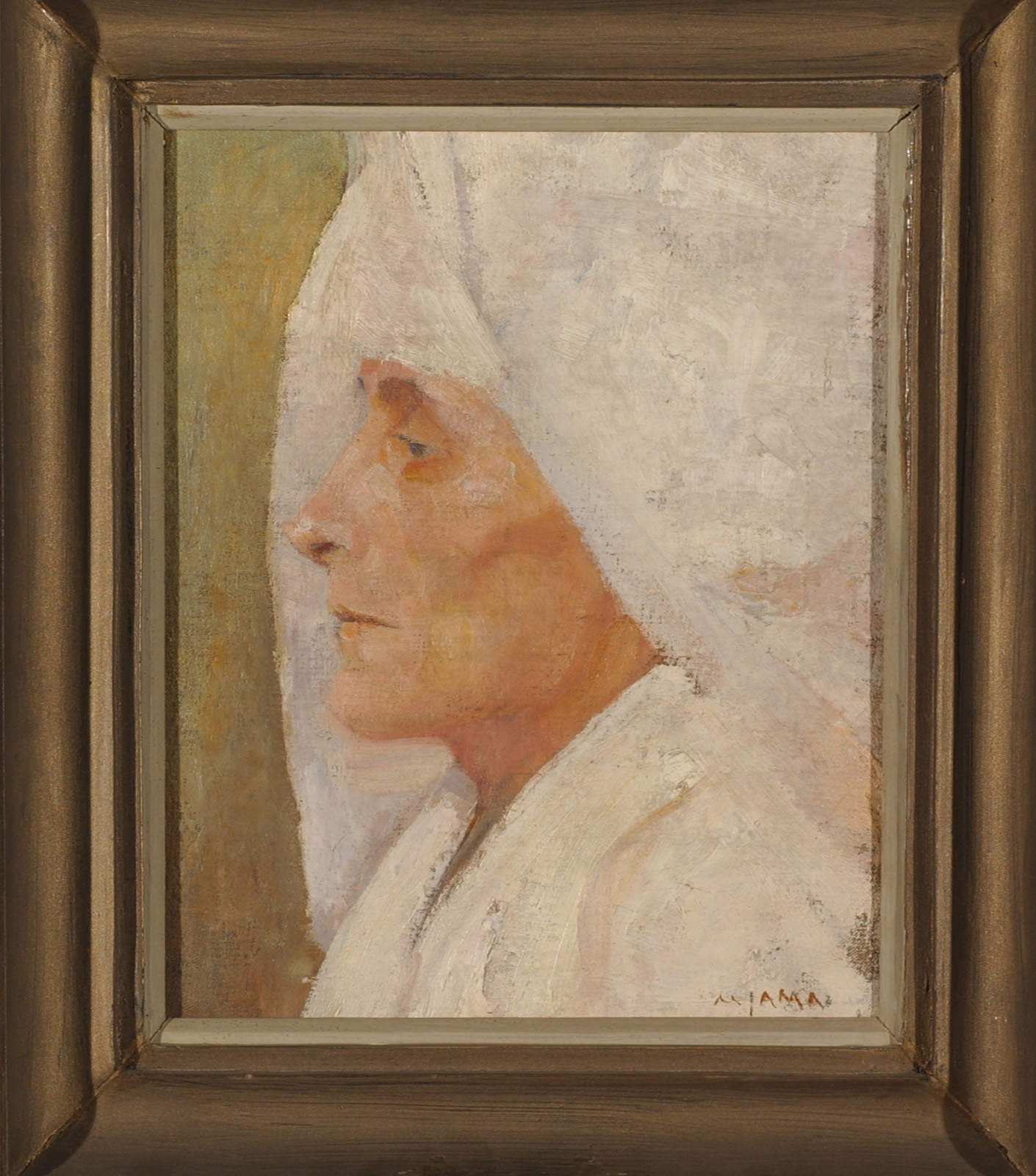
Sister of Charity
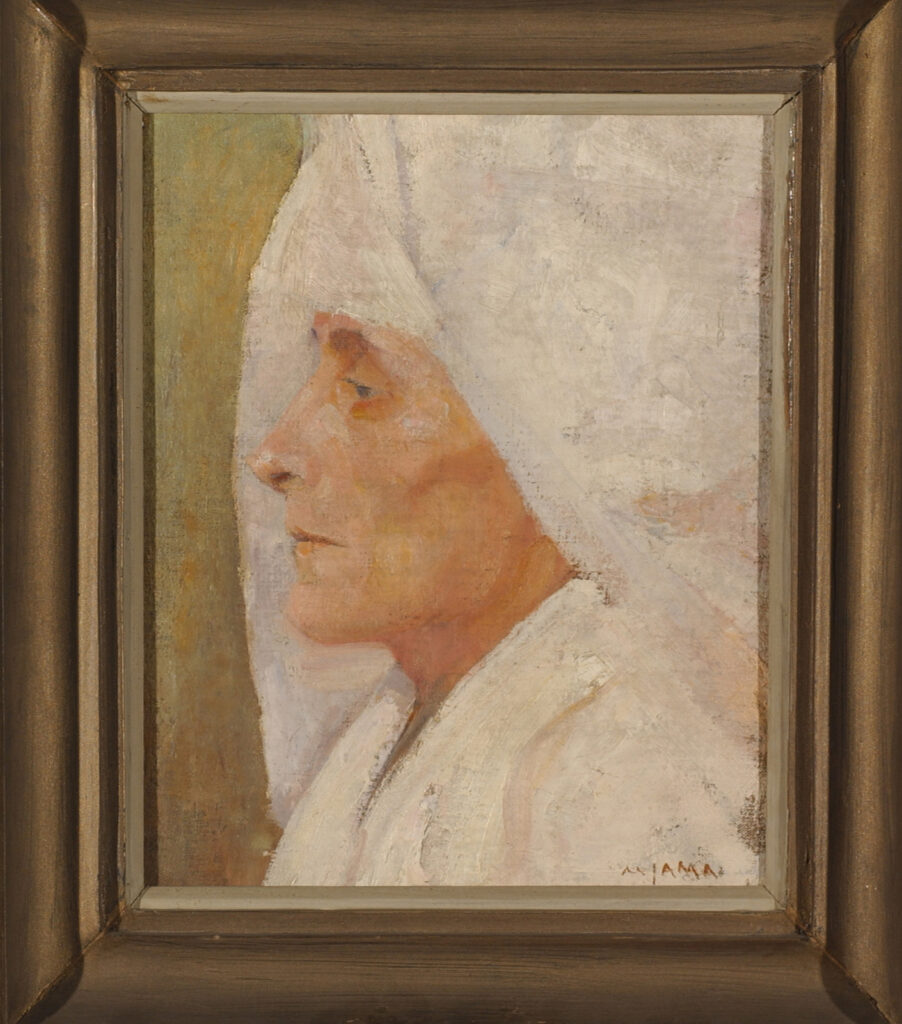
Though entitled The Merciful, this painting is not likely that of a nun. The Sisters of Mercy wore starched cornettes on their heads until 1964 and their habits were grey or black, while the headpiece of the woman in the painting here does not seem to be starched and her torso is clothed in white linen. Thus, we must understand this study of the subject’s head in the context of the Munich practice of painting white on white, a trend particularly popular in the 1890s. We date Jama’s early work to around 1900, the latter part of his time in Munich, where for a brief time he studied at the Academy under Johann Caspar Herterich before going on to work independently. The picture could be a programmatic example of transcending Ažbe’s pedagogical approach of the Kugelprinzip. Disagreements with Ažbe only intensified shortly after this painting was produced and Jama stopped attending his school. Against the flattened space, the face gives the impression of a relief by decoratively dividing the painting’s surface through the curved lines of the headpiece surrounding the subject’s face. The white of the dress, the skin color of the face, and with it the matching tones in the background create a colorful perspective within a planar composition and simulate daylight.