16. 11. 2021
Visiting information

The online exhibition From close up . . .is dedicated to works of art exhibited in the permanent collection of theNational Gallery of Slovenia.Have you ever wondered about the right way tolook at a work of art that is hanging in front of you? There’s actually no suchthing as a right way and a wrong way. Strategies for observing works of artvary from individual to individual. Interesting from this point of view is astudy using eye-tracking technology conducted by the National Gallery in Londonin conjunction with researchers from the University of Derby in the context ofan exhibition on the concept of time in art (Telling Time, 2000–2001).[1] The results of this study revealed that we do not actually look at paintings asa whole, but instead our gaze focuses on individual fragments, from which wethen assemble a total image.
Our attention can be drawn by the colours, moodand individual details of a work of art.
This online exhibition will focus on details –specific elements in the selected paintings – and take them as our startingpoint. These elements, which can include objects of various kinds, individualanimals, plants, inscriptions, symbols and also people, can play an importantrole in our understanding of the content and origin of a particular work ofart, or in art in general.Content or meaning in art is the subject of anarea of art history known as iconography. The word derives from Greek andliterally means “description of images”. It helps us understand the content andmessage of a work of art, which in some cases can be rapidly identified and inother cases is concealed. Let us look, then, at what is concealed in the worksof art that make up the permanent collection of the National Gallery inLjubljana.
[1] The
researchers obtained results from more than 5,000 visitors aged between 15 and
34. Participants were invited to observe one of three selected reproductions of
paintings in a special room for 20 seconds. During this time an eye-tracking
device recorded the participant’s eye movements and compared them against the
images shown. The results were published in an article by Wooding, Mugglestone,
Purdy and Gale (2002).
THE WORLD OF OBJECTS
Different objects play different roles in works
of art. For the most part, these are symbolic meanings, where a specific object
acts as a key to identifying content. Most frequently these are attributes –
objects associated with the life of the person depicted or which indicate their
character, position or activity. In the case of depictions of holy figures,
these will be objects relating to the life of the saint or their martyrdom
which serve to distinguish them from others. Other objects can have concealed
meanings.
The Key
The key
has a twofold function of unlocking and locking, of letting in and shutting
out, and it therefore plays a similar role in the symbolic world. In Japan,
keys are a symbol of prosperity because they unlock the rice store.
Possession
of a key confers authority and power, so we frequently encounter it as a symbol
of royal power or rule, and also of spiritual authority. In the Christian
world, keys are an important attribute of saints such as St Peter and St
Servatius, while St Martha and St Zita – the patron saints of housewives and
domestic servants – are depicted carrying bunches of keys. The golden and
silver keys handed to St Peter by Jesus symbolise the transfer of authority and
are still part of the papal insignia today.
But keys
do not only open the doors to houses and towns: they also symbolically open the
spiritual passage to another state of being. Janus keys, named after the Roman
god of gates, doorways and beginnings, opened the gates of the solstices, thus
granting admission to the waxing and waning phases of the cycle of the year.
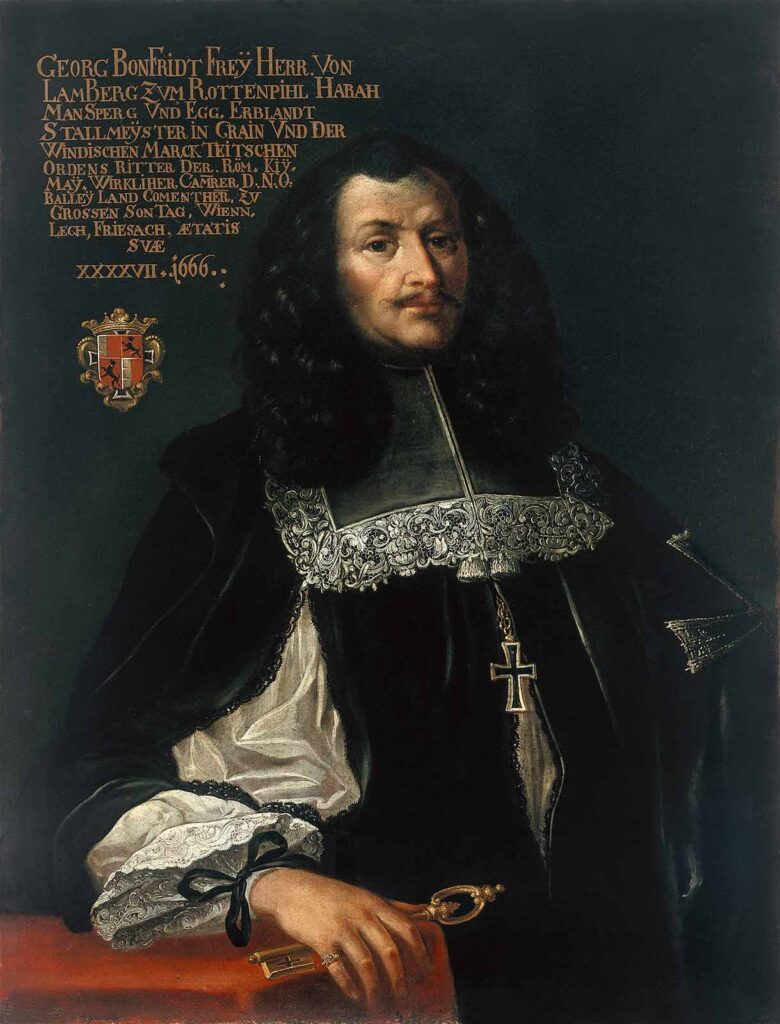
The key
that Baron Georg Bonfrid (Gottfried) von Lamberg holds in his hands indicates
the important function and honour entrusted to the subject of the portrait and
his family by the Emperor himself. It represents the hereditary office of
chamberlain – one of seventeen formal and honorary functions that indicated the
exalted rank of an individual and were performed on special occasions such as
the act of hereditary homage by the Estates following the accession of a new
Emperor. The symbol of the office of chamberlain was a golden key studded with
precious stones. Baron von Lamberg, however, did not receive this title until
1664, along with the title of commander of the Austrian province of the
Teutonic Order. At the time of the hereditary homage to Emperor Leopold I on 13
September 1660, Lamberg still held the title of standard-bearer, which meant
that he was allowed to wave a banner when the Emperor arrived at the church
entrance and the knights and other nobles passed into the church. Once inside,
he stood with his banner to the right of the Landesfürst (the
territorial prince). During the homage itself he stood on his left. He was also
entitled to sit at the ceremonial banquet held to mark the Emperor’s visit.
We can
also see a key in the portrait of Count Leopold von Lamberg, Georg’s kinsman
from the Weissenstein branch of the family, which was painted by Valentin
Metzinger and hangs in the Grand Hall of the National Gallery.
You can
view the key in the painting from close up in Room 6 of the National Gallery’s
permanent collection.
The pear
One of the earliest mentions of this fruit in
literature is in Book 7 of Homer’s Odyssey, in which the pear is
mentioned along with figs, apples and pomegranates as a gift of the gods that
grows in the garden of Alcinous, the king of the happy Phaeacians on the island
of Scheria (present-day Corfu).
The pear usually has a positive meaning because
of its sweet flavour. The Roman author Pliny the Elder mentions several
varieties of pear in his Natural History, including the Tiberianapear, named after the Emperor Tiberius, who loved to drink its sweet juice. In
antiquity the pear was linked to Aphrodite (Venus), the goddess of love,
because of its shape, which is reminiscent of the female body and the womb.
Statues of the goddess Hera (Juno) were apparently carved out of pear wood.
Pears appear in art less frequently than
apples. Depictions of pears appear in the mural paintings of Pompeii (AD 45–79)
and in Roman mosaics. Like the apple, the pear frequently appears in depictions
of the Virgin Mary and Child, in which it is a symbol of Christ’s incarnation
and his love for humanity. Among the most famous depictions of the Virgin Mary
and Child with a pear is the so-called Alzano Madonna by the Italian
Renaissance artist Giovanni Bellini (c. 1485, Accademia Carrara, Bergamo).
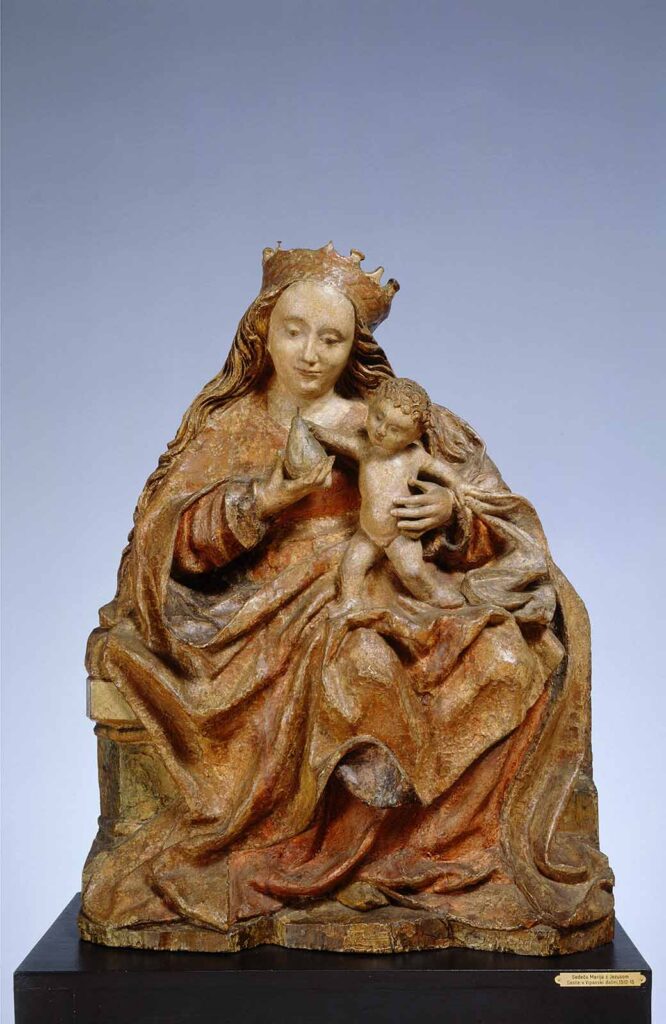
The seated Virgin Mary
with Child in the
National Gallery is the work of an unknown carver based on northern European
models such as the copper engravings of “Master E. S.”, which was found in a
house in Ljubljana’s Šempeter suburb. It shows the Virgin Mary wrapped in a
heavy cloak which entirely covers her throne and her body. Her right hand holds
a pear, which the Christ child is tenderly reaching for with his hand.
You can
see the Gothic statue in the Falcon Hall of the National Gallery.
The missing crown
The crown (like the wreath) has a symbolic
meaning of superiority – its place is at the apex (for example on the head) and
it therefore indicates something that is above everything else in terms of
value. Its circular shape is a sign of perfection. It symbolises dignity,
authority and access to higher levels and forces. Along with the orb and
sceptre, it is one of the principal insignia of royalty or sovereignty.
Crowns and wreaths were placed on the heads of
victorious military commanders, scholars, geniuses, poets and athletic victors.
In the Western world they were traditionally placed on the heads of sovereigns
by representatives of spiritual authority (popes, bishops), symbolically
showing that the ruler had also been chosen by God.
Within the Christian tradition, we encounter
the crown in depictions of the Virgin Mary, who is thus portrayed as the Queen
of Heaven. The Crown of Thorns is the symbol of Christ’s suffering and death on
the Cross. Crowns also frequently appear as the attribute of saints and martyrs
of noble birth, or as an indication of their victory over sin and death. Crowns
accompany saints such as St Aloysius de Gonzaga, St Louis of Toulouse, St
Catherine, St Barbara and St Elizabeth of Hungary.
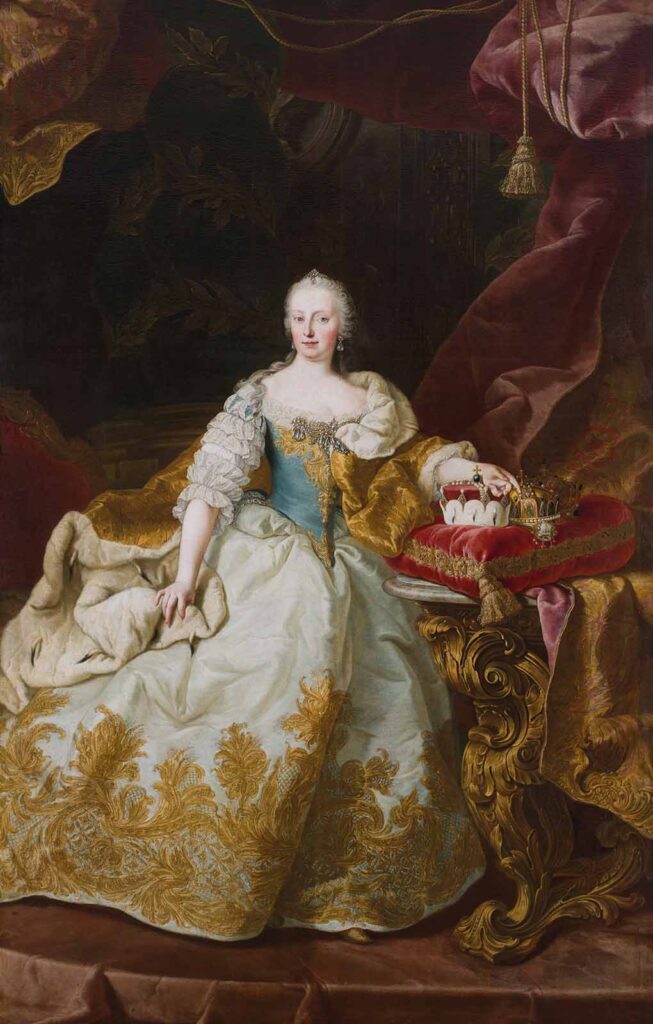
Sometimes the absence of an object can be just
as telling as its presence. Next to Maria Theresa on a velvet cushion trimmed
with gold we observe three crowns – her hand rests on the crown of the
Archduchy of Austria; behind it is the Crown of St Stephen, also known as the
Holy Crown of Hungary; and behind that the Crown of St Wenceslas, the state
crown of the rulers of Bohemia. All three crowns represented titles to which
Maria Theresa had acceded: she was Archduchess of Austria, Queen of Hungary and
Queen of Bohemia. Missing, however, is the Imperial Crown of the Holy Roman
Empire (now kept in the Imperial Treasury at the Hofburg in Vienna), a
masterpiece of gold, enamel-work, precious stones and pearls that was probably
made for the imperial coronation of Otto I and was used to crown the emperors
of the Holy Roman Empire from the tenth century until 1806.
Maria Theresa was, in fact, never crowned
Empress in her own right. Only men were entitled to the title of Emperor and
the crown. Since Maria Theresa’s father Charles VI had no living male
descendants, he issued the Pragmatic Sanction to ensure that his daughter could
inherit the Habsburg hereditary possessions, which would otherwise also have
passed to a male relative. The honour of the imperial crown went to Maria
Theresa’s husband Francis Stephen, Duke of Lorraine, who was elected Holy Roman
Emperor in 1745, whereupon his wife received the title of Empress. We find the
missing imperial crown in the portrait of Maria Theresa’s husband as Emperor
Francis I (Room 8 of the National Gallery).
The homes of the nobility could contain entire
galleries of ancestral portraits, by which the family demonstrated their origin
and dignity. Almost every noble home also had a portrait of the sovereign on
the wall. Yet few could afford a portrait by the highly respected Viennese
court painter Martin van Meytens. The latter’s portrait of Maria Theresa
adorned Leopoldsruhe, a mansion in Ljubljana built in the mid-eighteenth
century for Count Leopold von Lamberg that later became known as Cekinov
grad (“Sequin’s Castle”) through a corruption of the surname of later owner
Lőrincz Szőgyény. Count Leopold divided his time between Ljubljana and Vienna
and, as imperial chamberlain, was in good standing at the imperial court, which
also gave him access to distinguished artists such as Meytens.
You can
see the painting for yourself in the Grand Hall of the National Gallery.
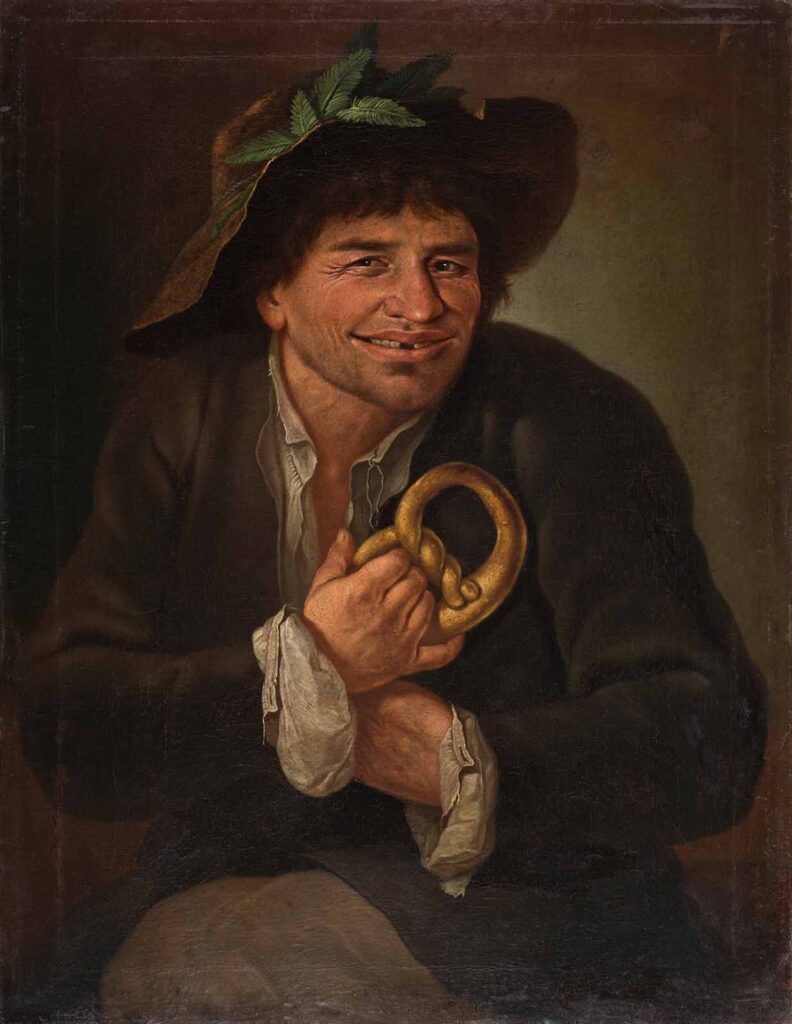
The pretzel
A pretzel is a type of baked pastry made from
leavened dough consisting of flour, water, salt and a raising agent. Its form
has changed over time. In the High Middle Ages a pretzel generally had the
shape of a small loaf with its ends turned up. Later it took on a more
stick-like form and was twisted into the shape of the letter B or the number
eight.
In Slovenia pretzels are believed to have
originated in the context of the Dominican convent in the
Velesovo–Adergas–Trata area. Pretzel making in Velesovo died out during the
First World War but continued in nearby Vodice, where pretzels are still baked
today according to the old Adergas recipe.
The word pretzel is believed to derive
ultimately from the Latin word bracchium (arm), which eventually entered
German as Brezel. Another possible origin is the Latin word pretiolameaning “little rewards”.
All forms of pretzel are believed to derive
from the Roman round loaf, which had a cult significance even in antiquity.
This survived into the Early Christian period, since the pretzel was used as
Communion bread.
The largest numbers of pretzels were baked at
Advent and during Lent, when the consumption of meat, dairy products and eggs
was forbidden. In the painting The Fight between Carnival and Lent by
Pieter Bruegel the Elder (Kunsthistorisches Museum, Vienna), a pretzel appears
as an attribute of the personification of Lent, a starving figure battling with
gluttonous Carnival.
Both the shape and the meaning of the pretzel
are complex. In Christian iconography the pretzel can have several meanings. In
the Middle Ages it symbolised hands crossed on the breast in prayer (usually to
the Holy Trinity), while in the same period it began to appear as the symbol of
the bakers’ guild.
In Dutch culture the pretzel frequently appears
as a symbol of fragility, drawing attention to the transience of life and the
way it is caught between good and evil. In some places the pretzel also appears
as a symbol of good luck. In the Rhineland, for example, pretzels are baked for
the New Year. On the other hand its shape, which is reminiscent of a heart,
alludes to love (often tangled).
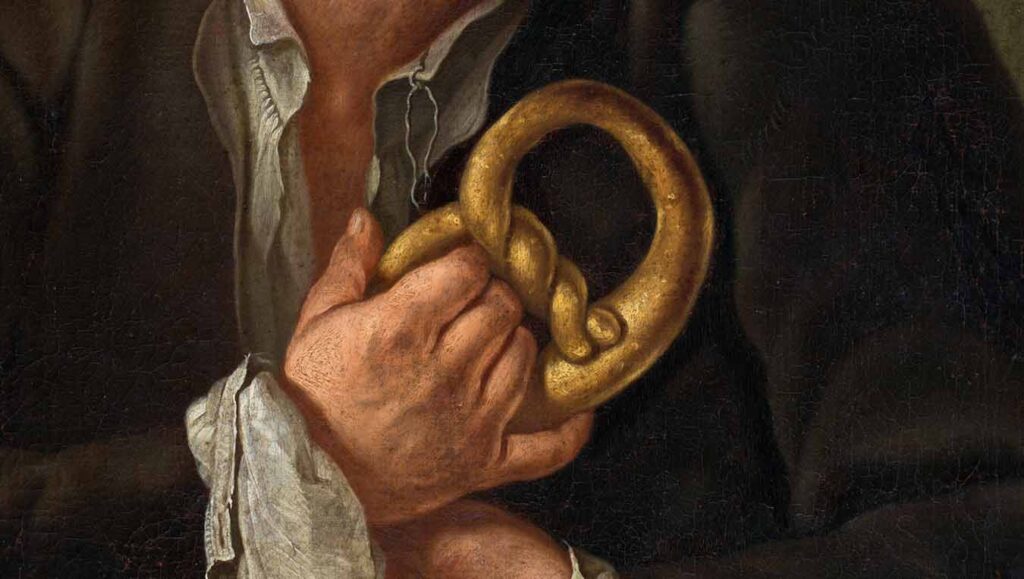
The pretzel in the painting by the baroque
painter Fortunat Bergant is similar to those made in the German market town of
Biberbach, in which the plaited ends of the dough imitate interwoven human
fingers. Man with a Pretzel is one of only two genre paintings in
Bergant’s oeuvre (the other being The Fowler) and it has many levels of
meaning. Because of the presence of the pretzel, the painting was interpreted
in the past as a personification of Taste. But with his gap-toothed and
provocative smile, the subject of Man with a Pretzel also gives the
impression that he himself is as “crooked as a pretzel”. His appearance has
been making viewers smile ever since the work was painted.
You can
see the pretzel and the smiling man in Room 8 of the National Gallery.
The book
We associate books with knowledge and wisdom.
Books enjoy particular honour as bearers of wisdom. Old and rare books are
kept, like works of art, in special book collections, museums, galleries,
archives and private libraries. With the invention of printing and the
development of literacy, their content became accessible to the masses,
although at one time only limited groups of people had access to books and
libraries.
Books appear frequently in art. We see them as
attributes in the hands of apostles and evangelists. They also accompany
numerous saints and serve to emphasise their erudition or their authorship of
specific important texts. Thus the four evangelists with their symbols – St
Luke (ox), St Matthew (angel), St John (eagle) and St Mark (winged lion) – are
portrayed in the act of writing words. St Jerome, one of the four Great Church
Fathers who is best known for the Vulgate, his Latin translation of the Bible,
is also most frequently depicted in the act of translating and writing words
into the sacred text he is engaged in producing.
A book with the Greek letters alpha and omega
represents Jesus, while reading is also an important theme in the scenes of the
life of the Virgin Mary. Mary’s mother Anna teaches her to read as a little
girl and Mary is frequently shown reading in depictions of the Annunciation.
Books can appear open or closed in artistic
depictions. An open book reveals its contents to the reader, while the content
of a closed book is untouchable, inaccessible to the reader, mysterious, and
can represent something negative. A closed book secured by seven seals, on
which the Lamb of God is seated, is a symbol of the Apocalypse. According to
legend, an open book beneath the paw of the winged lion of St Mark symbolised
the Venetian Republic in peacetime, while a closed book represented it in time
of war.
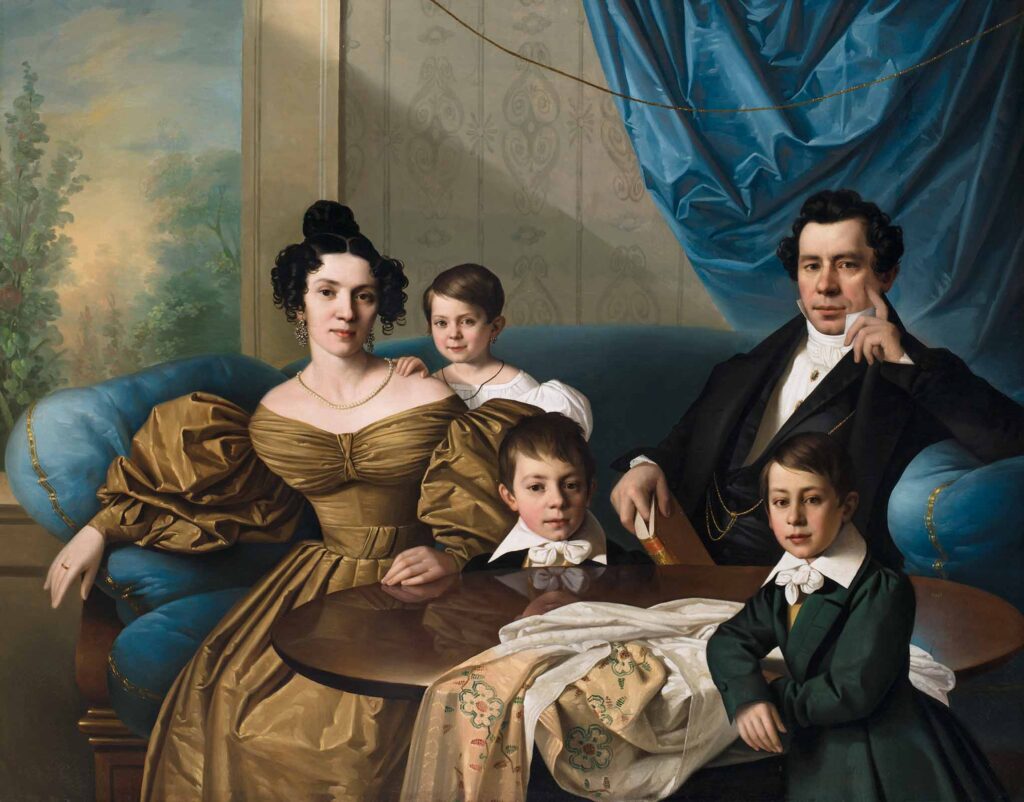
Books and bookshelves are an important part of
portraits of the nobility and the middle classes, where they act as a status
symbol emphasising the subject’s education and also wealth, since books were
not cheap. In the family portrait painted by the Biedermeier artist and
excellent portrait painter Jožef Tominc we observe a book bearing the
inscription Hippocr[ates]. This is a nod to the profession of the head
of the family, Dr Dimitrije Frušić (1790–1838) and emphasises the importance of
education, which alongside family, privacy and nature was cultivated as a value
during the period of the rise of the bourgeoisie between 1820 and 1870. The
Serbian doctor, linguist and journalist moved with his family to Trieste in
1819, becoming a member of the city’s cultural elite and actively collaborating
on the construction of the Ospedale Maggiore, then Trieste’s main
hospital.
You can
view Dr Frušić and his family – his wife Jovanka, his sons Čedomil and Dušan
and his daughter Milica – in Room 13 of the National Gallery.
ANIMALS
Animals have played a key role in the life of
human beings since prehistoric times. At various times they have represented
deadly danger, been a source of food or played a role in spiritual or religious
ceremonies. With domestication they have lightened Man’s everyday burden –
helping with work, tilling the earth and gathering crops, providing transport
and the raw materials for clothes, offering protection against wild animals and
predators and, eventually, taking on the role of pets. Modern research shows
that animals have an extremely positive influence on a person’s life and mental
health and they are therefore increasingly used in therapy – to improve fine
motor skills and balance, to reduce feelings of fear and loneliness, to improve
self-image, to develop relaxation techniques, and so on.
We encounter depictions of animals in the
earliest cave paintings and they also appear as the companions of saints,
various divinities and the subjects of noble portraits. The nobility
particularly prized hunting scenes and still lifes, which they used to adorn
the rooms of their homes.
Animal symbolism, linked to the appearance and
nature of individual animals, derives from the texts of the writers of
antiquity, such as the works of natural history by Pliny the Elder and
Aristotle, the Physiologus, Ovid’s poems, Aesop’s fables and moral
descriptions in medieval bestiaries and the lives of the saints.
The hind
In Roman mythology the female red deer or hind
was consecrated to Juno – the goddess of love and marriage. Female deer are
associated with motherhood, gentleness and modest beauty, so it is no surprise
that princesses in fairy tales are often transformed into does. A doe with
golden horns – or a stag – frequently also appears accompanying Artemis, the
Greek goddess of hunting.
On the basis of the writings of the ancient
authors Pliny the Elder and Aristotle, people in the Middle Ages believed that
the animal could be lured with music and, while thus enchanted, also captured.
The hind and the stag appear in medieval texts
as enemies of the snake. The smoke from burning stag antlers drives off snakes.
The hind was said to lure snakes from their nests with the hot breath of her
nostrils or with saliva, and then to trample them with her hooves. This belief
was quickly adopted by Christian symbolism as the victory of good over evil,
where Christ tramples the devil.
Since the hind has extremely acute hearing, it
is often depicted as an allegory of the sense of hearing. It also represents
vitality and longevity, since it was believed that a sick hind was capable of
finding a cure for itself, while the left antler of a hart or stag was believed
to contain the healing power capable of curing many ills.
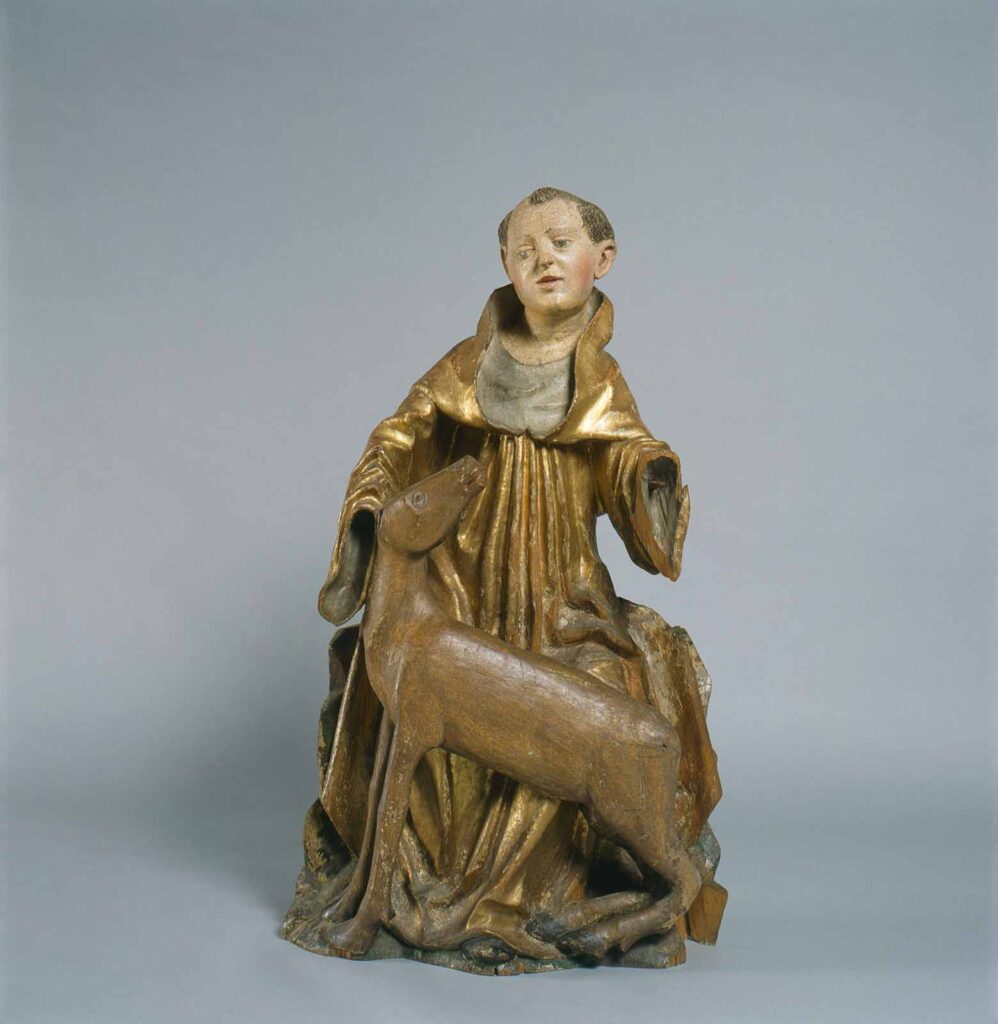
The hind is an attribute of St Giles, who lived
the remote life of a hermit and lived only on roots and plants, in this way
strengthening his faith. One harsh winter, when plants were scarce, God is said
to have sent him a hind so that he could nourish himself with her milk.
The statue of St Giles with the hind was made
in around 1505 by a Late Gothic carver whose real name is unknown and who is
known as the Master of the Trboje Madonna after the fine statue of the Virgin
Mary and Child in Trboje near Kranj. St Giles came to the National Gallery from
the parish church in Bled.
You can
see the hind with St Giles in the Falcon Hall of the National Gallery.
The Fish
The fish is the symbol of water, the element in
which it lives. It is also a symbol of life and fertility, since it reproduces
rapidly and the female deposits large numbers of eggs or roe at spawning time.
In China it is, like the dragon, a symbol of
good luck.
In Christian symbolism the fish stands for
Christ, because of the Greek phrase Iesous Christos, Theou
[h]Uios, Soter (Jesus Christ, Son of God, Saviour), the first
letters of which spell ICHTHUS, the Greek word for fish. Jesus himself
is also frequently portrayed as a fisherman, with the faithful as fish.
The fish appears as an attribute in depictions
of Tobias with the Archangel Raphael, since according to legend the latter used
the gall of a fish to cure Tobias’s father’s blindness.
St Zeno, a fisherman from Verona, is depicted
with a fish hanging from his bishop’s crozier. A fish with a bunch of keys in
its mouth accompanies St Benno of Meissen, the patron saint of Munich.
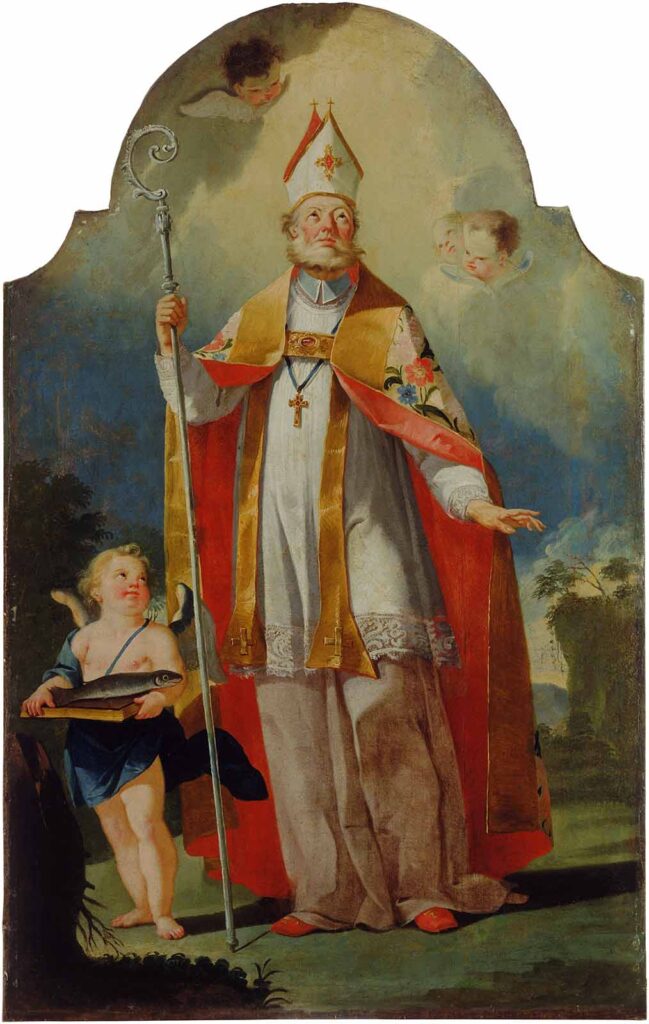
The fish shown lying on a book held by a putto
standing next to St Ulrich in the painting by the baroque artist Anton Cebej
could also be linked to Christ and the word of God, although in actual fact is
a reference to a legend from the life of the saint which relates how one
Thursday evening Ulrich was dining with his friend Bishop Conrad of Constance.
After dinner the two men talked long into the night. So engrossed were they in
conversation that did not notice that the day was breaking. When a messenger
arrived with a letter for Ulrich from the Prince of Augsburg, the saint, not
realising that it was already Friday, offered him the remains of the meat left
on the table. Friday is, of course, a day of fasting, when eating meat was not
permitted. The messenger wanted to denounce Ulrich to the Prince and accuse him
of failing to observe the commandment, but when he tried to show the Prince the
meat on the table he saw to his surprise that it had turned into a fish.
You can
see St Ulrich and the fish in Room 7 of the National Gallery.
The eagle
If the lion is the king of beasts,
then the eagle is the king of all birds. People once believed that it flew
higher than all other birds – that it could rise so high as to breathe the air
of the gods of Olympus – so it is no coincidence that it became the symbol of
the Greek supreme god Zeus. The ancient Greeks tried to read the message of the
gods in the flight of eagles and in this way predict future events.
From Roman times onwards, the eagle has
frequently appeared as the symbol or emblem of states and nations. It was also
adopted by the Byzantine and then German emperors. A two-headed eagle with an
orb and sceptre in its talons became the symbol of the Holy Roman Empire and,
later, of the Austrian Monarchy. The bald eagle is the national symbol of the United
States of America.
The eagle has played an important role in the
cult surrounding rulers and emperors since antiquity. When the body of a dead
emperor was burnt on a funeral pyre, priests released an eagle to carry his
soul into the world beyond.
The eagle is also seen as a symbol of a just,
magnanimous and benevolent ruler, since it looks after the well-being of weaker
creatures – when it has eaten its fill it leaves them part of its prey, while
numerous smaller birds live around its nest and feed on the remains. In the
same way, vassals and subjects live on the benevolence of their master.
Christian symbolism linked the eagle to the
Resurrection and the spiritual rebirth of baptism – it was said that when an
eagle began to feel its strength waning with age, it flew towards the sun to
burn off its old feathers, and then plunged three times into a clear pool, from
which it at last emerged completely reborn.
Other texts talk about how eagles hunt and kill
snakes – which is interpreted as vanquishing evil. An eagle appears as an
attribute of St John the Evangelist – the words of his Gospel rise high into
the sky like an eagle.
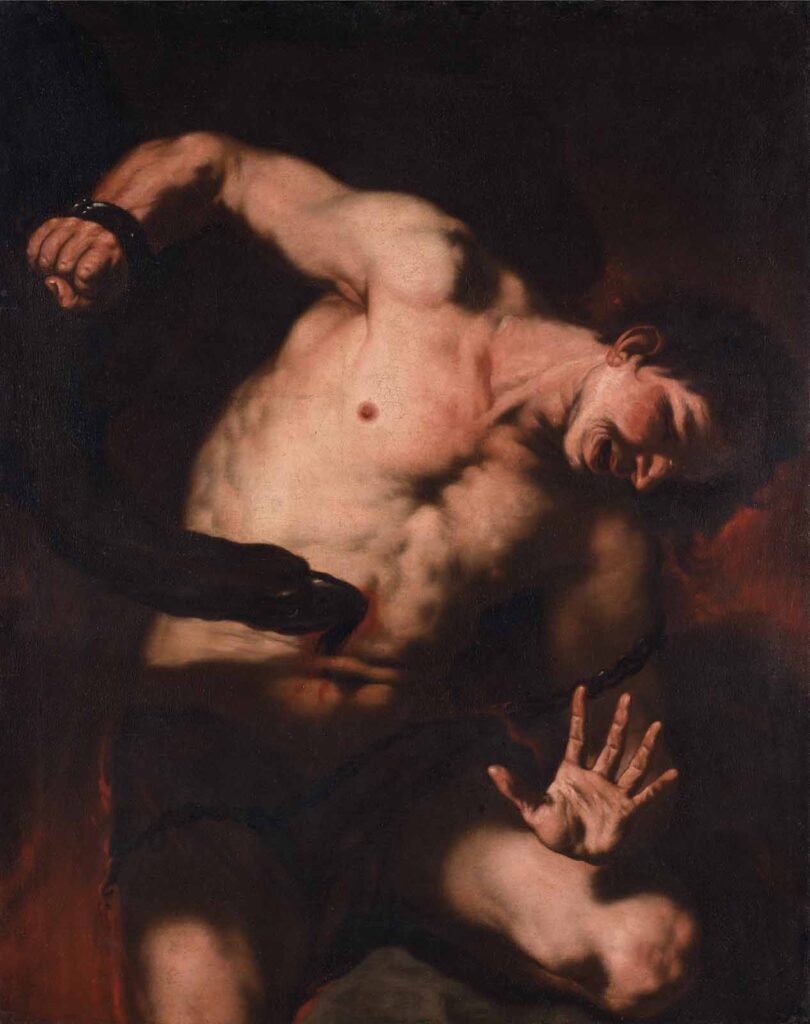
The Neapolitan painter Luca Giordano, who was
nicknamed Luca fa presto (“Luca paints quickly”) because of the speed
with which he worked, included an eagle in his painting Prometheus Bound,
a depiction of the popular Greek myth in which Prometheus is punished for
defying Zeus. The supreme god had hidden fire from mortals, since he wished to
exterminate them and make room for a new race. Prometheus took pity on them and
so broke off a sunbeam and gave it to humanity. As a punishment for this
disobedience, Zeus had him chained to a rock in the Caucasus, where an eagle
came at the same time every day and pecked out his liver. Prometheus thus
frequently appears as an allegory of Christ’s suffering on the Cross.
You can
see Prometheus Bound and the eagle in Room 5 of the National Gallery.
The snake
The symbolism of the snake is extremely rich
and varied in different cultures around the world, sometimes with diametrically
opposed meanings. The snake plays an important role in the cosmos and in the
creation of the world and various natural phenomena. Its symbolism is
frequently inseparably tied up with that of the dragon, since the latter was
considered to be a giant serpent.
The Huichol, an indigenous people of Mexico
believed that a two-headed snake encircled the world, spitting the rising sun
from its jaws in the east and swallowing the setting sun in its jaws in the
west. In Mexican and other Mesoamerican religions, the image of a feathered
serpent was adopted by the supreme deity, whom the Aztecs called Quetzalcoatl
and the Maya called Kukulkan.
The Ouroboros – a serpent biting its own tail –
is a symbol of time or eternity and appears on tombstones.
In Greek mythology the snake is linked to
prudence, since it appears as a sacred animal of Athena, the Greek goddess of
wisdom. It is also connected to the god Apollo and his son Asclepius, the god
of healing. The rod of Asclepius, a snake-entwined staff, is still a symbol of
medicine and pharmacy today. Even in antiquity, snake venom was used to make
medicines and antidotes, while by shedding its skin the snake “rejuvenates” and
in this way prolongs its life.
The shedding of skin also found a place in the
Christian world as a symbol of being reborn into eternal life. It is mentioned
in Matthew’s Gospel: when the snake’s old skin becomes too tight, it fasts for
forty days, slithers through a crack between two rocks and then sloughs off its
old skin in one piece.
On the other hand, the role of the snake is
usually negative. Numerous Greek heroes fight against snakes. Heracles defeated
the snake that Hera sent against him while still in his cradle. Later he killed
the Lernaean Hydra. Perseus cut off the head of snake-haired Medusa with a
single blow of his sword. Serpents also killed the Trojan priest Laocoön and
his sons after he tried to warn the Trojans about the suspicious gift in the
form of a wooden horse.
The snake thus appears in the role of a
creature that brings evil into the world and must therefore be fought against
in any way possible. The Egyptian god of chaos and lord of hell Apep (Apophis),
who lived deep in the underworld and was the enemy of Ra, the sun god,
frequently appeared in the form of a snake, and sometimes as a crocodile. In
Christian belief, the snake is deeply rooted as a symbol of the devil, evil,
sin and temptation. A serpent was to blame for humanity’s original sin, because
it tempted Eve. Mary, who represents a new Eve, is thus depicted in the role of
the Immaculate with her foot placed on the head of a snake – she does not heed
the tempter (as Eve did before her), but instead vanquishes it.
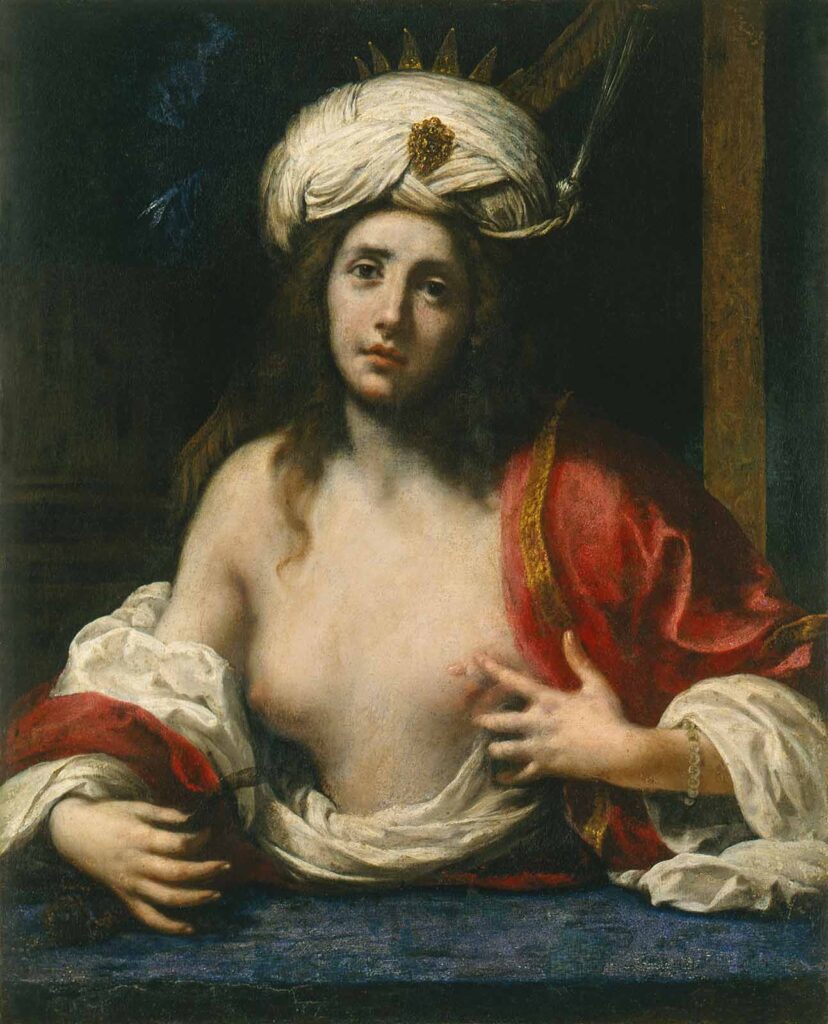
A snake (an asp or Egyptian cobra) plays a key
role in the death of Cleopatra, the last queen of Egypt. This event, which is
described by the ancient Roman writers Plutarch, Strabo and Cassius Dio, has
become an extremely popular subject in art, particularly in painting. When
Cleopatra learned that her lover Mark Antony had been defeated and had committed
suicide, she sealed herself in a stone tomb, resolved to take her own life. In
some versions of the story, she died in the way that the pharaohs are believed
to have died: carried into immortality by the bite of a sacred asp. Cleopatra is said to have taken a snake
that was hidden in a basket of figs and clutched it to her breast. In other
versions of the story, she died as a result of a mixture of poisons or a
poisoned ointment which she applied to her skin. She died on 12 August of the year 30 BC at the age of
32, and the Ptolemaic dynasty died with her.
You can see the
bare-breasted Cleopatra with the poisonous snake in the painting by the
Florentine artist Felice Ficherelli in Room 5 of the National Gallery.
The dragon
The dragon
is a mythological creature that appears in practically all world cultures. It
is a guardian of valuables and hidden treasures and must be defeated if we want
to get to them. The symbolism of the dragon, also known as the great (or
greatest) serpent, is interwoven with that of the snake, since no distinction
was made between the two creatures in the past.
In Eastern
cultures the dragon is a symbol of prosperity, fortune, strength and wisdom and
linked to the emperor as a celestial, creative and regulating power. It also
has quite a positive role in heraldry. As a guardian and a fear-inducing
opponent, it appears on the coats of arms of countries, towns and noble
families. The dragon on Ljubljana’s coat of arms is connected to the
mythological story of Jason, who stole the golden fleece and fled aboard the Argo,
pursued by King Aeëtes, across the Black Sea, up the Danube and the Sava and
all the way to the Ljubljanica, the river that flows through Ljubljana. There,
the Argonauts dismantled their ship with the intention of transporting it
overland to the Adriatic, but by a lake at the source of the Ljubljanica they
encountered a terrible monster – a dragon – which, of course, they successfully
vanquished.
Apart from
on coats of arms and in other heraldic contexts, the dragon has a strongly
negative connotation in the Western Christian world. Medieval bestiaries say
that the home of dragons was torrid Ethiopia, where they had their lair at the
centre of the Earth. The biggest danger from a dragon, apart from its sharp
teeth and its fire-breathing snout, was its tail, in which its unimaginable
power was concealed. It could use it to easily defeat even the biggest animals,
such as an elephant, by wrapping its tail round it and choking it to death.
Although when the elephant died, it fell on the dragon and buried it beneath
its weight. So the dragon actually digs its own grave.
Dragons
also appear as the attribute of certain saints – accompanying St Margaret and
St Martha – although in the Christian world it is the Archangel Michael and St
George who are the main victors when it comes to fighting dragons.
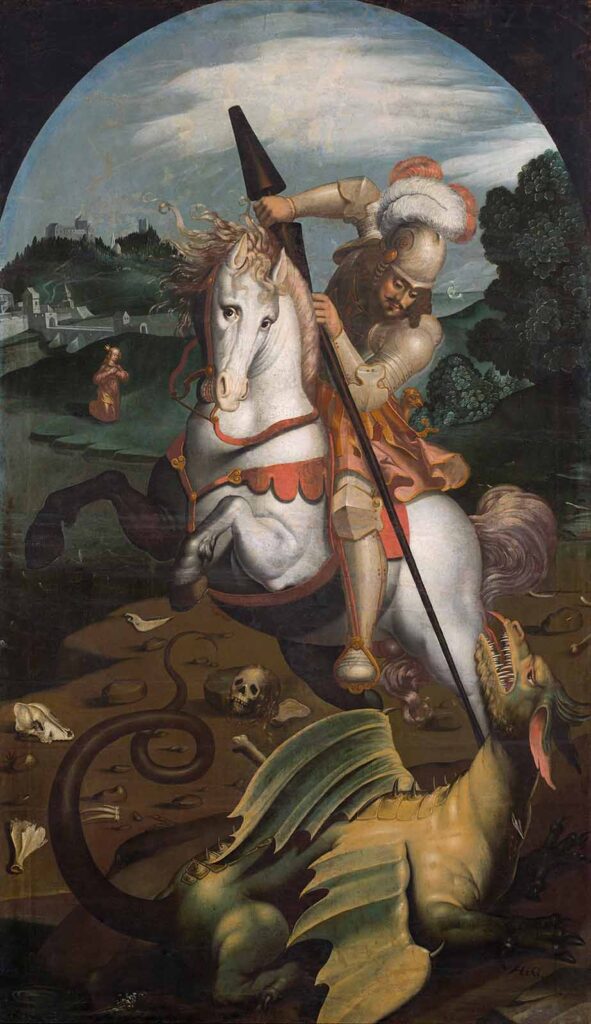
The dragon is considered a demonic being and,
like the snake, is an allegory for the devil, for Satan, or for evil and
heresy. It is in this role that we can understand the dragon in the painting by
Hans Georg Geiger von Geigerfeld. St George’s furious battle with the monster
actually takes place in a specific environment. In the background we can make
out Ribnica Castle and, on the hill above it, Ortnek Castle and the castle
church dedicated to St George, for which the painting was made. At the time the
work was painted, this area was a hotbed of barbarism and heresy, at least
judging from the number of visitations by bishops. The painting thus represents
a symbol of the Counter-Reformation battle against heresy.
You can
see the dramatic battle between good and evil in the Grand Hall of the National
Gallery.
INSCRIPTIONS AND OTHER SYMBOLS
Alongside
the main elements of paintings – the subjects of portraits, people, animals,
animate and inanimate nature – we often find inscriptions, dates,
abbreviations, symbols, numbers, stamps and other signs or symbols that can
likewise help us uncover the meaning of a specific work of art, and also its
history. Sometimes important information can also be found on the backs of
paintings.
These
elements can reveal the authorship of an individual work of art and tell us
about its creation, who commissioned it, who owned it, and its presence in a
given collection, at auctions or in exhibitions – all of which combines to
define the provenance of the work in question.
Inscriptions
can serve to identify the people depicted in the painting, allegorical figures,
personifications, objects or even events, for the purpose of making
interpretation of the painting easier. In medieval works, inscriptions are
frequently linked to quotations from the Bible, where the principal purpose was
to encourage piety. A moral or didactic inscription or text in combination with
a picture is an important element of emblems and devices, which were
particularly popular in the Renaissance and baroque periods.
Some
inscriptions or markings can be quickly identified, while others require a little
more effort. An example of the latter are dates written in the form of
so-called chronograms – most commonly Latin inscriptions in which specific
letters are emphasised and which, when read correctly, tell us the date the
work was created.
Inscriptions
can also be hidden over time beneath layers of overpainting. We can reveal them
again with the help of various imaging techniques such as radiography,
multispectral analysis and conservation-restoration procedures.
The framed tablet
Inscriptions in works of art are found in
various forms. Sometimes they appear as texts in painted scrolls and books or
emerge from the mouths of the figures depicted in a given scene like speech
bubbles in a cartoon. In the case of portraits, particularly those of members
of the nobility, we frequently encounter brief texts on an undefined,
monochrome background that provide information about the identity of the
subject, their titles and functions, their age, and so on.
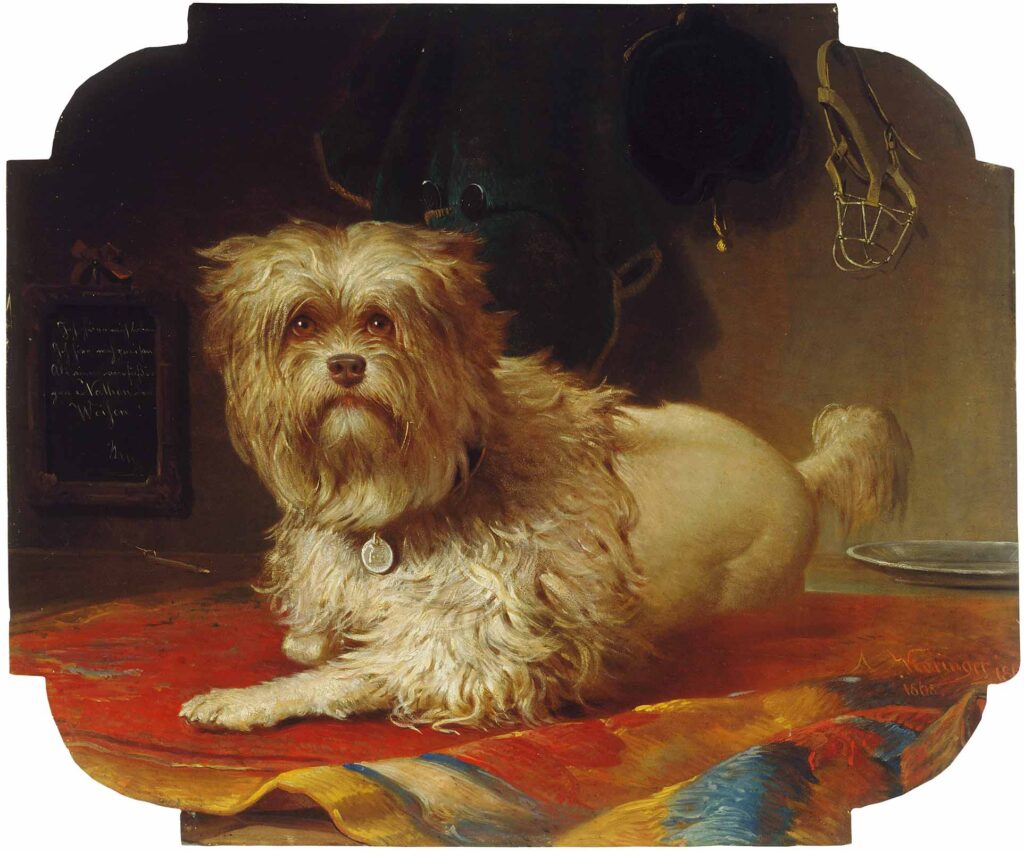
In the background of the image of a dog painted
on a colourful rug by Anton Karinger we see – as well as a muzzle, a coat, a
hat, a flask and a bowl – a slate tablet hanging from a nail on the wall, with
the following inscription:
Ich höre mich loben
Ich höre mich greifen
als einen vierfüßiger
Nathan den Weisen.
(Slišim, da me hvalijo,
slišim, da me dražijo,
kot četveronožca
Natana Modrega.)
This brief German text written in chalk is a
humorous reference to the dramatic poem Nathan the Wise (Nathan der
Weise) by the German Enlightenment writer and dramatist Gotthold Ephraim
Lessing (1729–1781). Nathan is the principal character in this dramatic work,
set during the Third Crusade. Through wisdom and tolerance, the wise Jewish
merchant Nathan, the enlightened sultan Saladin and the young Templar (a
Christian) overcome the differences and disagreements implicit in the differing
views of the world represented by their individual faiths.
The long-haired Affenpinscher in the painting
is thought to have belonged to Karinger’s wife Roza and, judging from the
inscription, played an important role in their life and marriage, which was
without children. Like Nathan the Wise, this four-legged friend helped smooth
over any disagreements that appeared between the spouses.
You can
view the work in Room 13 of the National Gallery.
The signature
The artist’s signature is a conscious act that
establishes the presence of the author of a work of art. The location of the
signature is also important. As well as providing information to the viewer
about the work’s authorship, the signature can reveal the artist’s attitude
towards the work of art itself.
An artist can express his or her presence by
means of a forename and surname, a forename or surname alone, initials, a
monogram or a symbol. In some cases artists include a self-portrait, skilfully
incorporating it into the scene.
Yet even in the case of signatures, a degree of
caution is necessary, since these can be added later and do not necessarily
guarantee the authorship of the work. Occasionally the later addition of
signatures is born out of the conviction that a given work truly is the
creation of a specific artist, although subsequent signatures are often found
on works of art as the result of less noble intentions – they are there to
mislead or to increase the value of a work in the art market.
Artists’ signatures first appear in antiquity
but are relatively rare in the Early and High Middle Ages. The concept of
authorship began to regain importance in the fifteenth century and blossomed
during the early Renaissance, when the collective consciousness of the guild
system began to give way to the cult of the individual and individual
creativity. If cave dwellers modestly “signed” their cave paintings with a
handprint, Greek sculptors such as Aristocles, Praxiteles and Polykleitos
proudly carved their names into the bases of their statues. Notable among the
rare medieval signatures is that of Giselbertus, a French sculptor who carved
his name beneath the image of Christ at the Last Judgement on the tympanum of the
Romanesque cathedral in Autun. Just over 300 years later, the Netherlandish
painter Jan van Eyck expressed his authorship and presence in the Arnolfini
Portrait with the words “Jan van Eyck was here” (Johannes de eyck fuit
hic).
The signatures of the baroque painter Fortunat
Bergant are also notable. He added them in significant places – for example on
the folded-over edges of papers held by the subjects of his portraits, on the
edge of the Virgin Mary’s mantle, on St Paul’s sword, in an open book beneath the
image of Our Lady of the Immaculate Conception contemplated by St Aloysius, and
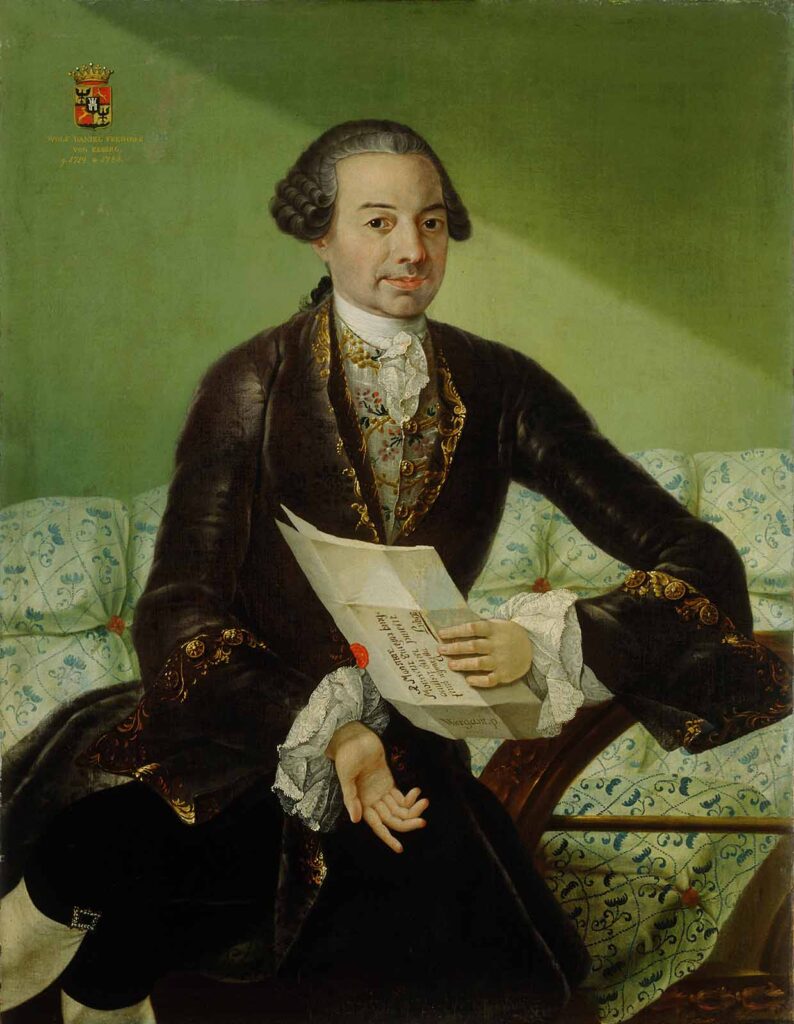
even on the sarcophagus in which the body of the dead Christ is laid. In his
portrait of his most important patron, Baron Wolfgang Daniel von Erberg, he
signed his name on the folded corner of the important letter his patron is
holding in his hand. By adding his signature to his paintings, Bergant
symbolically placed himself among the subjects of his portraits.
You can
see Bergant’s signature on Baron von Erberg’s letter in Room 8 of the National
Gallery.
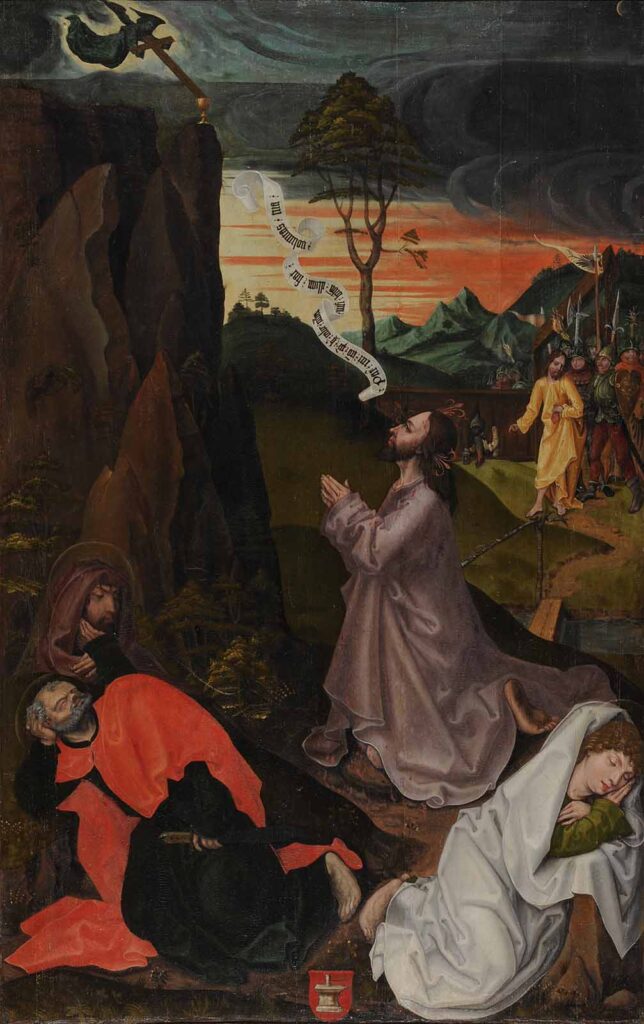
The scroll and the coat of arms with an anvil
As we have already said, inscriptions and texts
of various kinds can appear floating freely in space, carved onto painted stone
and wooden elements, on the edges of garments and even on the pages of books or
on scrolls and ribbons bearing inscriptions.
The Late Gothic panel painting from the chapel
of ease dedicated to St Nicholas in Koritno above Čadram in eastern Slovenia
contains several elements that help us comprehend the content of the work and
also the circumstances of its creation and ownership.
The picture shows Jesus praying at the foot of
the Mount of Olives, a scene mentioned in the Gospels of Mark, Matthew and
Luke. Only Luke’s Gospel mentions the presence of the angel seen in the top
left-hand corner of the painting. Jesus made his way to the Mount of Olives
after the Last Supper and, in the Garden of Gethsemane, prayed in agony and
sweated tears of blood, since he was already aware of the cruel destiny that
awaited him. This awareness and consequent resignation are additionally
emphasised by the approaching Judas and the legion of Roman soldiers in the
background, on their way to arrest Jesus, and by the scroll bearing an
inscription that rises diagonally from Jesus’ mouth towards the image of a
chalice and the angel atop the cliff. The inscription reads:
Pater mi, si non potest hic calix transire nisi
bibam illum, fiat voluntas tua.
(Father, if this cup cannot pass away except by
my drinking it, thy will be done!)
This fine Late Gothic work was previously
attributed to the Nuremberg painter Michael Wolgemut (1434–1519) and his
workshop, in which Albrecht Dürer (1471–1528) also studied, but some deviations
from the characteristics of Nuremberg painting would seem to indicate that the
work may have been painted elsewhere, possibly in the Alpine region.
In the middle of the bottom edge of the
painting we observe a coat of arms on which the tools of a blacksmith – an
anvil and hammer – are depicted on a red shield. This is the coat of arms of
Valentin Fabri, parish priest of Slovenske Konjice and archdeacon of the Savinja
archdeaconry, under whose auspices the churches of Slovenske Konjice, Eberndorf
(in Austria) and Vuzenica were renovated in the last decade of the fifteenth
century and the first decade of the sixteenth. An example of a “speaking coat
of arms”, the emblem is directly linked to the surname of the person who
commissioned the painting, or its intermediate owner, since the Latin word fabermeans blacksmith, and this was also the profession of Valentin Fabri’s father.
You can
view the painting from close up in Room 1 of the National Gallery.
The coat of arms on the jug
Along with a noble title (knight,
baron/baroness, count/countess, prince/princess, duke/duchess), the coat of
arms was one of the most important and notable attributes of the noble
individual or family. The right to use it and the rules that accompanied its
conferral were regulated by a special heraldic commission at the imperial
court. In the application for a particular title of nobility, the applicant was
required to list their merits, which were then entered in the patent of
nobility. At the same time the applicant had to submit a draft of their chosen
coat of arms, which would then be verified and approved by a censor. As a rule,
the coat of arms consisted of a shield and a decorative device. The symbols on
the shield frequently alluded to the surname of the applicants and their
relatives or indicated aspects of their personality, career, priorities and
values.
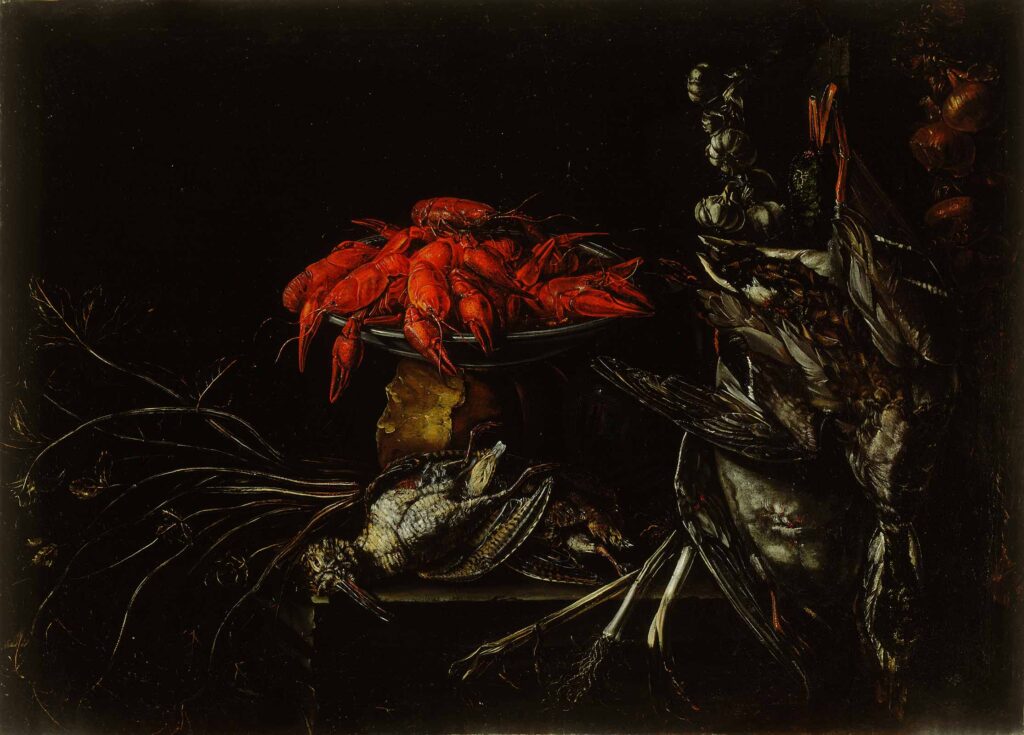
A barely visible coat of arms appears on a jug
in this still life by the Flemish painter Peter van Kessel. The arms are those
of the Zrinskis, an influential Croatian noble family who met with an
inglorious end owing to their part in an anti-Habsburg conspiracy, and consist
of the old arms of the Šubic family and the arms of the noble house of Ernuszt,
who descended from a Jewish family originating in Sweden and who possessed the
Međimurje region before it passed to the Zrinski family. The Zrinski coat of
arms is thus an impaled escutcheon (a shield divided vertically into two equal
halves). The sinister (or heraldic left) side (the right-hand side for the
viewer) shows a white tower on a red field. The tower has three merlons and
rectangular or round-arched windows. Two gold stars are seen above the tower,
one to the left and one to the right. The tower stands above a battlement that
likewise has three merlons. The dexter (or heraldic right) side shows two black
eagle wings, spread open on a gold field.
The coat of arms is a subtle clue to the
identity of the individual who commissioned the painting: either Nikola VII
Zrinski or his brother Petar IV Zrinski. Both played a major role in the
Zrinski-Frankopan Conspiracy against Emperor Leopold I and both met with a sad
fate. Nikola lost his life in an accident during a wild boar hunt in 1664,
although rumours quickly spread that the imperial court was involved in his
death. His brother Petar was found guilty of treason for his part in the
conspiracy against the Emperor and was put to death by beheading in Wiener
Neustadt in 1671.
You can
view the painting from close up in Room 3 of the National Gallery.
Monograms, coat of arms and an inscription
A monogram is a symbol consisting of the
initials of a person’s forename and surname, frequently interwoven, which
appear in works of art as an abbreviation of the artist’s signature. The
monogram that is perhaps best known to the general public is the “AD” monogram
of the German Renaissance artist Albrecht Dürer (1471–1528). He used this
monogram to sign his paintings and woodcuts and even had it legally protected
by imperial privilege to prevent its use by other artists wishing to take
advantage of his name.
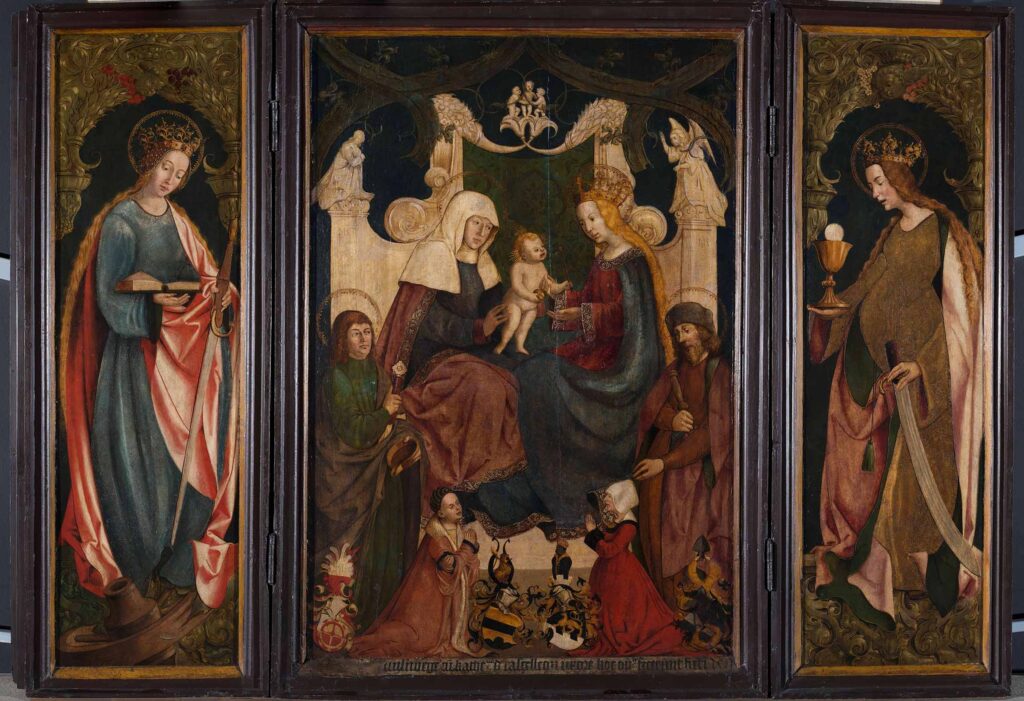
A monogram was also used as a signature by the
Tyrolean painter Marx Reichlich, whose workshop was responsible for the
so-called Knillenberg altarpiece. This “winged” altarpiece is a triptych. When
closed, the side panels (alternatively referred to as “shutters” or “wings”)
show paintings of St Sebastian and St Christopher. When opened, they show St
Catherine and St Barbara. The central panel is taken up by a stone throne and
shows St Anne, the infant Jesus and the Virgin Mary, and two saints. The
columns to the left and right of the throne are topped by figures of the Virgin
Mary and the Archangel Gabriel, the angel of the Annunciation. The painter’s
carved monogram “MR” appears on either side, immediately below the figures.
At the bottom of the painting, two figures in
the costume of the burgher class kneel in submissive poses. We can establish
the identity of these figures – the individuals who commissioned the painting –
with the help of the four coats of arms and the rather poorly preserved
inscription in blackletter or Gothic minuscule that runs along the edge of the
frame at the bottom of the central panel:
[…]uylenberger cum Katherina de Castelleon
uxore hoc opus fecerunt fieri 1511
(This work was commissioned in 1511 by
[…]ujlenberger and his wife Katherina de Castellano)
The coat of arms in front of the kneeling man
is that of the family of Andreas Knillenberg, consisting of a black Dreiberg(triple mount) on a gold field and a black fess (band) running horizontally
across the centre of the shield. Above the shield is a helm (knight’s helmet),
from which a golden lion emerges between two black horns. The noble Aichberg
family of Old Bavaria had similar arms and it is possible that the Knillenbergs
took them over after the Aichbergs died out.
The coat of arms in front of the kneeling woman
represents the family arms of Katherina von Köstlan/de Castellano and consists
of a diagonally divided black and silver shield with a golden lion on it. Above
it is a helm topped by a wall crown and a dark-skinned figure wearing a crown.
The coats of arms at either side of the panel are believed to be those of the
mothers of the individuals who commissioned the work. On the right-hand side,
behind Katharina, we see the coat of arms of the Tyrolean family Kirchmayr von
Ragen. The shield consists of a blue field
divided by a silver bend (diagonal band) on which a pair of golden arms
support a silver plough. The arms appear again above the helm that tops the
shield. On the left-hand side, behind Katharina’s husband Andreas, we see a
coat of arms with a mill wheel, representing the Mülwanger family.
We may assume that through the inclusion of
family coats of arms and a prestigious commission with one of the most important
Tyrolean painters of his day, who even worked for the Emperor himself, the two
spouses wished to further emphasise the eminence, wealth and piety of their
relatively recently ennobled family.
You can
view the painting from close up in the Falcon Hall of the National Gallery.
Bibliography
- Gašper Cerkovnik,
»Triptih družine Knillenberg« Marxa Reichlicha v ljubljanski Narodni galeriji, Zbornik za umetnostno zgodovino, n. s.
45, 2009, pp. 20–52 - Emilijan Cevc,Gotska plastika na Slovenskem,
Ljubljana 1973 - Jean Chevalier,
Alain Gheerbrant, Riječnik simbola. Mitovi, sni, običaji,
geste, oblici, likovi, boje, brojevi, Zagreb 1983 - Blaženk First,
Ribniško obdobje Mojstra HGG. Zgodovinske okoliščine nastanka Geigerjevih slik
v ribniški župniji, Kronika. Časopis za
slovensko krajevno zgodovino. Iz zgodovine Ribnice na Dolenjskem, 33/3,
2018, pp. 479–506 - Tine Germ,
Simbolika živali, Ljubljana 2006 - Tine Germ,Podoba in pomen v likovni umetnosti.
Osnove ikonografije, Maribor 2006 - Tine Germ,Uvod v ikonografijo, Ljubljana 2014
- Franz Herre,Marija Terezija. Velika Habsburžanka,
Ljubljana 2015 - Jeffrey M. Hurwit,Artists and signatures in Ancient Greece,
Cambridge 2015 - Luciana Impelluso,Nature and its symbols, Los Angeles
2004 - Barbara Jaki,Meščanska slika. Slikarstvo prve polovice
19. stoletja iz zbirk Narodne galerije, Narodna galerija, Ljubljana 2000 [exhib.
cat.] - Jules Janick,
The pear in history, literature, popular culture, and art, Acta horticulturae, 596, 2002, pp. 41–52 - Anton Janko,
Modri Natan (tudi) med Slovenci, Delo, 23/109, 14. 5. 1981, p. 16 - Metoda Kemperl,
Portretna zbirka ljubljanske križevniške komende, in: Križanke (ed. Luka Vidmar), Ljubljana 2018, pp. 96–107 - Metoda Kemperl,
Slika kot izraz lojalnosti cesarski hiši – Marija Pomagaj iz ljubljanske
križevniške cerkve, in: Križanke (ed.
Luka Vidmar), Ljubljana 2018, pp. 108–117 - Leksikon
ikonografije, liturgike i simbolike zapadnog kršćanstva (ed.
Anđelko Badurina), Zagreb 1979 - Matej Klemenčič,
Župnijska cerkev v Konjicah in gradbena dejavnost Valentina Fabrija / Die
Pfarrkirche von Konjice und die Bautätigkeit des Valentin Fabri, in: Gotika v Sloveniji. Nastajanje kulturnega
prostora med Alpami, Panonijo in Jadranom / Gotik in Slowenien. Vom Werden des Kulturraums zwischen Alpen,
Pannonien und Adria / Il gotico in Slovenia. Sulla formazione dello spazio
culturale tra le Alpi, la Pannonia e l’Adriatico (ed. Janez Höfler),
Ljubljana 1995, pp. 111–129 - Matej Klemenčič,
Uroš Lubej, in: Almanach in slikarstvo druge polovice 17.
stoletja na Kranjskem (ed. Barbara Murovec, Matej Klemenčič, Mateja
Breščak), Ljubljana 2005, pp. 127–129, cat. S1 - Tina Košak,
Prestar in Ptičar. Enigmatična Bergantova lika v kontekstu evropskega žanrskega
slikarstva, in: Fortunat Bergant
(1721–1769) (ed. Katra Meke), Narodna galerija, Ljubljana 2021 [exhib. cat.],
pp. 97−113 - Marja
Terezija. Med razsvetljenskimi reformami in zgodovinskim spominom (ed.
Miha Preinfalk, Boris Golec), Ljubljana 2018 - Karin Leitner,
Kristus na Oljski gori, in: Gotika v
Sloveniji, Ljubljana 1995 [exhib. cat.], pp. 334–335, cat. 191 - Louisa C. Matthew,
The painter’s presence. Signatures in Venetian Renaissance pictures, The art bulletin, 80/4, 1998, pp.
616–648 - Luc Menaše,Evropski umetnostnozgodovinski leksikon,
Ljubljana 1971 - Katra Meke,
»To je pa vendarle naš človek. Ima nekaj, kar je nam sorodno.«, in: Fortunat Bergant (1721–1769) (ed. Katra
Meke), Narodna galerija, Ljubljana 2021, [exhib. cat.], pp. 45–95 - Katra Meke,
in: Fortunat Bergant (1721–1769) (ed.
Katra Meke), Narodna galerija, Ljubljana 2021, [exhib. cat.], pp. 208–211; p.
244, A12 - Mojca Mikolič,
Jožef Tominc. Prispevek k datiranju portreta dr. Frušića z družino, Bilten SUZD, 15, 2011. Retrieved from:
http://www.suzd.si/bilten/arhiv/bilten-suzd-15-2011/345-raziskave/356-mojca-mikolic-jozef-tominc-prispevek-k-datiranju-portreta-dr-frusica-z-druzino
(30. 8. 2021) - Jure Mikuž,Nema zgovornost podobe. Telo in slovenska
umetnost, Ljubljana 1995 - Miha Preinfalk,Auerspergi. Po sledeh mogočnega tura,
Ljubljana 2005 - Mariano Rugále,
Miha Preinfalk, Blagoslovljeni in prekleti. 2, Po sledeh
mlajših plemiških rodbin na Slovenskem, Ljubljana 2012 - Slovenski
etnološki leksikon (ed. Angelos Baš), Ljubljana 2004 - Ferdinand Šerbelj,
Tina Košak, in: Fortunat Bergant (1721–1769) (ed. Katra
Meke), Narodna galerija, Ljubljana 2021, [exhib. cat.], pp. 232–235, cat.
36–37; p. 245, A18 (with the cited older literature) - Roelof Van
Straten, Uvod v ikonografijo. Teoretični in praktični napotki,
Ljubljana 2006 - Mieczysław Wallis,
Inscriptions in painting, Semiotica. Journal of the International Association for
Semiotic Studies / Revue de l’Association Internationale de Sémiotique,
9/1, 1973, pp. 1–28 - Eye movements of large populations. I, Implementation
and performance of an autonomous public eye tracker, Behavior research methods, instruments, & computers, 34, 2002, pp.
509–517 - Silvija Žnidar,
Portret Marije Terezije v Narodni galeriji v Ljubljani Martina van Meytensa ml.
Datacija in interpretacija, Bilten SUZD,
15, 2011. Retrieved from:
http://www.suzd.si/bilten/arhiv/bilten-suzd-15-2011/345-raziskave/357-silvija-znidar-portret-marije-terezije-v-narodni-galeriji-v-ljubljani-martina-van-meytensa-ml-datacija-in-interpretacija
(26. 8. 2021)
Online sources:
- 7
important things to know about artist signatures.
Retrieved from: https://www.christies.com/features/7-things-to-know-about-artist-signatures-8365-1.aspx
(1. 9. 2021) - Imperial
privilege for Albrecht Dürer, Nuremberg (1511). Primary sources on copyright
(1450-1900) (ed. L. Bently, M. Kretschmer). Retrieved
from: www.copyrighthistory.org - What
to look for on the back of a painting – an expert guide.
Retrieved from: https://www.christies.com/features/8-things-you-can-learn-from-the-back-of-a-painting-10293-1.aspx
(1. 9. 2021)
Web Exhibition
Represented by: Barbara Jaki
Author of the exhibition: Katra Meke
Photo: Bojan Salaj, Janko Dermastja (©
Narodna galerija)
Language editing: Zala Mikeln
Translation: Hugh Brown, Amidas d. o. o.
Multimedia: Peter
Sodja
Bibliography review: Nataša
Ciber
Online exhibition | From 16 Nov. 2021 onward
National Gallery of Slovenia
Prešernova 24
1000 Ljubljana