 5. 11. 2021
Visiting information

The National Gallery of Slovenia has held a number of
exhibitions on the theme of childhood over the years. The first, entitled The
Child in Painting and Sculpture, took place at the Jakopič Pavilion in
1938. The exhibition The Child and the Family in Slovene Art in 1975 was
followed four years later by Images of Children in the Past. In 2006
children’s portraits were presented in the context of images of families at the
exhibition Painted Families.
Depictions of children in various poses in the
National Gallery’s collection are most frequent from the late eighteenth
century onwards, although individual portraits of children can already be found
in the Dutch painting of the seventeenth century, a period in which children
ceased to appear in paintings merely as symbols and instead gained their own
individual features and character. Children have been depicted in paintings and
sculptures since antiquity and figures of children appear in everything from
medieval scenes of mother and child to depictions in contemporary art. In
religious paintings, genre painting and mythological scenes, children are
personified as putti, angels, mythological figures, and so on, until eventually
they assume the personal characteristics of individuals. The literature of art
in different periods contains images of children as innocent victims, upon
taking their first steps, delighting adults with their playfulness, as
miniature adults themselves, or as still helpless yet promising members of the
human community.
In the seventeenth century children were usually
portrayed in the company of adults, in family portraits. In most cases they
appear before the viewer as members of a family group, alongside their parents,
in a demure, shy or mistrustful attitude. In the eighteenth century we
encounter them in the portraits of the upper classes, who could afford to
commission such works, as miniature versions of adult ladies and gentlemen.
Such portraits tell us above all about the status of the family. Children are
not depicted playing – merely with the objects of play. Their expressions are
reserved and they look shyly towards the viewer. From the sociological point of
view, the late eighteenth century saw a change in attitudes towards children
and the importance of early childhood in upbringing. It became more common for
women of the middle and upper classes to nurse their children themselves.
Attitudes towards children over time have been a subject of study in numerous
fields, including history, anthropology, ethnology, history of art, sociology,
psychology and even law. Artistic depictions are an incredibly precious
document of an age, since they show children of different classes in different
periods, presenting them with all their differences of social circumstance and
environment.
The first half of the nineteenth century saw a rapid
growth in artistic depictions of a carefree childhood. With the growing role of the middle
classes, family life became an increasingly important factor in society after
the French Revolution. In this period the middle classes began to
commission artists to paint not only their own portraits but those of their
progeny as well. Children with typical hairstyles – girls with their hair in
ringlets or braids and tied up in a bow or hanging loose over their shoulders –
and dressed either in children’s clothes or in outfits that imitated the
contemporary fashions of serious adult attire are shown reading, with favourite
pets, asleep or at play. The toys included in the portraits tell us more about
the affluence of the family to which the subjects belonged than about their
owners’ love of play, since only rich middle-class families could afford
luxuries for their children, which in those days included toys. Children are
depicted sitting or standing and their portraits can be face only, head and
shoulders, half-length, three-quarter-length or full-length. Boys, as the heirs
of the head of the family, are dressed in hunting attire, with symbols of
power, while girls are pictured in graceful and agreeable poses. The miniature
versions of adult wardrobes are replaced by clothes designed for play, and
children are portrayed in relaxed attitudes and with inquisitive gazes,
surrounded by toys, children’s books, children’s furniture or other attributes
and, in the case of exterior settings, by landscape views and floral symbolism.
As the late nineteenth century became the twentieth, an everyday attitude
towards the children portrayed began to establish itself, while artists also
experimented with different formal approaches.
Throughout the history of fine art portraits, playful,
graceful, direct, cheerful, sweet, attractive, smiling and also serious
depictions of children have told viewers stories about their social extraction,
their connection with the world of adults, captured moments, loneliness,
security, self-assurance, fear and happiness.
The selection of portraits of children from the
permanent collection of the National Gallery of Slovenia invites us to look at
their expressions, interpret the language of their eyes and gestures, and feel
the emotions they transmit to us from decades or centuries in the past, as we
walk among the descendants of aristocrats, famous princesses, scions of eminent
families, and also anonymous little girls and boys.
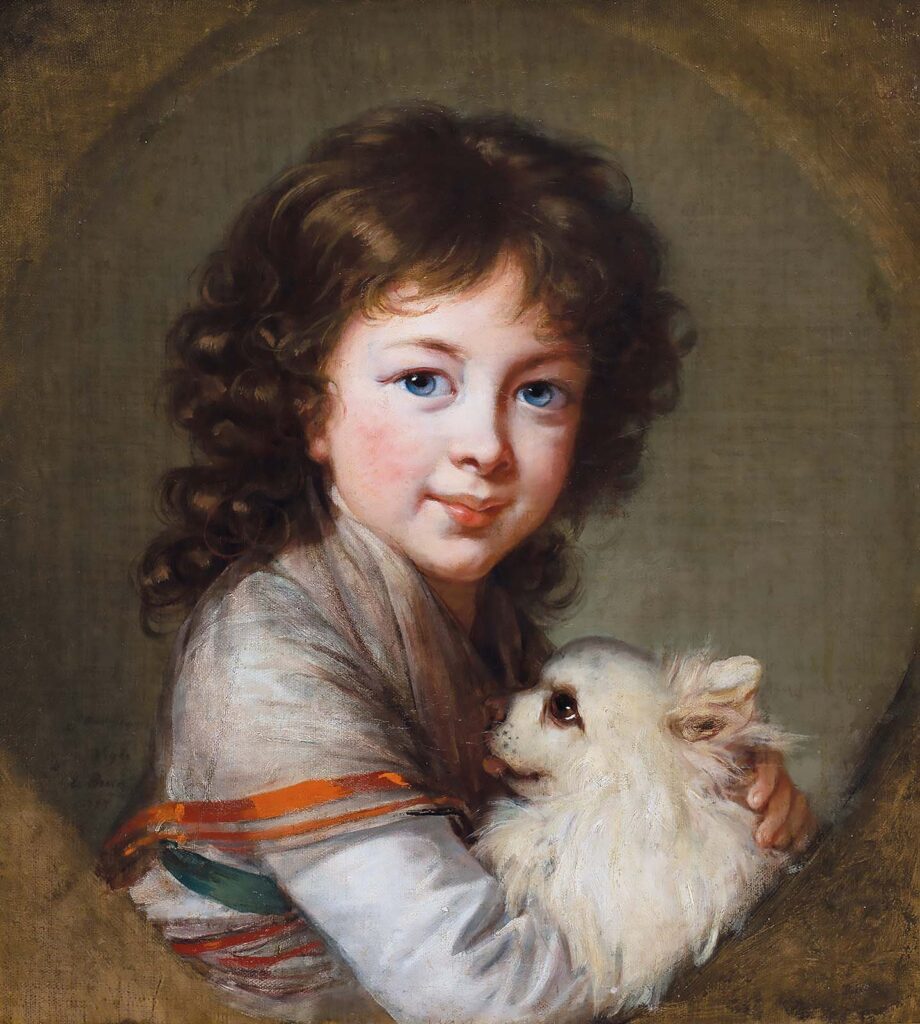
The
painting shows Elisabeth (“Isabella”) Mniszech (1787–1830), the daughter of a
niece of King Stanisław II August Poniatowski of Poland, himself a remarkably
intelligent and educated man who had visited most of the capitals of Europe.
Isabella sat for Vigée Le Brun during the latter’s
sojourn in St Petersburg and is also mentioned in the painter’s memoirs. Vigée
Le Brun enjoyed the esteem of King Stanisław August, his sister Countess Louise
Zamoyska and her daughter Countess Urszula Mniszech.
The young lady, shown in a head and
shoulders oval portrait, is dressed in light-coloured clothes with a half-smile
on her pretty face, which is framed by the curls of her hair. Her body is
turned to the right, towards the viewer, and she looks out of the painting with
a good-humoured and self-assured gaze as she clutches her pet dog, a white Italian spitz or volpino.
It seems likely that the girl herself chose her loyal four-legged friend to
share her portrait with her. The presence of the dog in the picture makes the
composition richer and the overall image even more charming.
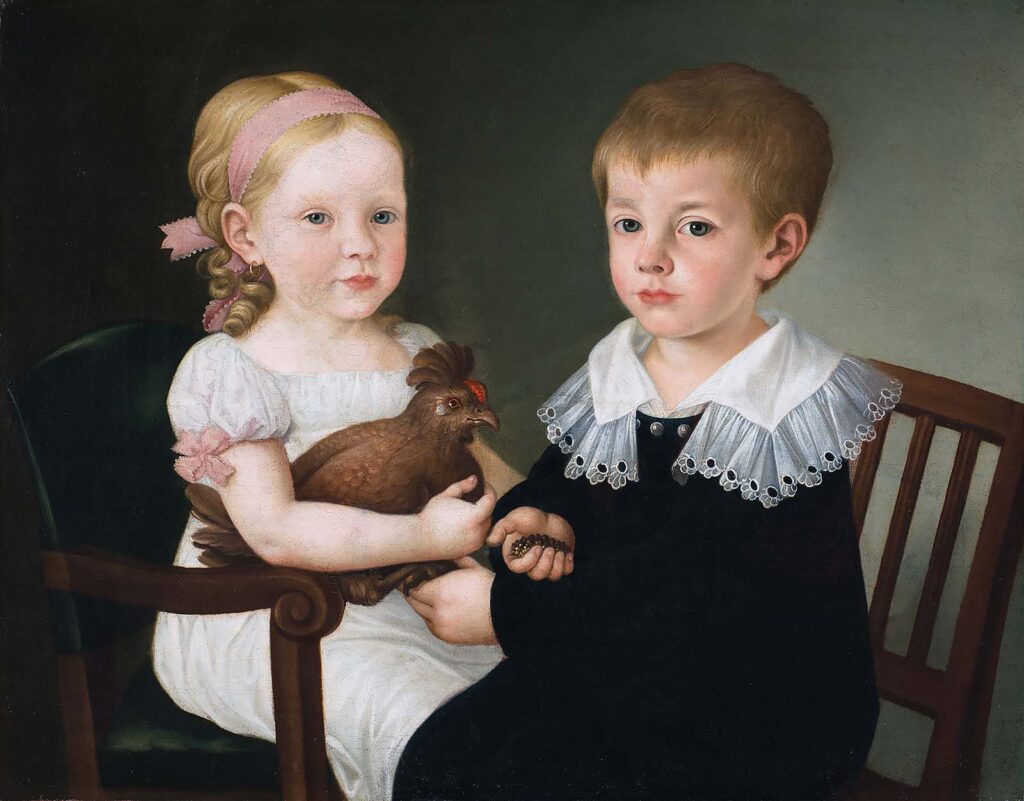
This
childhood portrait of Julija Primic (1816–1864) and her two years older brother
Janez is the work of the eminent painter Matevž Langus. Julija Primic grew up
to be one of the richest and most beautiful heiresses in Ljubljana. She also
attracted the attention of France Prešeren, who dedicated one of his most
famous poems, Sonetni venec (A wreath of sonnets, 1834), to her by means
of the acrostic PRIMICOVI JULJI (“To Julija Primic”) in the master sonnet of
the sequence.
The
seated brother and sister are shown in three-quarter view against a grey-green
background, Julija in a dark green armchair on the left and Janez on a wooden
chair on the right. This was how their parents carefully arranged them and
placed them before the society painter Langus. A pink band adorns Julija’s fair
hair and a bow of the same colour can be seen on the sleeve of her white dress.
She is holding a hen, which her brother is feeding. Toys and domestic
animals are typical attributes in Langus’s portraits of children. Janez is dressed in a dark outfit with a contrasting white
collar. The faces of the two subjects, with their similar features and blue
eyes, convey an impression of reserve, embarrassment and shyness.
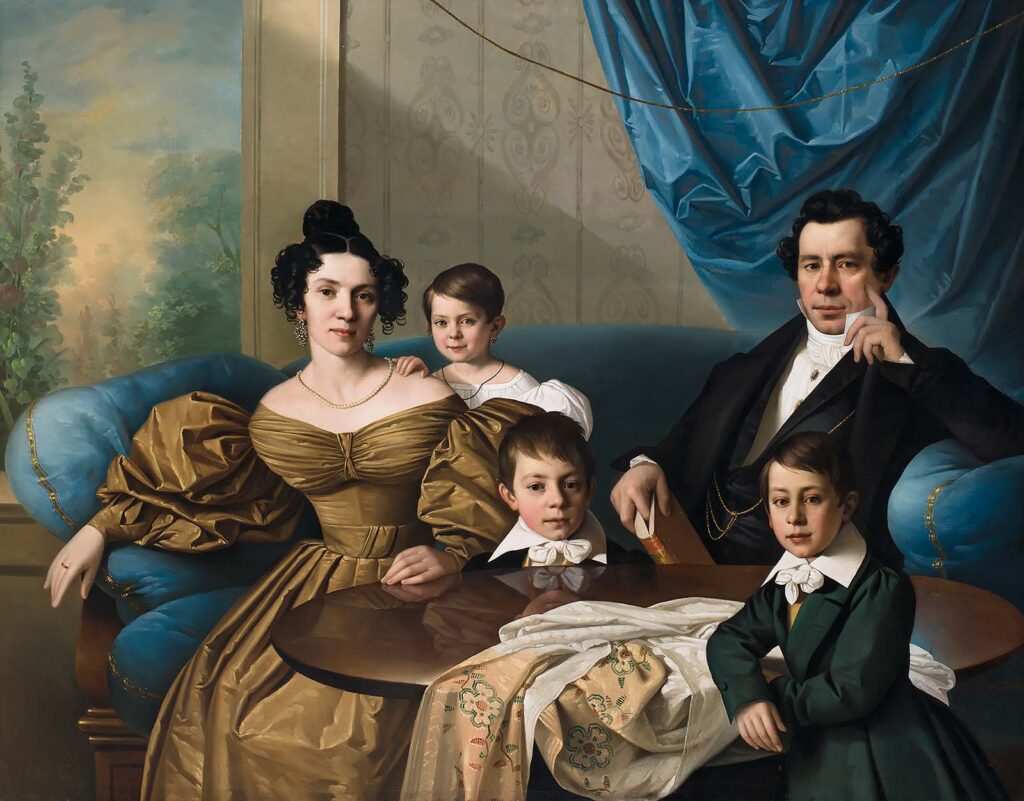
Jožef
Tominc, who was one of the most sought after portrait painters among wealthy
members of the middle class, painted Dr Dimitrije Frušić (1790–1838), a
physician, journalist and prominent member of the Serbian community of Trieste,
together with his young family.
The
physician is seated comfortably on a canapé in front of a blue curtain and the
lighter diagonal of the background, a book of Hippocrates in his hand. Next to
him, his wife Jovanka and their three children are shown around a polished oval
table. His wife is dressed in a light brown gown and wearing fine family
jewellery. The little girl by her side, her hand placed on her mother’s
shoulder, wears a white dress, while the two boys are in dark jackets with
white collars. One of the boys kneels next to his mother behind the table,
while the other is shown in front of the table and leaning against it. The
older boy, Čedomil, who is allotted a place on the right, in front of the table
and directly below his father, as befits a firstborn son, died the year the
picture was painted. Dr Frušić himself died three years later.
All
three children are painted convincingly, with faces that eloquently express
aspects of their character: satisfaction, pride, mischievousness and good
nature. All these characteristics can also be seen in the figures of the
parents, and the family of Dr Frušić thus presents itself to us as a harmonious
and integrated family unit.
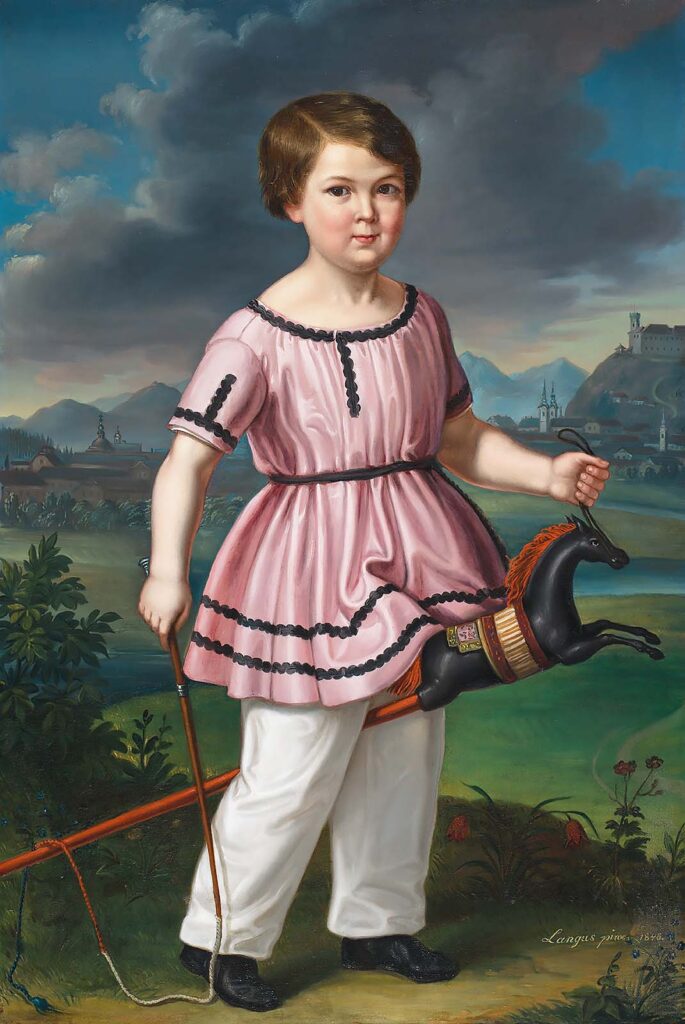
The
frescoist and Biedermeier portrait painter of Ljubljana’s middle class Matevž
Langus painted Karl Hummel’s homonymous young son in the year of the Springtime
of Nations. The Hummel family lived in Ljubljana but also owned property in
Graz and Trieste. The Hummels had three children: Karl, Irene and Franz. The
firstborn, Karl, inherited his father’s gift for music, spent his life in Graz
and never married.
Langus
painted the young Karl in front of a view of Ljubljana beneath a cloudy sky.
The boy is shown full length astride a wooden hobby horse, symbolic flowers at
his feet. The hobby horse, which Karl pretends to urge to a gallop with the
whip in his right hand, functions as a status symbol. The subject of the
portrait is dressed in white trousers and a pink tunic, his body turned
casually towards the viewer. His doll-like face simultaneously expresses
reserve and mischievousness. The portrait of Karl Hummel Jr is one of the most
representative examples of a solo portrait of a child from this period.
Upon
graduating from the Academy of Fine Arts in Vienna, Mihael Stroj initially
settled in Zagreb, where he made his name as a painter of portraits of members
of the city’s wealthy middle classes. In 1842 he left Zagreb for Ljubljana,
where he began to receive commissions for portraits from notable citizens of
the Carniolan capital. The commission to paint a childhood portrait of Valentin
Krisper came shortly after his arrival in Ljubljana.
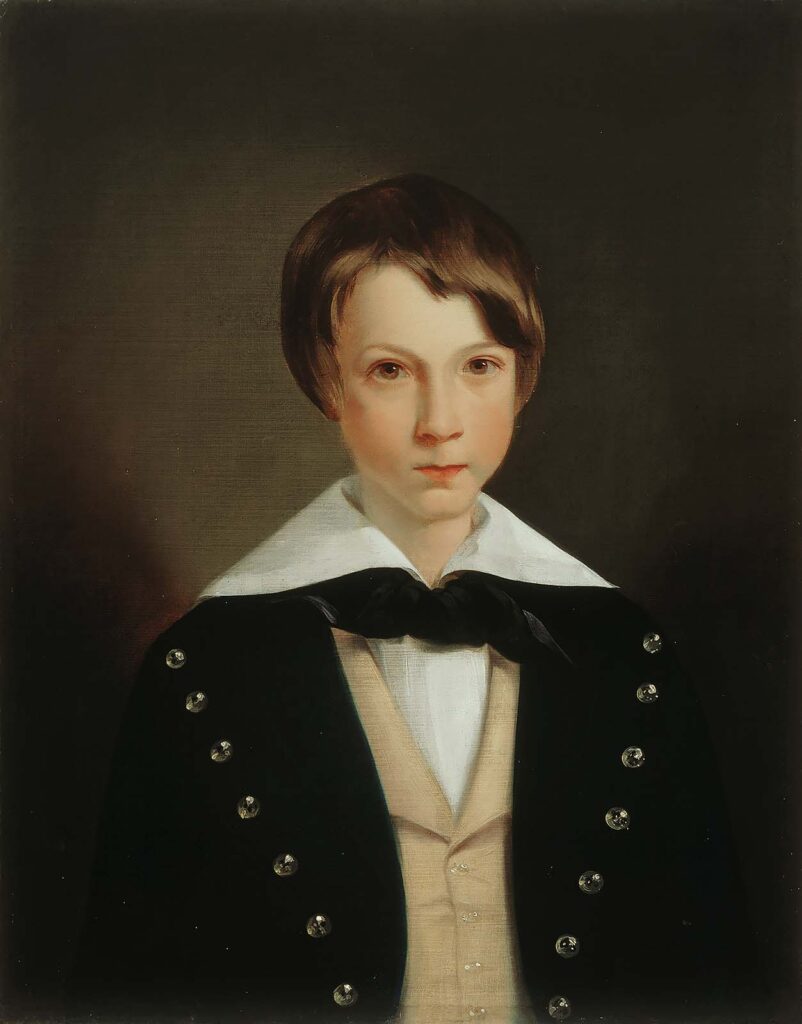
Valentin Krisper (1835–1912) was the son of the Ljubljana merchant Anton
Krisper (1805–1865) and a future factory owner. Society portrait painter Mihael
Stroj painted a head and shoulders portrait of the nine-year-old Valentin
against a neutral background. He is dressed in a white shirt, tan waistcoat and
blue topcoat with two rows of buttons. His pale face – red cheeks, lips pressed
together – is painted in a soft manner and expresses the delicate nature but
also the quiet self-assurance of the middle of Anton Krisper’s three sons.
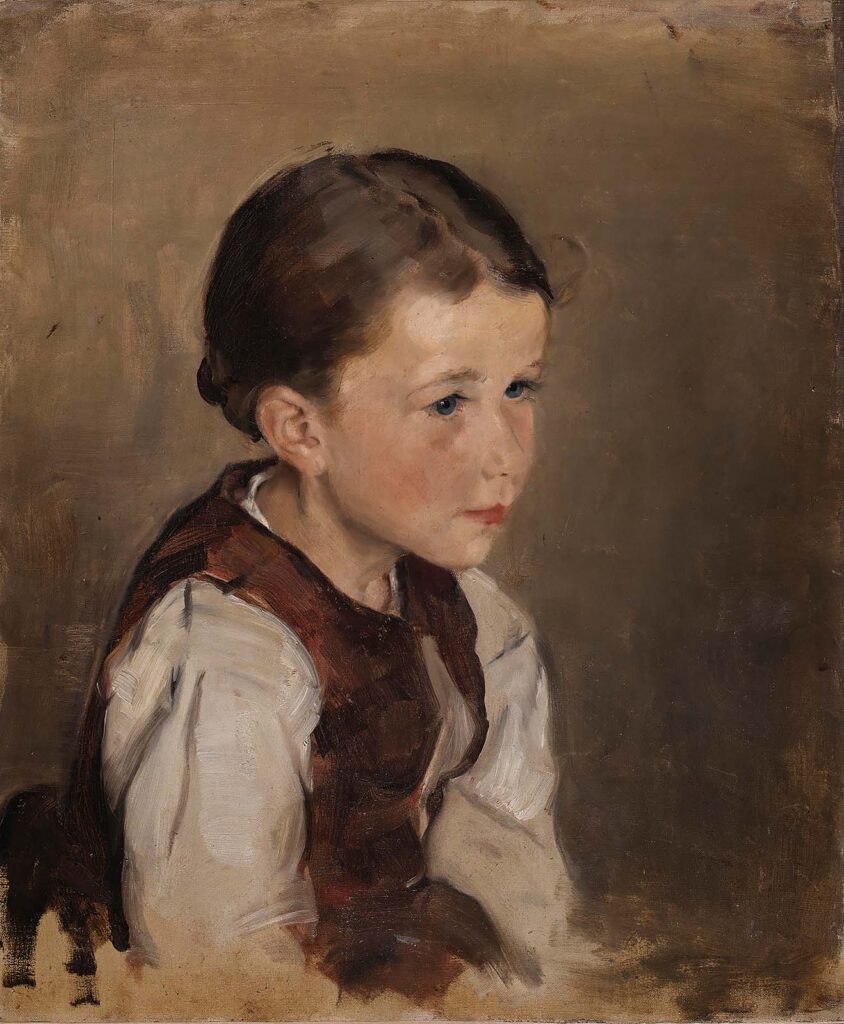
Ivana
Kobilca painted Girl in a Red Waistcoat while attending the private
school of painting for women run by Alois Erdtelt (1851–1911) in Munich. Above
all, Erdtelt imparted to his students the techniques of studio-based female
portraiture. Kobilca painted several portraits of children in the 1880s,
including Girl (1882–1889), Study of a Red-Haired Girl(1882–1889) and Bust of a Boy in a Red Hat (1888–1889). Her images of
children were commercially successful, so she devoted particular attention to
studies of childhood portraits and became unrivalled as a painter of children.
This
half-length portrait shows a little girl seated in three-quarter profile
against a neutral background, a serious expression on her face and her gaze
fixed in front of her. Her hair is tied up and she is dressed in a white blouse
and a sleeveless red garment. The study features brownish colouring, relaxed
brushwork and an “unfinished” character that seems to involve the viewer in the
creation of the image.
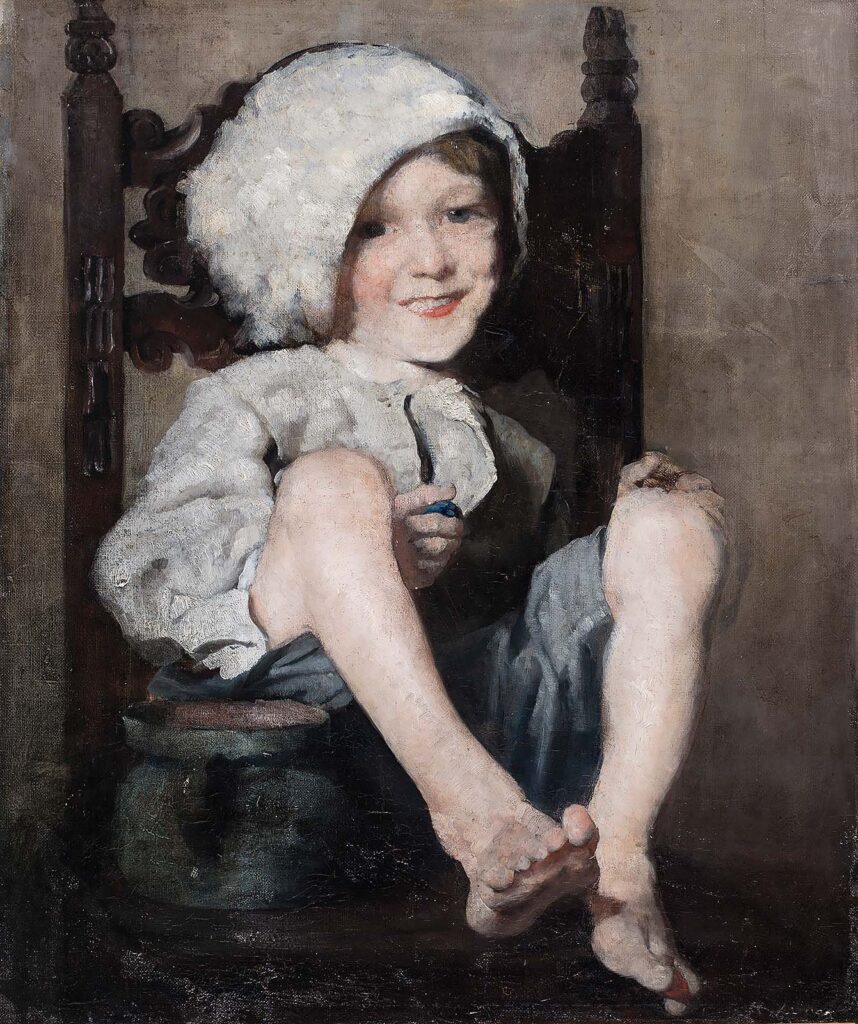
At
the time of painting Boy Wearing a Fur Cap, Ferdo Vesel spent the first
half of the year in Slovenia before returning in the autumn to Munich, where he
had completed his examinations at the Academy of Fine Arts but still had the
use of a studio. The portrait dates from the period in which Vesel was
transitioning from painting heads to full-length figures. This full-length
portrait of a seated barefoot boy, characterised by careful modelling and muted
tones, comes from his Munich studio.
The boy is seated in a relaxed attitude on a neo-Renaissance chair, his
right leg lifted over a pot or jug placed on the chair’s right-hand edge (on the
left of the painting). On his head he wears an adult’s fur cap. He is dressed
in a white shirt and broad grey-blue trousers, which he has rolled up past his
knees. In his right hand he holds a plum. His face, which has a laughing,
playful and joyful expression, is turned towards the viewer. The artist has
painted the boy in a relaxed,
carefree and playful pose that expresses his childishness and at the same time gives
the painting greater depth.
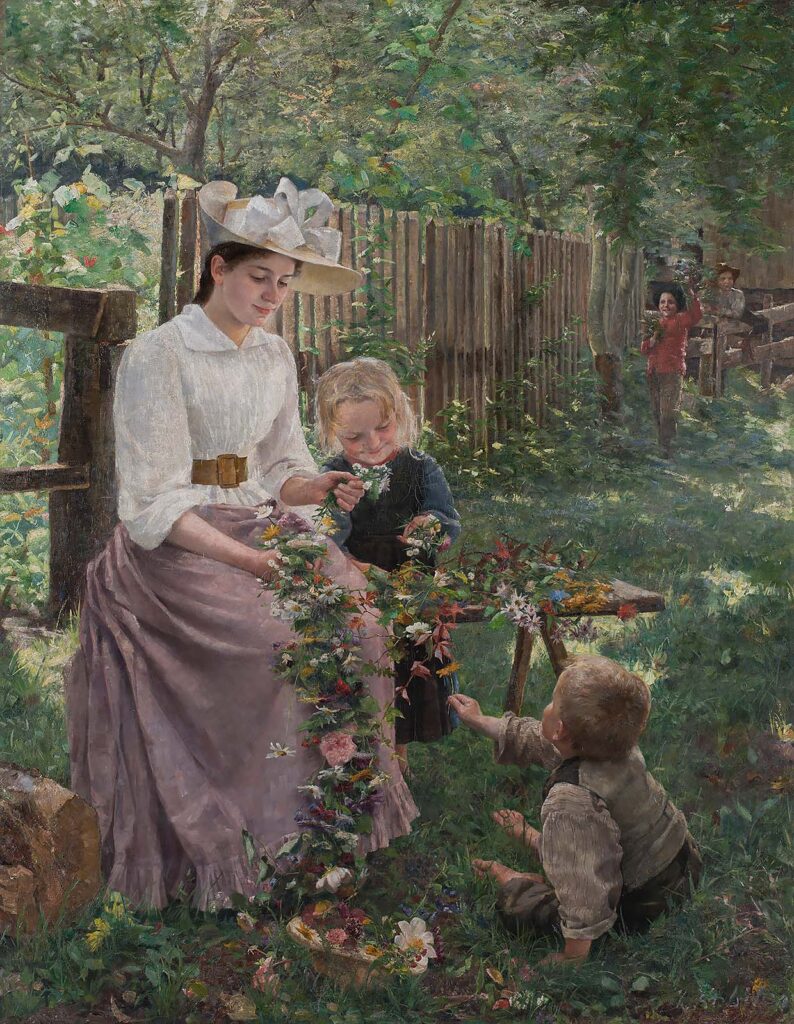
Ivana Kobilca
painted what is today the most popular painting in the National Gallery of
Slovenia over the course of two summers at her mother’s home in Podbrezje in
north-western Slovenia. Having garnered great success with it, she later
presented it to the National Gallery. The creation of the work coincided with
her departure from Munich and her plans to move to Paris. Influenced by Munich’s modernism and French en
plein air painting, she painted the large-format work in light colours with
accentuated lighting effects. The work presents us with a relaxed summer scene
of sunlit greenery and a peaceful holiday atmosphere. Kobilca depicted her younger
sister Fani making a floral wreath with the help of her young cousins, Katrica
and Janezek Blek. In later years the artist would remember: “The children were
crowding all around me and criticising me as I worked: That’s not right! You’ll
see, she’ll fix it!”
Both the Blek children in the foreground and the two young lads by the fence in
the background are depicted in full figure in a playful and sociable mood.
Janezek Blek, dressed in brown trousers, a shirt and a sleeveless pullover, is
seated on the ground with his back to the viewer, proffering a flower to Fani. His
older sister stands next to Fani in a blue dress, contentedly sorting flowers.
Two smiling young lads with hats on their heads are bringing flowers to the
group from the background of the scene. The figures depicted in the painting
also represent the social contrast between the urbane young lady on the one
hand and the village urchins on the other.
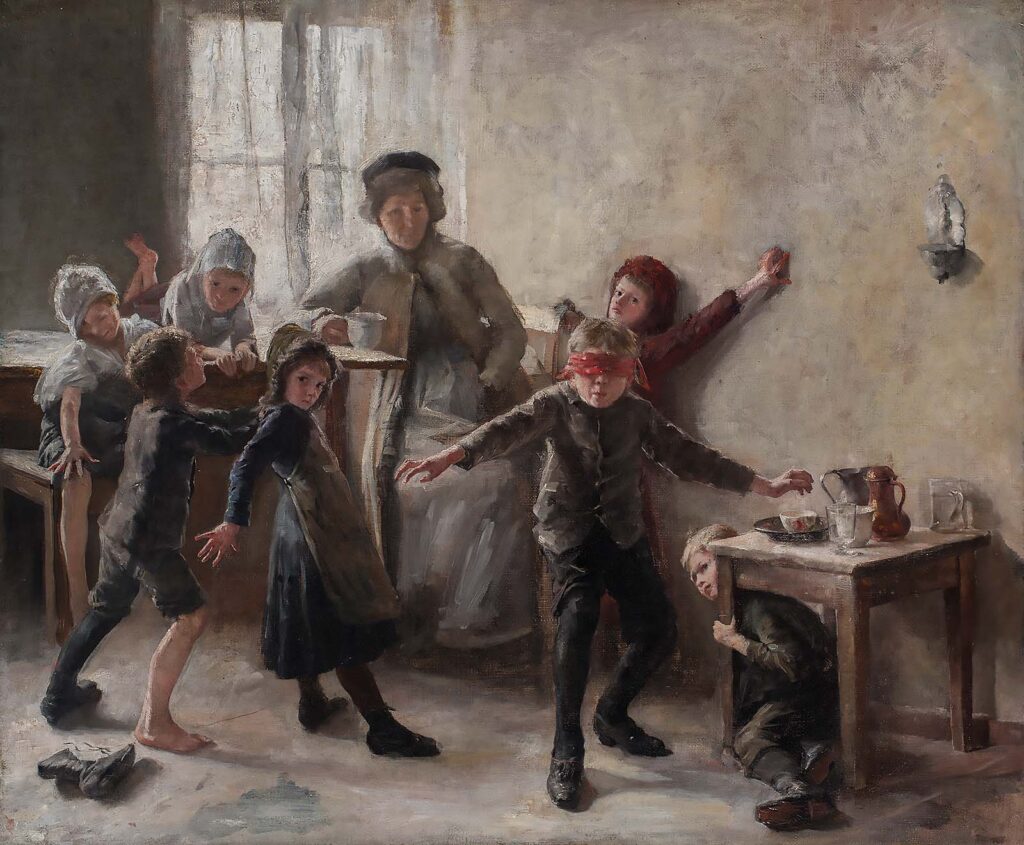
In
1891 Ferdo Vesel’s painting Blind Man’s Buff was included in an exhibition
of works submitted by students at the Academy of Fine Arts in Munich for a
Christmas competition on the theme of winter. Using a lighter application of
monochrome tones, the artist has created a genre scene depicting a game of
blind man’s buff being played in an interior. Themes of childhood and interiors
were popular subjects among students of the Munich Academy under Ludwig von
Löfftz. The winter theme is suggested by the pale wintry light shining through
the curtained window in the background and the fact that the children are
playing indoors in the warmth.
The nursemaid seated at the table with a coffee cup in her right hand is
surrounded by seven merry children depicted in frozen attitudes as they play a
game of blind man’s buff. The full-length figures create a circular
composition. The expressions and movements of each of the children offer us a
psychological insight into their characters. A barefoot girl lies on the table,
her legs crossed at the ankle, observing the game from a position of safety.
The boy seated next to her with a hat on his head and his trouser leg rolled up
over his knee is reminiscent of the Boy Wearing the Fur Cap. Next to him
stands a boy with one shoe off and one shoe on. The girl on his right is
leaning backwards and turned towards the viewer. On the right-hand side of the
composition we have the central figure of the children’s game: a boy with a red
blindfold covering his eyes. With arms stretched out on either side, he seeks
his playmates. Behind his back a girl leans against the wall. To her left
another little boy is hiding under a table containing sundry utensils.
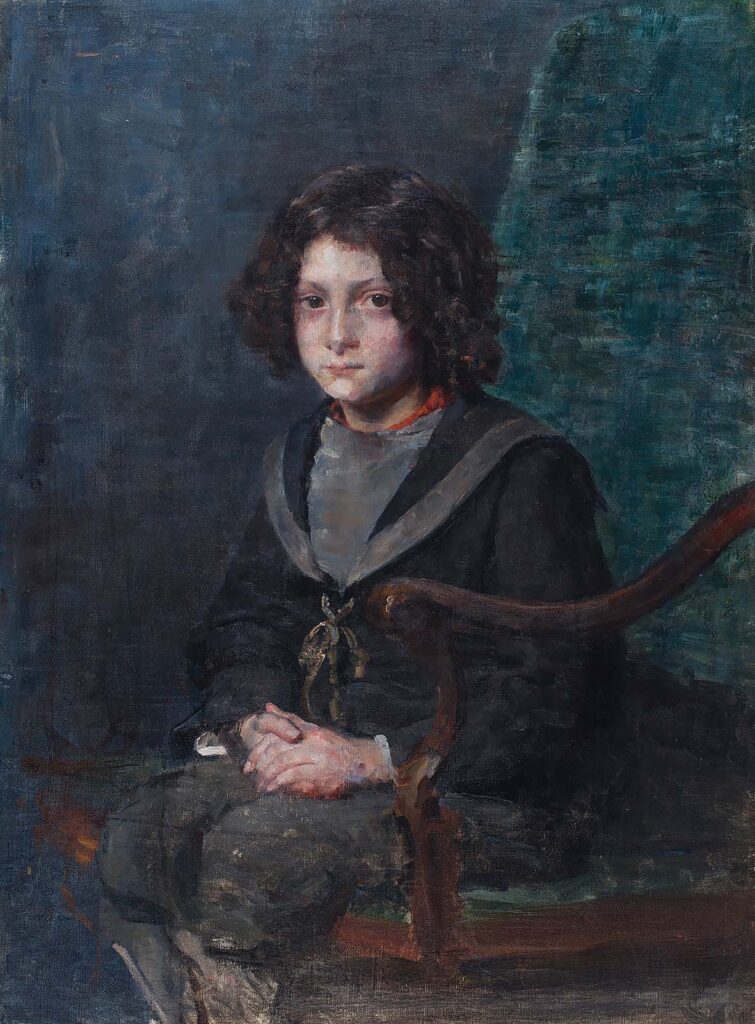
Ivana
Kobilca painted her portrait of a boy in a sailor suit during her melancholic
blue period, a time of disappointment and mourning for her lost love in Paris.
After seven years studying in Munich, she was now a proficient and assured
portrait painter.
The entire painting of the boy in the sailor suit is pervaded with
sadness and melancholy. This is partly the result of the artist’s chosen
palette of darker, subdued colours. Against a neutral background, the boy sits
on a chair that is too big for him, with a wooden armrest, his face turned
directly towards the viewer. He is dressed in a dark outfit with a sailor
collar. His hands are folded in his lap. The painting does not include the
lower part of his legs. The boy’s serious, pale face is framed by long curly
hair. His appearance is characterised by melancholy in his attitude, his face
and, above all, his highly expressive eyes.
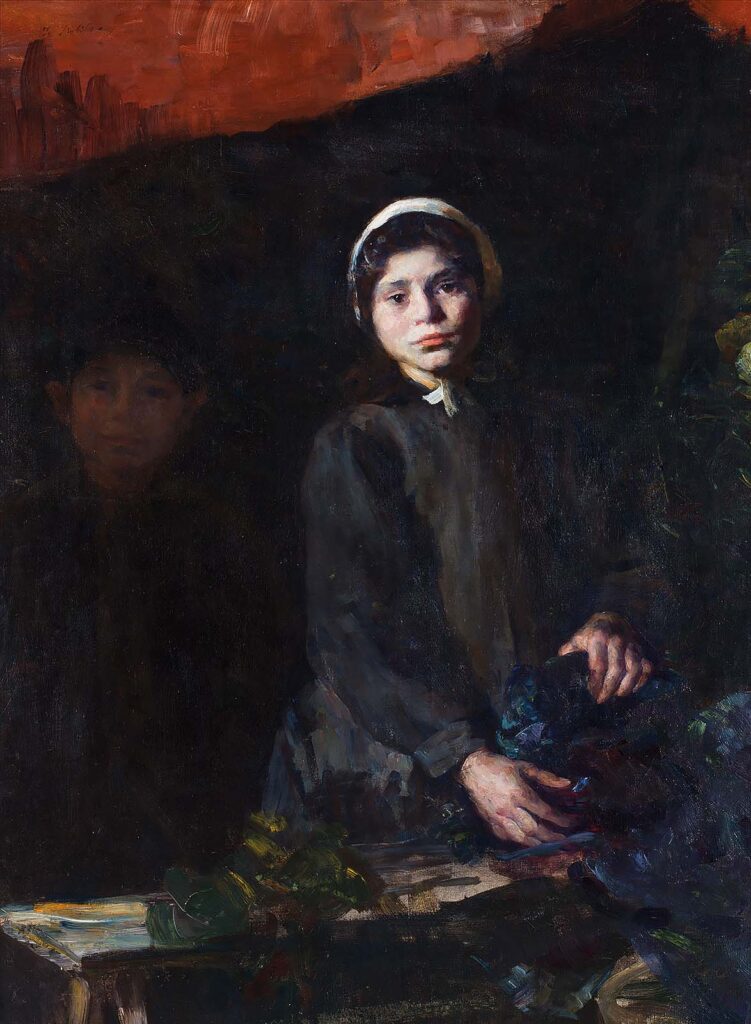
Ivana Kobilca painted her Parisian
Woman Selling Vegetableswhen she was living in Paris, during her cold blue melancholic phase. She
captured the poor peasant girl on canvas in Barbizon, to where she had
retreated from Paris along with her artist friends. The work represents one of
the pinnacles of her oeuvre in terms of quality.
Standing out against the dark colour of the girl’s
dress, the vegetables on the stall in front of her and the barely distinguishable
face of the concealed figure of a small boy on the left of the painting, are
the girl’s lighter coloured hands, which appear unnaturally large – as though
to emphasise that this is a person who earns a crust by the sweat of her brow,
and her face, wrapped in a white headscarf. This young girl does not spend her
time at play but instead earns her daily bread in the world of adults. Her face
is melancholic and offers a clear glimpse of her state of mind.
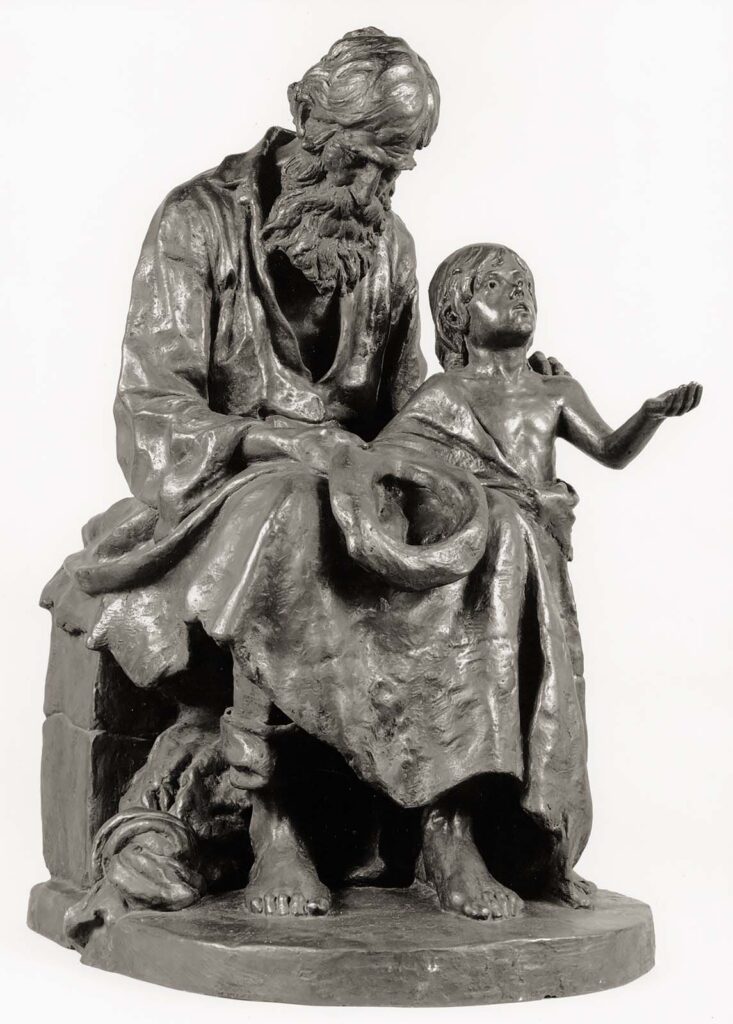
Alojzij Repič
created his sculptural group Blind Beggar with a Boy in 1895 while
studying at the Academy of Fine Arts in Vienna. He exhibited the work, then
entitled The Blind Man at the First
Slovene Art Exhibition in 1900, and then again at the Jubilee Art
Exhibition held at the Jakopič Pavilion in 1940 to mark the fortieth
anniversary of the earlier event.
With this
example of academic realism, the sculptor touched on social themes. The old man
– a seated blind and barefoot beggar with a hat in his right hand – rests his
left hand on the left shoulder of a half-naked boy who is also begging for
money with his left hand out. The boy’s raised left hand emerges from the
Renaissance-style triangular composition and in this way accentuates the
meaning and theme of the sculpture. The boy’s head is slightly raised, his eyes
wide open and his lips parted; the expression on his face and his entire figure
express the little boy’s active efforts and desire to obtain alms.
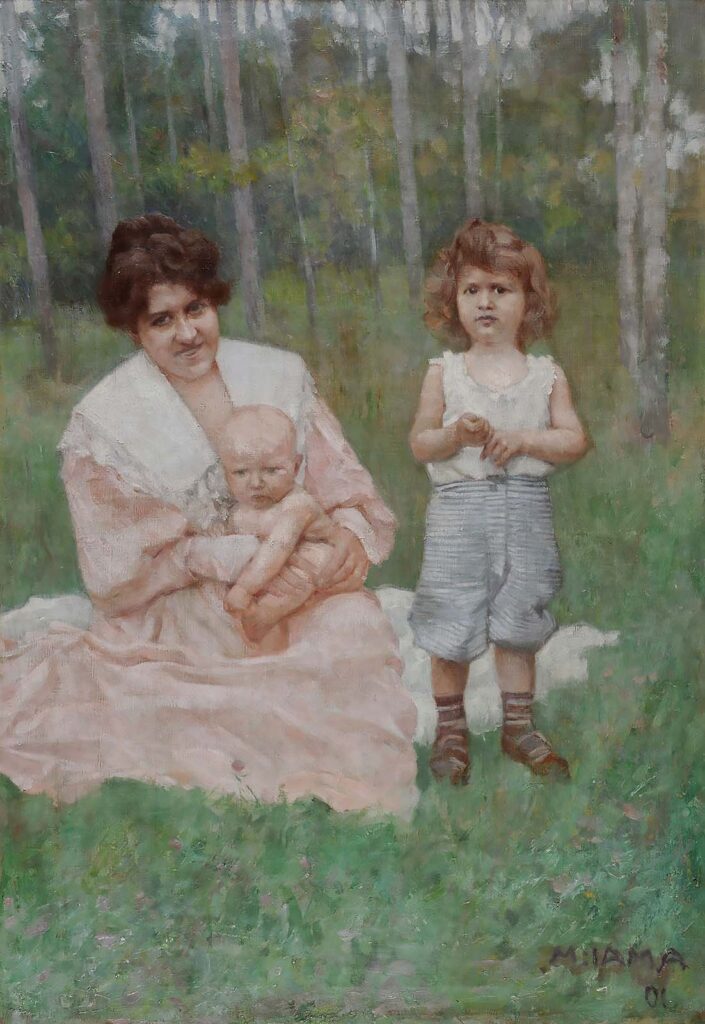
Of
the four leading Slovene Impressionists, it was Matija Jama who dedicated
himself most to painting children.
He painted this young family – Rozi Bleiweis and her two children – in a
natural setting amid greenery, a stand of silver birch trees in the background.
He almost certainly used a photograph to help him while working. The
contentedly smiling mother in a pale pink dress holds a naked infant on her
lap. Her older child stands on her left, right hand bashfully clasping the
forefinger of the left. This relaxed bourgeois portrait from the turn of the
century is deliberately set in the countryside, seen as a place of recreation,
exercise and leisure. Only the coiffed hair and expensive clothes of the
subjects tells us anything about their status.
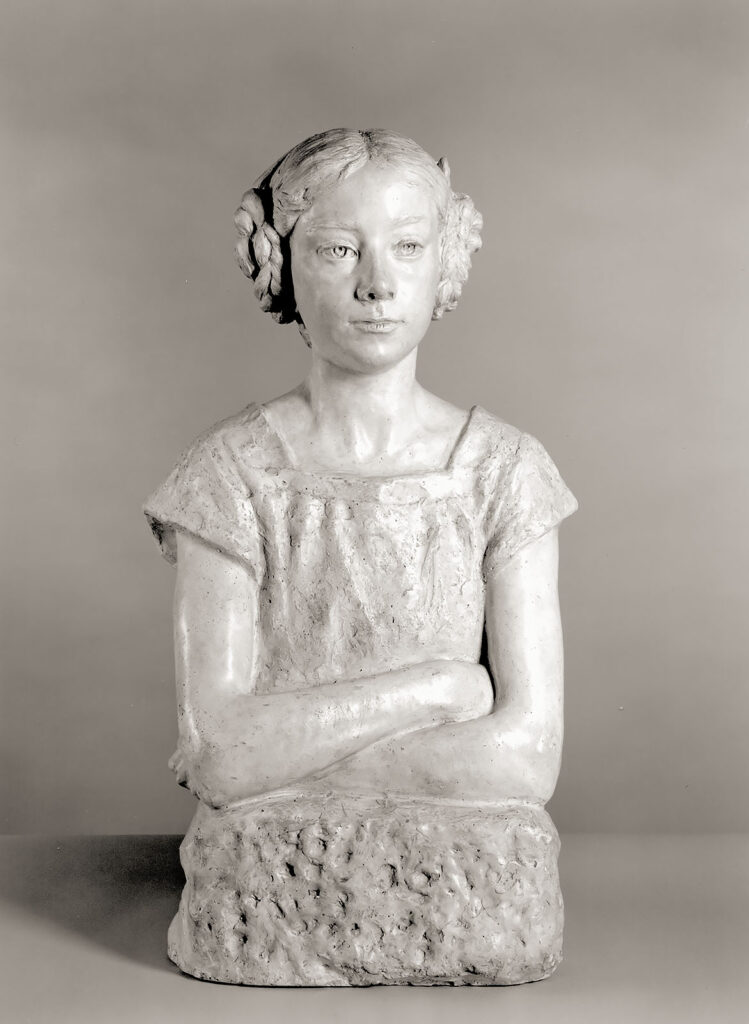
Ivan
Zajec created his realistic
half-length portrait of a girl
in around 1906. Girls were
among the sculptor’s preferred subjects and both his sculptural oeuvre and his
drawings contain many examples of childhood themes. Zajec also sketched figures
of girls in various poses in his sketchbooks, adding to them in phases. He
portrayed girls with typical hairstyles, dressed in children’s clothes, in
various situations: seated reading, standing and absorbed in play.
The realistic half-length plaster shows a girl
in a short-sleeved dress with her arms crossed and her braided hair carefully
arranged into coils over the ears. Her face and hands are smoothly worked and
contrast with the coarser lower part of the sculpture. The girl’s pose
expresses self-confidence and there is a hint of vanity in her face.
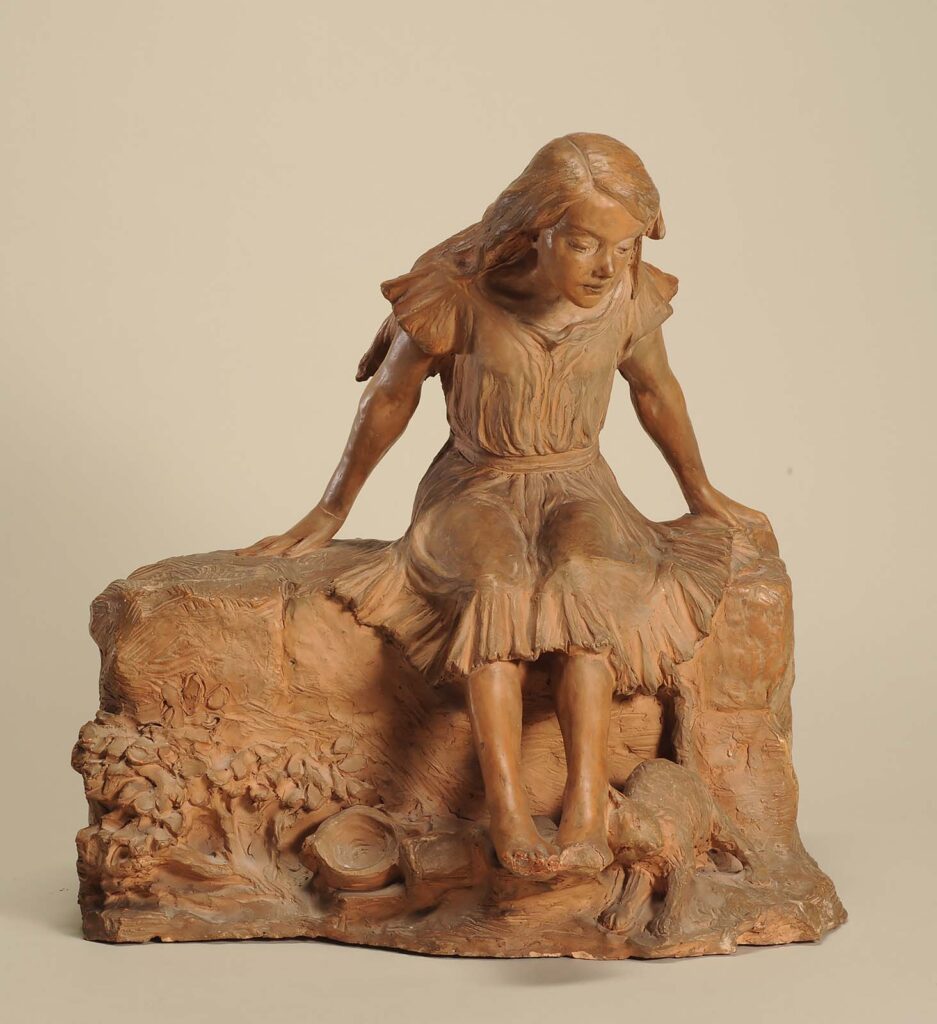
Ivan Zajec’s
small clay sculpture Girl with a Kitten joins his plaster A Girland a series of drawings of girls in his sketchbook in the gallery’s
collection. Girls were clearly a subject the sculptor enjoyed portraying. Ivan
Zajec’s oeuvre includes numerous small figurative works whose content marks
them as genre sculptures. His favourite materials for these sculptures were
plaster and fired clay. In the case of the terracotta sculpture Girl with a
Kitten, the sculptor signed himself Jean
Zajec, from which we may conclude that the work dates from the period in
which Zajec was living in Paris.
A long-haired girl in a summer dress sits on a bench, her attention
directed towards a kitten that is rubbing its head against her bare legs. The
girl is leaning forward with her whole body, entirely focused on the animal, a
delighted expression on her face. The overall composition emanates tenderness
and a relaxed, affectionate and playful mood.
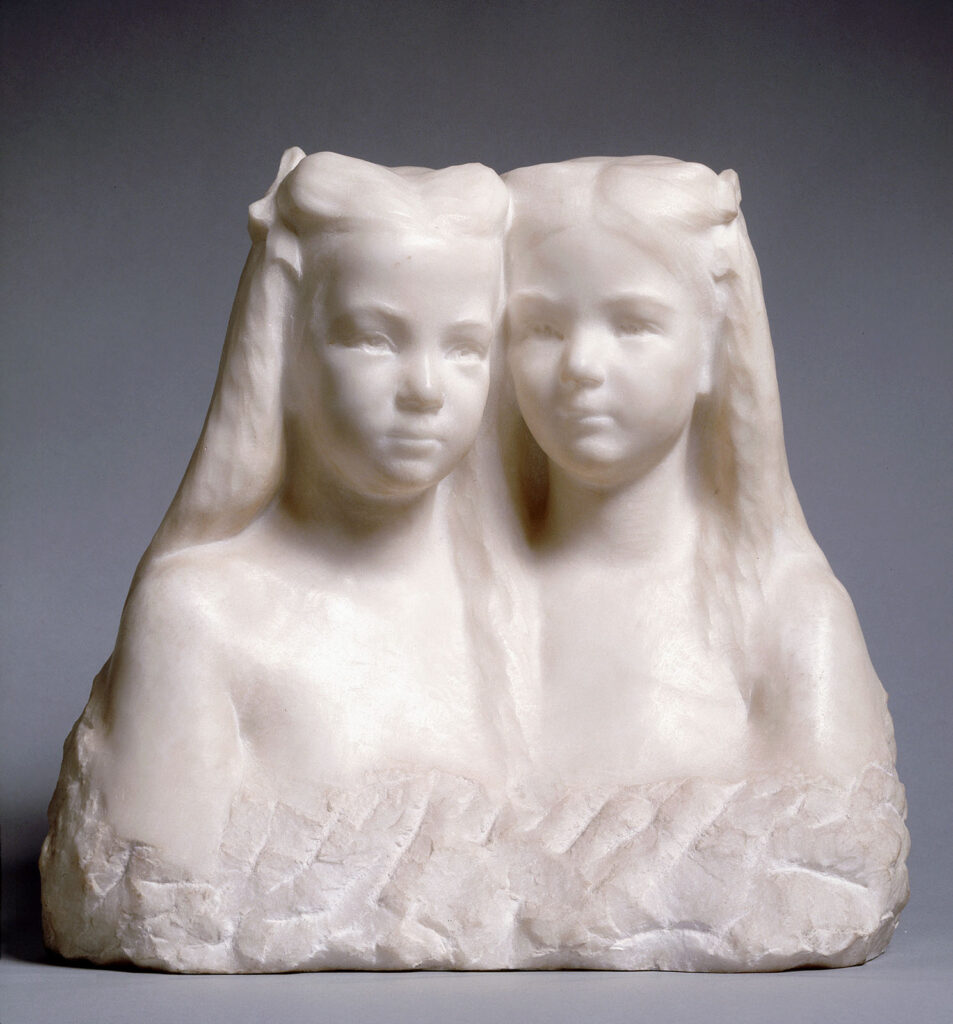
Franc Berneker enrolled at the Academy of Fine Arts in
Vienna in 1897 and, after completing a specialisation in sculpture in 1905,
remained there until 1915. In the first decade of the twentieth century, while
living in Vienna, he completed a series of realistic sculptural portraits of
figures from the cultural sphere and society, including patrons, supporters,
friends and their children. From his student years onwards, he had enjoyed the
support of the journalist, patron and educator Pavel Turner (1842–1924) and, in
particular, Fran Vidic (1872–1944). The latter was a literary historian,
translator and patron of the arts, who also held various political positions.
He was the co-founder of a Slovene literary club in Vienna and the patron of
numerous Slovene artists, among them Ivan Cankar, Ivan Grohar, Fran Tratnik,
Ivan Žabota, Ivan Vavpotič and Berneker.
The most intimate of all the surviving portraits of
the Vidic family is that of Ivan Vidic’s daughter Zdenka with her friend Mira
Ban. Zdenka Vidic was born on 9 May 1902 and was thus five years old when she
sat for Berneker. She died at the age of just nineteen, following a long
illness. The double portrait of the two girls is intimately imagined and
lyrically sensitive. The girls’ faces are softened by their childish features,
while their grace is emphasised by their hairstyles. The lower part of the work
is sculpted in a more textured fashion, in contrast to the smooth treatment of
the facial areas. The portrait reflects the soft, delicate and dreamy characteristics
of the Vienna Secession, while the material – white marble – further heightens
the poetic effect through its translucence.
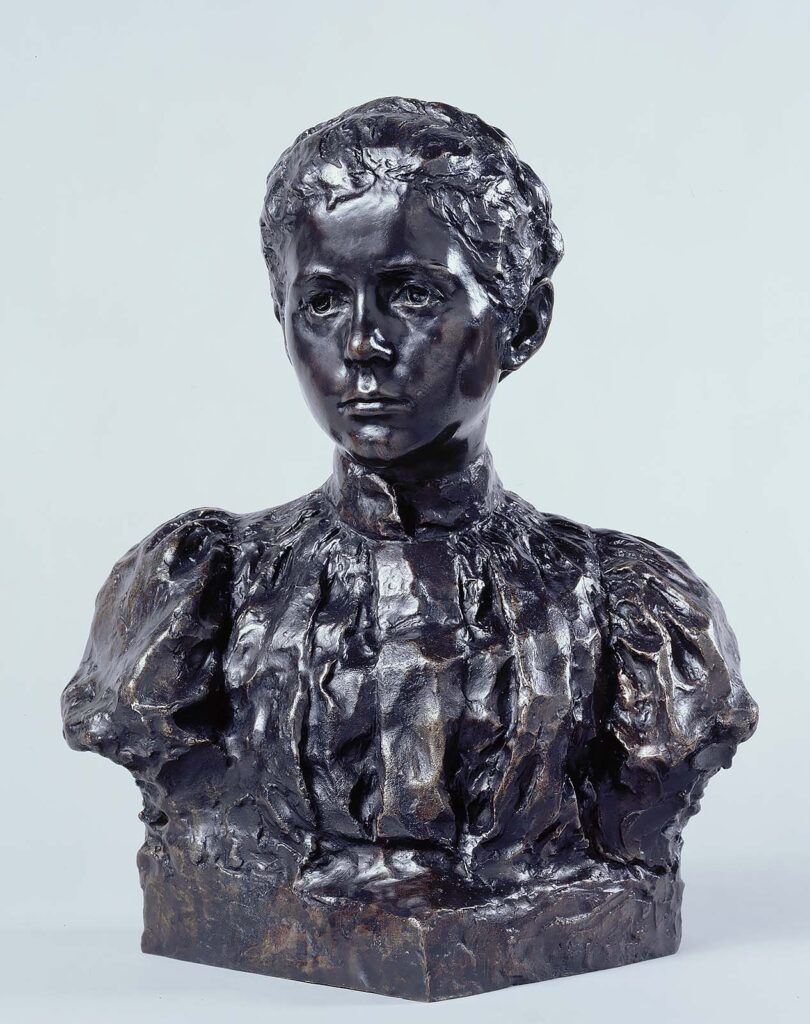
Franc Berneker enrolled at the Academy of Fine Arts in
Vienna in 1897 and, after completing a specialisation in sculpture in 1905,
remained there until 1915. In the first decade of the twentieth century he
created a series of portraits that followed Rodin’s modernist conception of
sculpture. He was able to infuse his realistic depictions with a unique
tenderness, dreaminess and mildness and expressed his artistic power and skill
through the sculptural treatment of varied surfaces.
In the case of this head and shoulder sculpture, the
coarser, richly textured treatment of the girl’s dress contrasts with the
smooth treatment of her face. The dress ends in a tall collar below her chin.
The girl’s hair is tied back, with the result that her delicate facial features
are clearly visible to the viewer. Her expression is poetic and wistful. The
work is one of the most picturesque portraits in Berneker’s oeuvre.
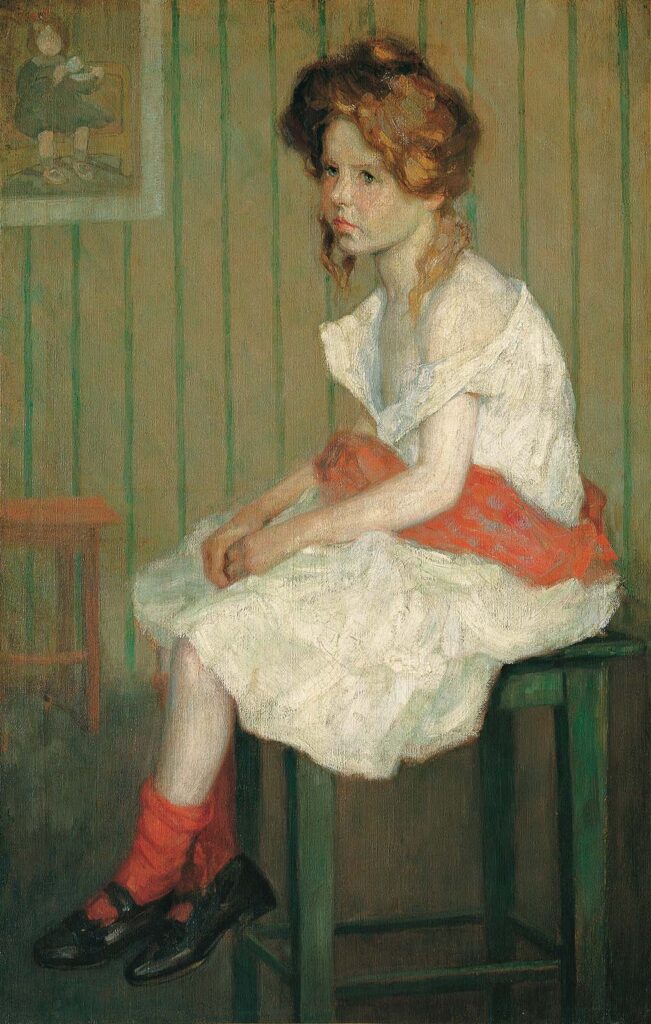
Henrika
Šantel belongs to the tradition of en plein air realistic painting as
practised in Munich. Her oeuvre includes numerous portraits, which she painted
in the style of academic realism. The restraint that was evident in her earlier
paintings was gradually replaced by a more decisive use of colour and light
contrasts.
Vivid colours and a light that seems to radiate from the girl’s white
dress are also features of this full-length seated portrait of a red-haired
girl. The girl is seated on a green-painted high wooden stool. The vertical
stripes on the wallpaper in the background are also green. She is wearing black
shoes and a white dress. Her vividly coloured hair stands out from the
background, as do her bright red socks and the red scarf or shawl around her
waist. The relaxed character of the scene is emphasised by her somewhat untidy
hair, the open front of her dress, the drapery in her lap and socks that have
slid down to her ankles. Through her pose and facial expression, the girl
eloquently conveys a sense of weariness or fatigue.
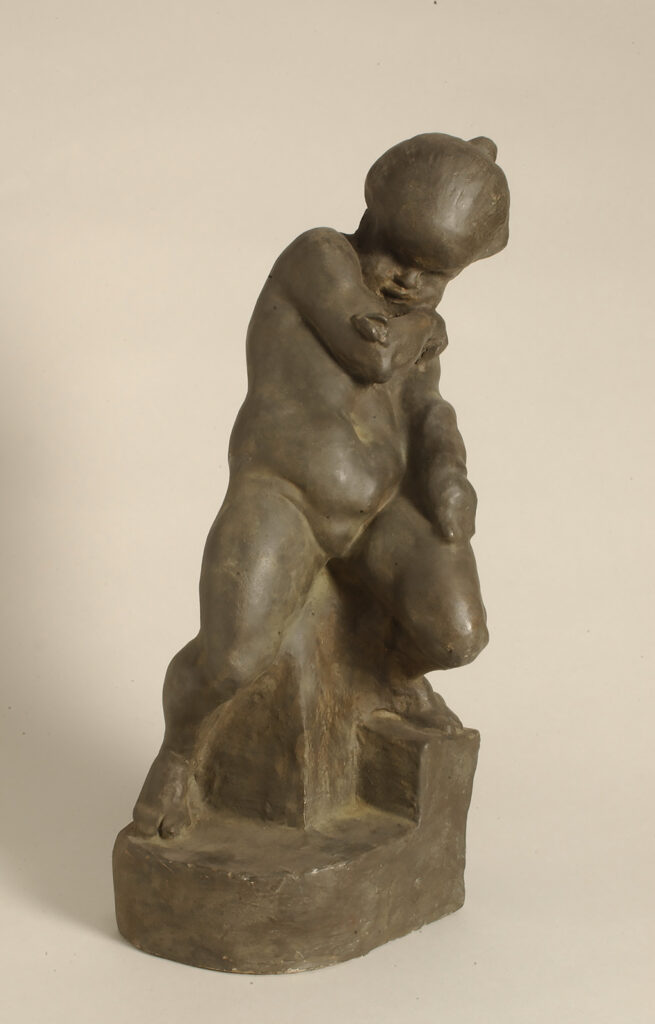
Lojze Dolinar is known for his realistic monumental
works of both free-standing and architectural sculpture. His oeuvre does,
however, also include a series of smaller intimate sculptures, of which Boy
with a Bee is one. The National Gallery purchased the work from the
artist in 1920, its first year of operation. The small intimate sculpture of
patinated plaster was included in the 15th Art Exhibition at the Jakopič
Pavilion in Ljubljana in 1918, under the title In Fear.
This genre sculpture presents the charming
neo-baroque figure of a chubby little boy who is afraid of being stung by a bee
and, in an attempt to escape the insect, is leaning back with his whole body
and trying to protect his face with his right arm, on which the bee has just
landed.
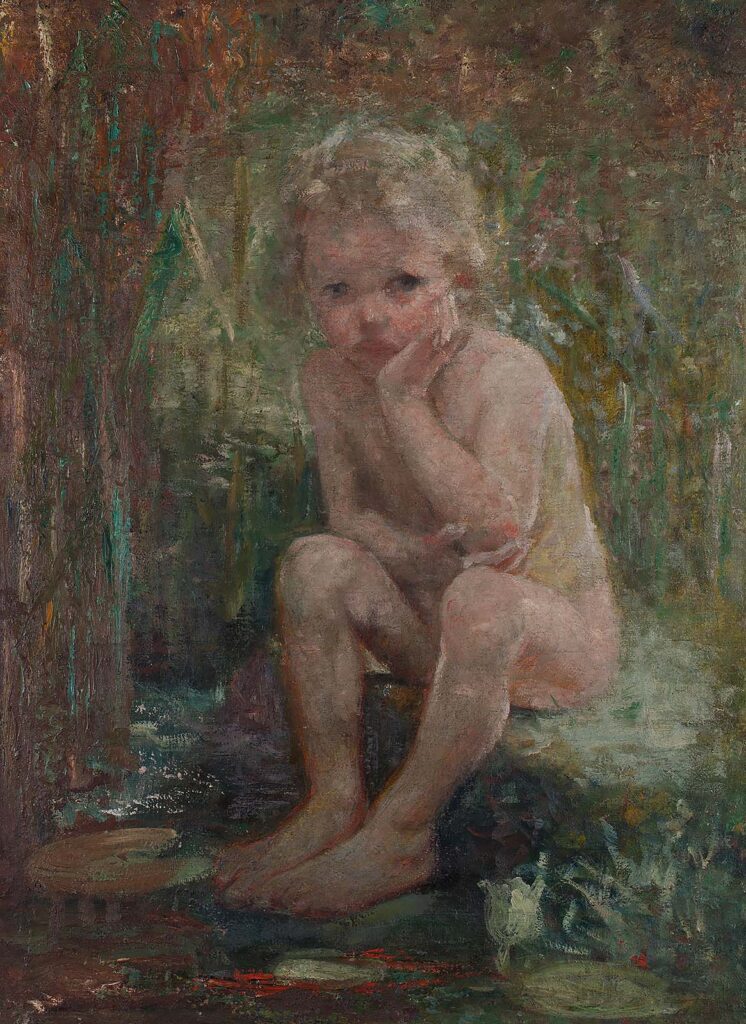
Ferdo
Vesel was a painter of portraits, nudes, landscapes, genre scenes and still
lifes. He painted this picture of a naked little boy sitting by the water in
natural surroundings in the early 1920s. The light in the picture falls from
the right and illuminates the left side of the boy’s body. His body, painted
with smooth brushstrokes, contrasts with the picturesquely painted vegetation
that surrounds him.
The fair-haired boy is sitting with his overlarge feet together, his
elbows resting on his knees and his chin propped in his left hand. His
expression is calm and pensive, a mood also hinted at by a pose that is
somewhat reminiscent of Rodin’s The Thinker.
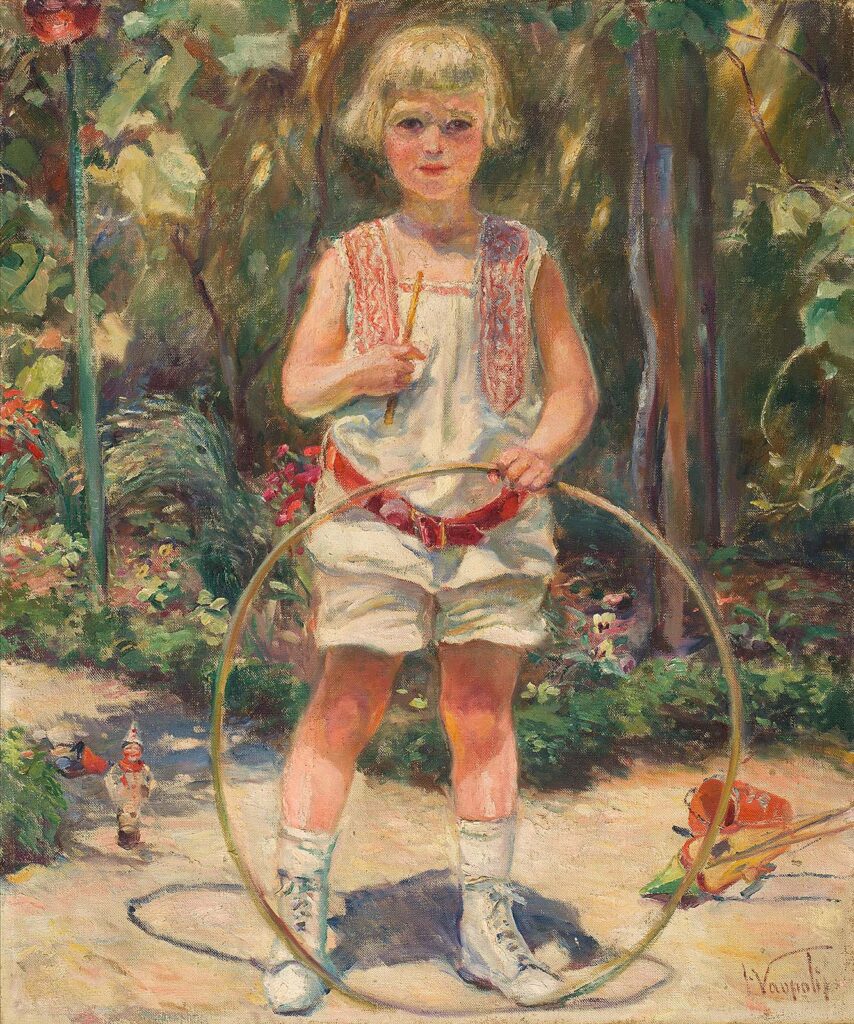
Ivan
Vavpotič was a portrait painter of Ljubljana’s middle classes, who commissioned
him to paint their portraits and those of their children, which he did in the
realistic style then popular. The work alternatively titled Boy in a Gardenor Boy with a Hoop is a portrait of Borut Žerjav. The painting is
compositionally well balanced and the light colours and sunny summer light
contribute to its gentle and serene mood.
The
fair-haired little boy stands with a hoop in his hands surrounded by toys in a
carefully tended garden. He is wearing white ankle boots and is dressed
festively in a white smock trimmed in red. The hoop had been a popular children’s toy since
antiquity and depictions of a boy or youth with a hoop were very common even on
the vase paintings of the fifth century BC. Vavpotič’s boy with a hoop aims to
be a representation
of a happy and carefree childhood.
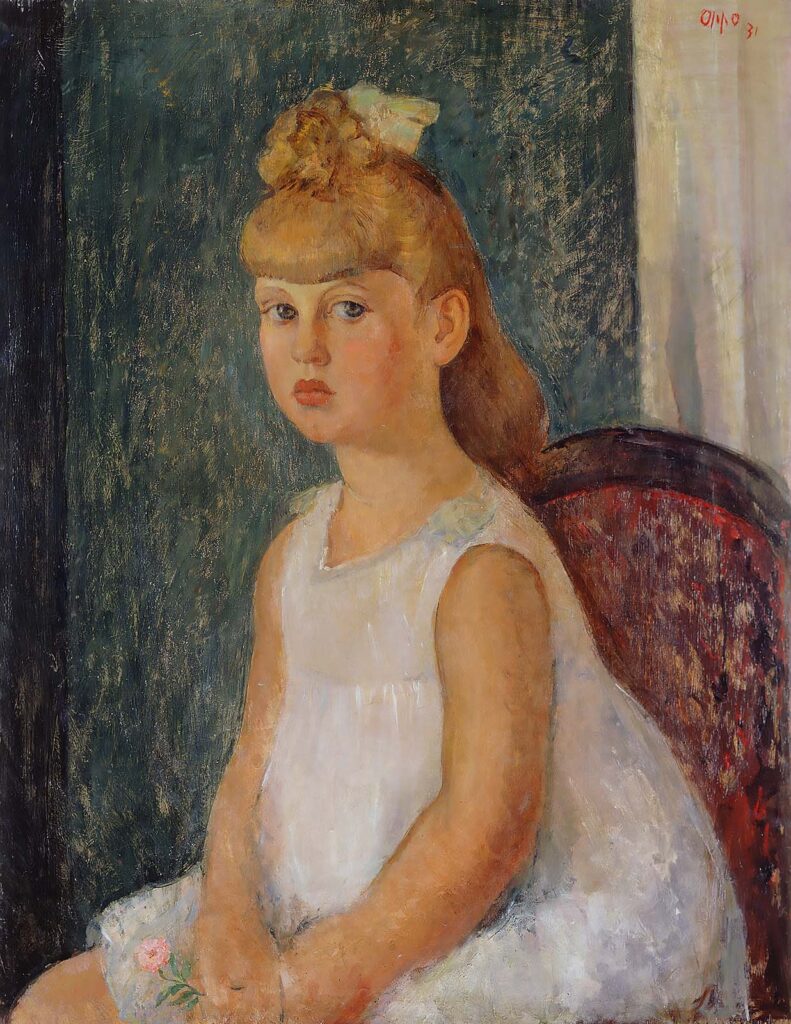
Cipriano
Efisio Oppo, an Italian
painter who trained in Rome, was initially an enthusiast
of French Impressionism and Post-Impressionism but later became a Naturalist in
the style of the nineteenth century.
Here he has painted his daughter Eugenia in a pale pink dress, seated on
a red-backed chair and holding a small pink flower. The composition alludes to
French Impressionist works, although the depiction of the girl’s face recalls
Italian Renaissance portraits. The girl’s serious expression suggests mild
dissatisfaction, condescension and vanity.
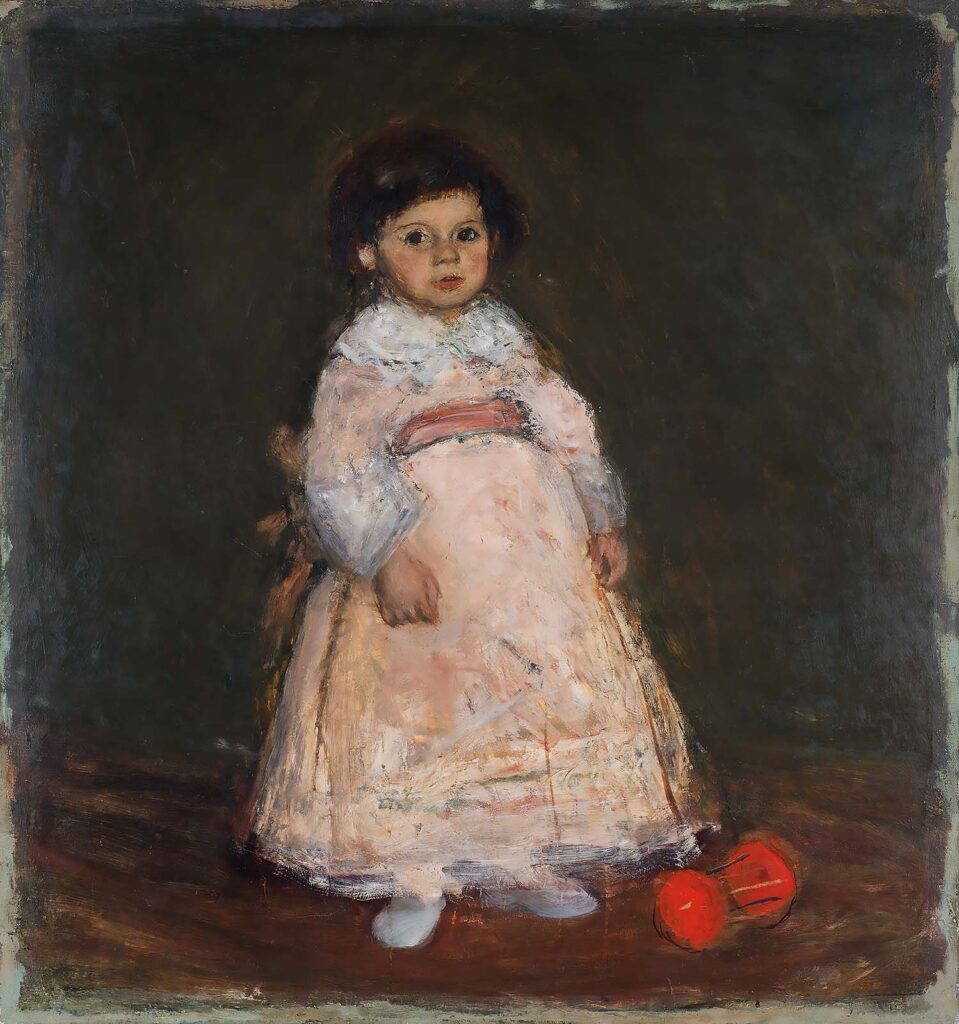
Gabrijel Stupica’s daughter Marija Lucija (1950–2002)
quickly became his favourite subject and an inexhaustible source of inspiration
to him.
Lucija in an Old-Fashioned Dress is one of the earliest depictions of the artist’s
daughter, who was three years old at the time. The many images of her are
linked via a strong tradition to the symbolic and objective worlds. The
dark-haired, dark-eyed little girl is shown here full length against a neutral
background, dressed in a light-coloured antique dress. She stands before us in
a self-confident and dignified attitude that reminds us of Velázquez’s
portraits of Spanish princesses from the seventeenth century.
Bibliography
Bambini nel tempo. L’infanzia e l’arte (ed. Luigina
Tozzato), Palazzo Te, Mantova, Milano 2004 [exhib. cat.]
Mateja Breščak, Alenka Simončič, Revelations.
Sculptor Franc Berneker and the Vidic family, Ljubljana 2014. Retrieved
from: https://www.ng-slo.si/en/exhibitions-and-projects/exibition-or-project/revelations-february-2014?id=2932
Mateja Breščak, Martina Vuga, Revelations. Ivan Zajec: Girls,
Ljubljana 2013. Retrieved from: https://www.ng-slo.si/en/exhibitions-and-projects/exibition-or-project/revelations-june-2013?id=1529
Anica Cevc, Otrok in družina v slovenski likovni, Narodna galerija, Ljubljana 1975 [exhib. cat.]
Children / Enfants / Kinder / Kinderen, Amsterdam 2005
Špelca Čopič, Franc Berneker. 1874−1932. Retrospektivna razstava ob 110-letnici
umetnikovega rojstva, Umetnostni paviljon Slovenj Gradec−Umetnostna
galerija Maribor−Narodna galerija, Ljubljana, Slovenj Gradec 1984 [exhib. cat.]
Špelca Čopič, Breda Ilich Klančnik, Lojze
Dolinar (1893−1970). Retrospektivna razstava / Retrospective, Moderna
galerija, Ljubljana 1996 [exhib. cat.]
Franc Berneker, Galerija likovnih umetnosti, Slovenj
Gradec 2001 [exhib. cat.]
Anna Green, French paintings of childhood and adolescence, 1848−1886,
Aldershot− Burlington
2007
Peter Hawlina, Valentin Krisper, [Paris] [s. a.]. Retrieved from: https://gw.geneanet.org/hawlina?lang=en&pz=peter&nz=hawlina&p=valentin&n=krisper
(23. 9. 2021)
Ivan Vavpotič. 1877−1943, Narodna
galerija, Ljubljana 1987 [exhib. cat.]
Ivana Kobilca (1861−1926). »Slikarija je vendar nekaj
lepega …« (ed. Nataša Ciber, Barbara Jaki, Alenka Simončič), Narodna galerija, Ljubljana
2018 [exhib. cat.]
Ivana Kobilca, 1861−1926, Narodna
galerija, Ljubljana 1979 [exhib. cat.]
Barbara Jaki, Langusov portret Karla Hummla
mlajšega, in: Vita artis perennis. Ob
osemdesetletnici akademika Emilijana Cevca / Festschrift Emilijan Cevc (ed.
Alenka Klemenc), Ljubljana 2000, pp. 497−504
Barbara Jaki, Meščanska slika. Slikarstvo prve polovice 19. stoletja iz zbirk Narodne
galerije, Narodna galerija, Ljubljana 2000 [exhib. cat.]
Jožef Tominc. Fiziognomija slike (ed. Barbara Jaki,
Mateja Breščak), Narodna galerija, Ljubljana 2002 [exhib. cat.]
Erika Langmuir, Imagining childhood. Themes in the imagery of childhood, New
Haven−London 2006
Michel Mohor, Ivana Kobilca (1861−1926). »Painting is something beautiful …«. Guidebook
to the exhibition, Narodna galerija, Ljubljana 2018 [exhib. cat.]
Nove pridobitve. 2001−2010 (ed. Barbara
Jaki), Narodna galerija, Ljubljana 2011 [exhib. cat.]
Kristina Preininger, Upodobitve otrok Matevža
Langusa, in: Zgodovina otroštva / History
of childhood (ed. Aida Škoro Babić … et al.), Ljubljana 2012 (Zbirka
Zgodovinskega časopisa; 45), pp. 69−79
Alenka Puhar, Prvotno besedilo življenja. Oris zgodovine otroštva na Slovenskem v 19.
stoletju, Zagreb 1982 (Biblioteka Globus)
Simon Schama, The embarrassment of riches. An interpretation of Dutch culture in the
Golden Age, London 2004
Alenka Simončič, Podobe prestiža. Antične zgodbe v steklu po gemah iz zbirke kneza Stanisława
Poniatowskega (1754−1833). Iz zasebne zbirke v Sloveniji, Narodna galerija,
Ljubljana 2017 [exhib. cat.]
Sto
umetnin Narodne galerije (ed.
Mateja Brečak), Ljubljana 2017
Ferdinand Šerbelj, Podobe otrok v preteklosti, Narodna galerija, Ljubljana 1979 [exhib.
cat.]
Tanja Tomažič,Igrače. Zbirka Slovenskega etnografskega
muzeja, Ljubljana 1999
Polonca Vrhunc,Ferdo Vesel. 1861−1946, Narodna
galerija, Ljubljana 1989 [exhib. cat.]
La voce dell’infanzia nelle Collezioni dei Civici
Musei di storia ed arte di Trieste, Palazzo Gopcevich, Trieste 2007 [exhib.
cat.]
Federico Zeri, Tuji slikarji od 14. do 20. stoletja, Narodna galerija, Ljubljana
1983 [exhib. cat.]
Federico Zeri, Ksenija Rozman, Evropski
slikarji iz slovenskih zbirk, Narodna
galerija, Ljubljana 1993 [exhib. cat.]
Zgodovina otroštva / History of childhood (ed. Aida Škoro
Babić … et al.), Ljubljana 2012 (Zbirka Zgodovinskega časopisa; 45)
National Gallery of Slovenia, represented by
Barbara Jaki
Author of the exhibition
Mateja Breščak
Photo
Bojan Salaj, Janko Dermastja (© Narodna galerija)
Language editing
Zala Mikeln
Translation
Hugh Brown, Amidas d. o. o.
Web page
Luka Hribar
Bibliography review
Nataša Ciber
Online exhibition | From 5 November 2021 onward
National Gallery of Slovenia
Prešernova 24
1000 Ljubljana