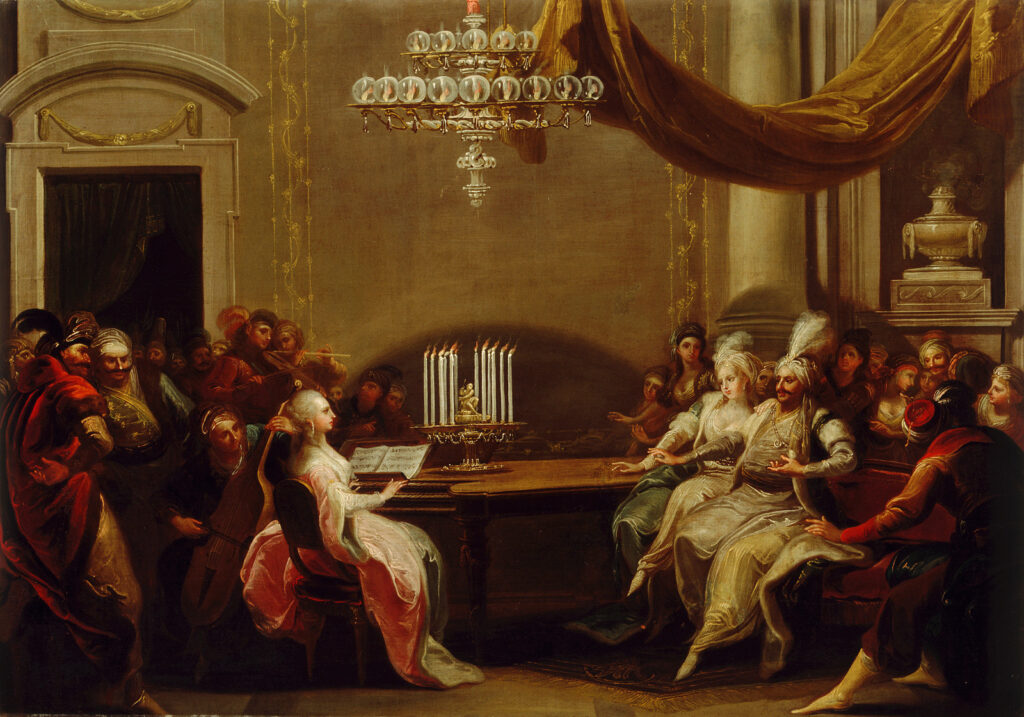
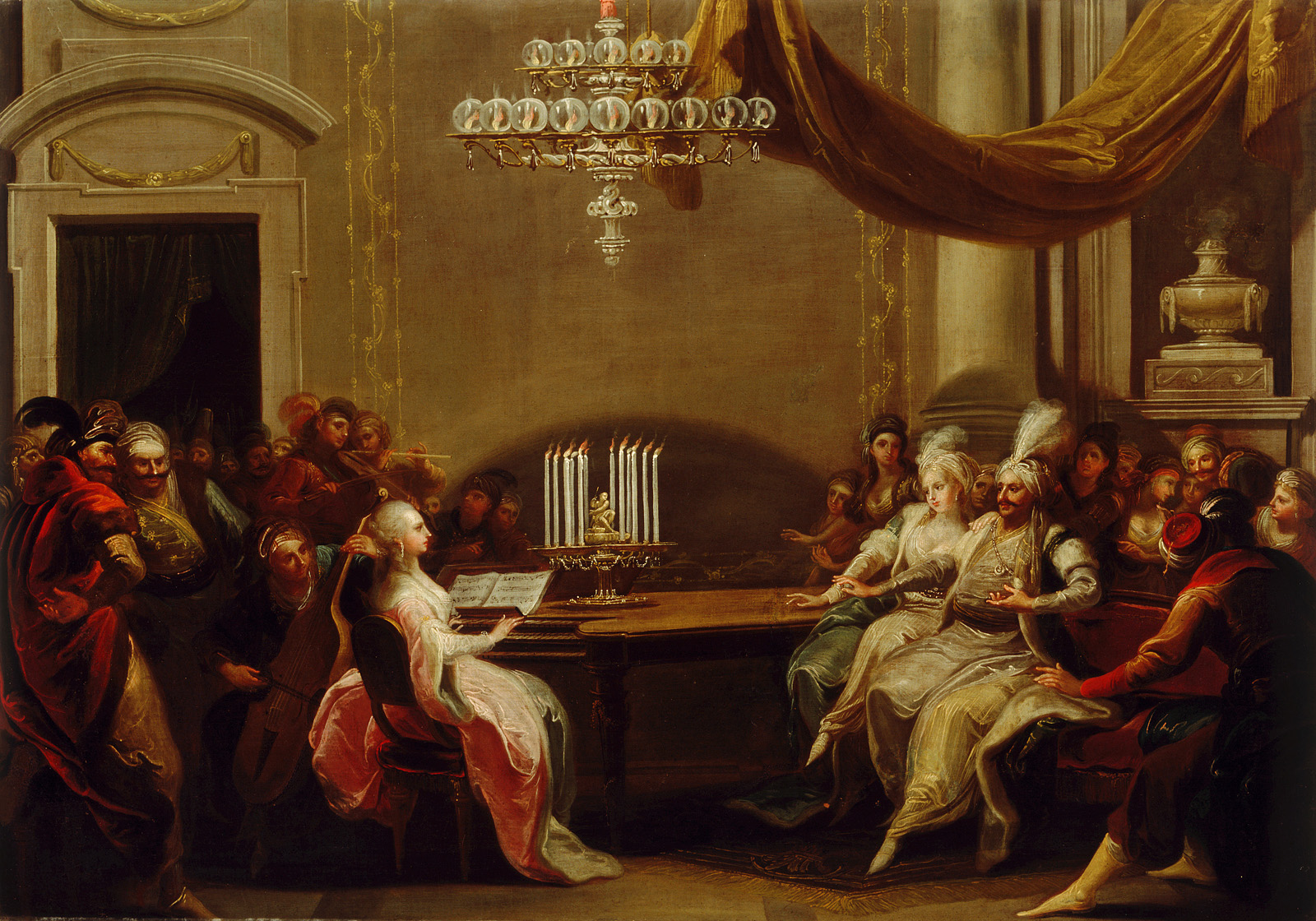
The architecture of the scene is classical, while the oriental features, which could be Turkish, lie in the costumes of the main figures.
The main compositional scheme of this picture, of which there are many variants, is based on the famous painting by Carl Van Loo (Nice 1705–Paris 1765) in the Wallace Collection in London (Inv. P. 451), which is signed and dated 1737. The painting by the French artist was owned by the King of Prussia and the Polish king Stanislaus Augustus. The mirror image composition of our painting shows that it was copied from some print, in fact from the print (in reverse) which Claude-A. Littret produced in 1766 and called The Great Sultan’s Concert. Van Loo’s original was very often copied.
There is another version of our painting, 64 x 98 cm, which was found at the Galerie Pardo in Paris in 1983. But there are many differences, in the architectural background, in the chandelier in the middle and in a number of smaller details. It is also in oil on canvas. It should be noted that the French model underwent a certain change – and this is also the case in Henrici’s interpretation – which is faintly reminiscent of some interiors by Pietro Longhi. The strongly highlighted head of the old man on the left, which we see en face in front of the opening of the door, is probably based on one of the heads which Giovanni Battista Tiepolo painted and which Domenico Tiepolo engraved in copper; they were published between 1770 and 1774.