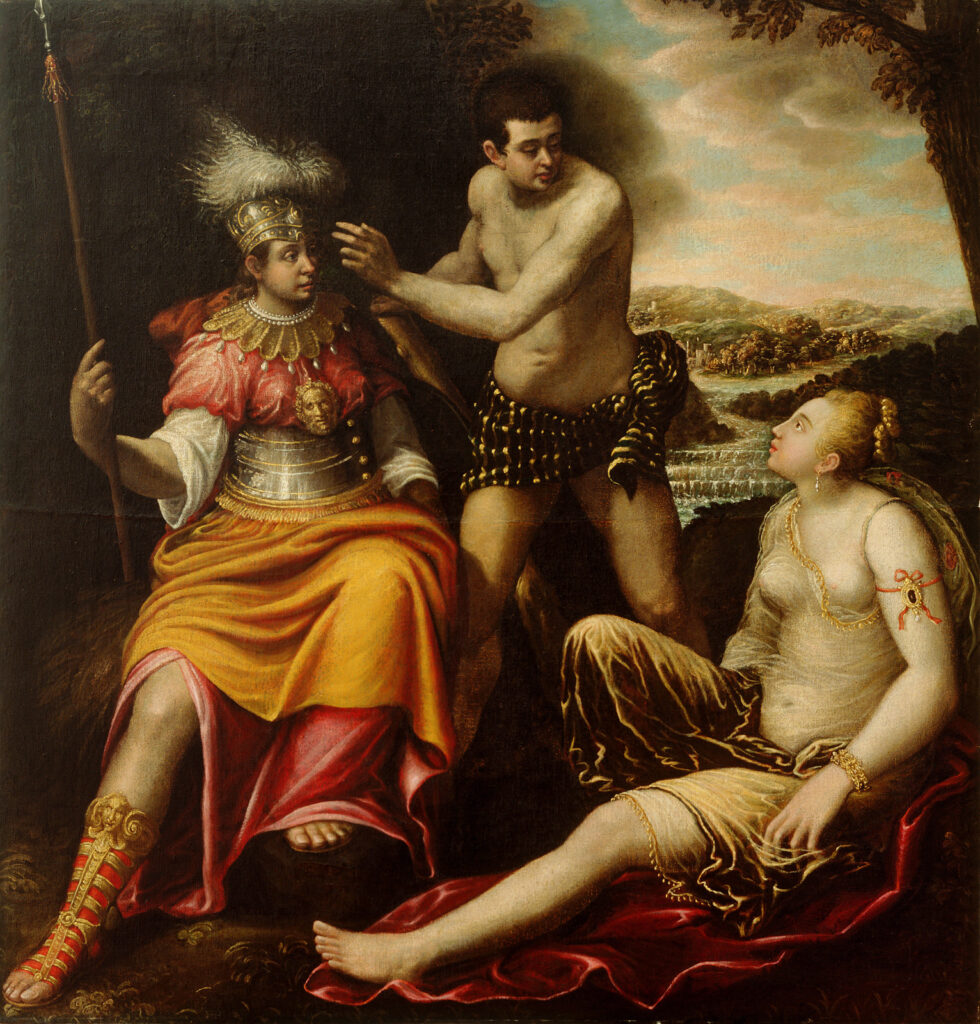
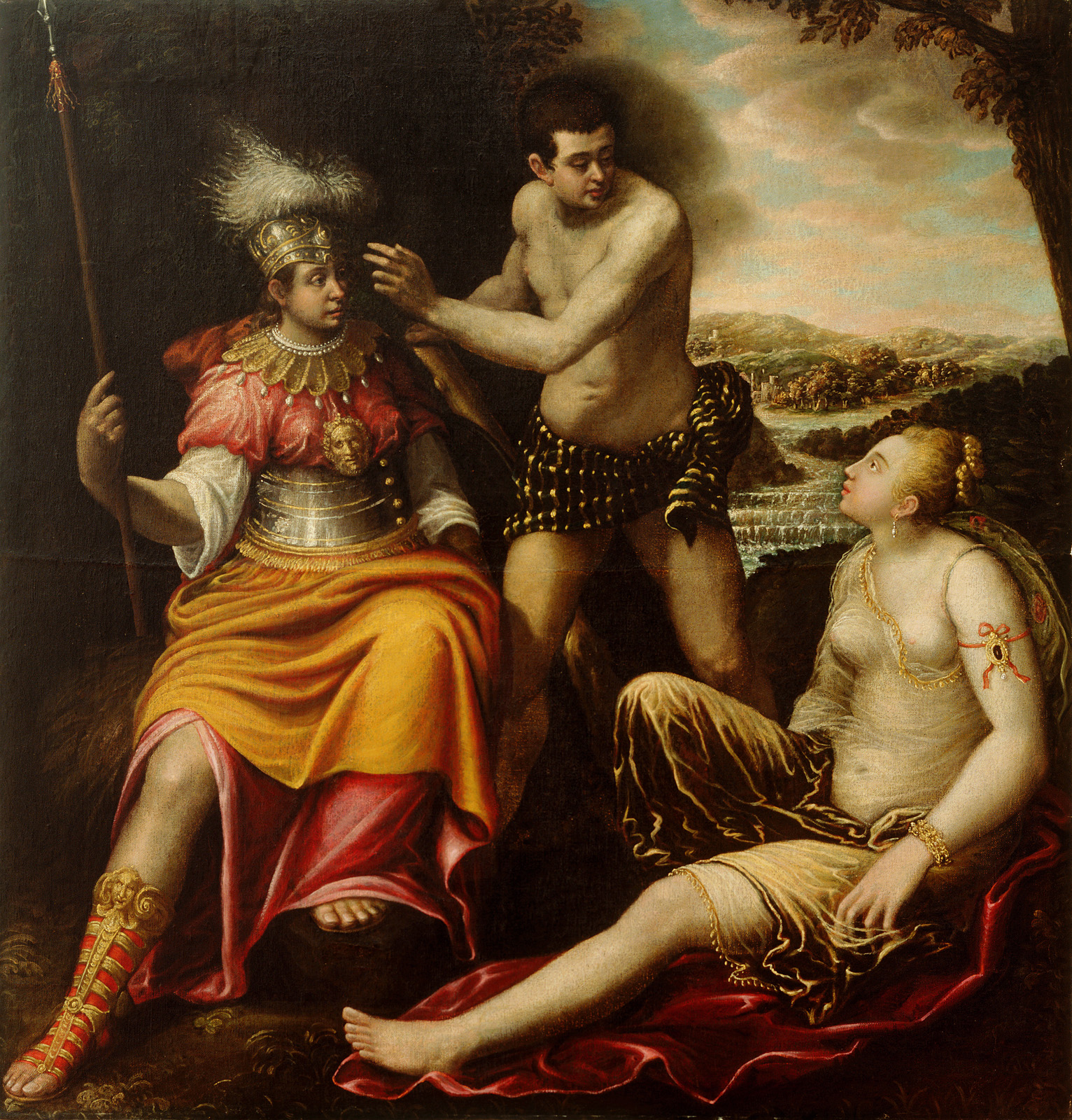
The motif is classical and originates from Xenophon (Memorabilia II, 1, 21 sq.) and Hesiod (Erga, 287 sq.): it shows the young Hercules with a club as his attribute, as he chooses between two roads which open before him – the first is ruled by Virtue, the other by Vice. The first of these allegorical figures is depicted as a female warrior, indicating that Virtue is continuously battling against Vice, while the second reminds us of half-naked courtesans adorned with jewels. Behind Virtue rises a steep hill, while in the background behind Vice lies a wooded plain with a meandering river.
The style of the picture, in particular in the figure of Hercules, recalls the last period of Baglione’s long creative life. Particularly illuminating are comparisons with three pictures which the artist painted for one of the chapels of the church of Santa Maria dell’Orto in Rome and which show the Virgin Mary with the Child and Saint Ambrose, Saint Charles Borromeo and Saint Bernard of Siena, Saint Ambrose Vanquishing the Aryans and Saint Charles Borromeo with the Plague-stricken. Characteristic of Baglione’s last period are also the fairly superficial treatment and the typological choice of the three persons.
It is very likely, if not even certain, that this is the work which Baglione himself mentions in his autobiography as representing Ercole…dalla Volutta…allettato, & egli voul’ andare al Tempio dell’ Eternita (Hercules…attracted by Vice, but he wants to go to the Temple of Eternity). The painter gave this picture as a present to Ottavio Tronsarelli of Rome. This is the man to whom he is said to have dictated his Vite; in any case it falls into the painter’s last period, between the years 1640 and 1642; this dating is also corroborated by the results of a stylistic analysis.