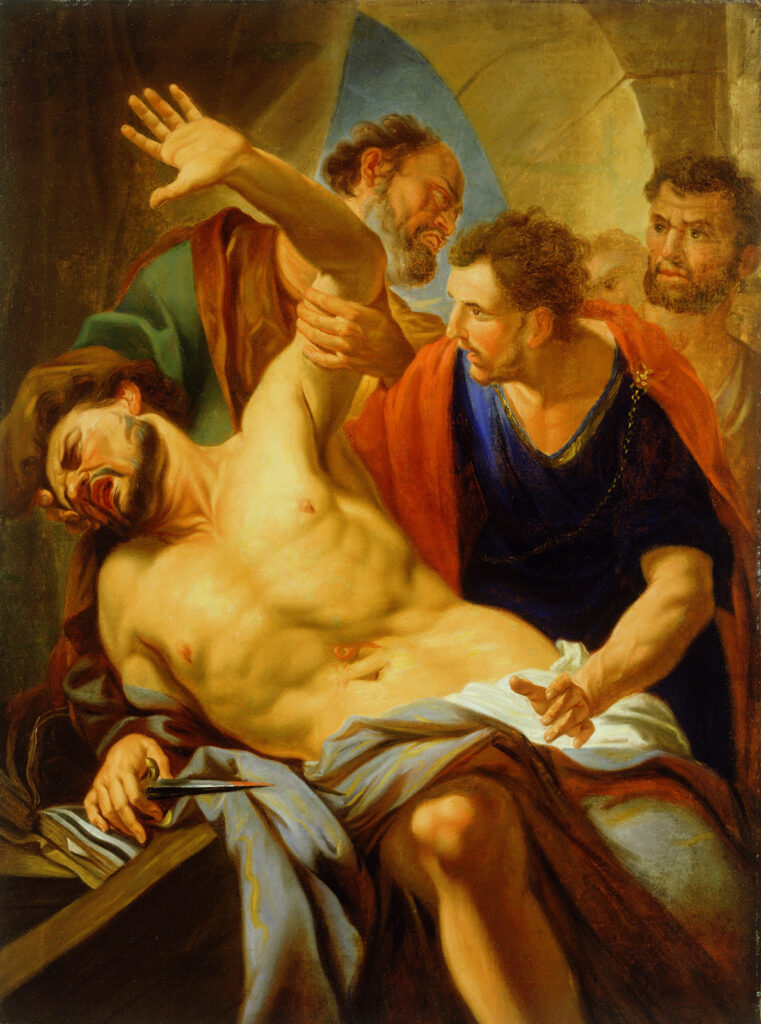
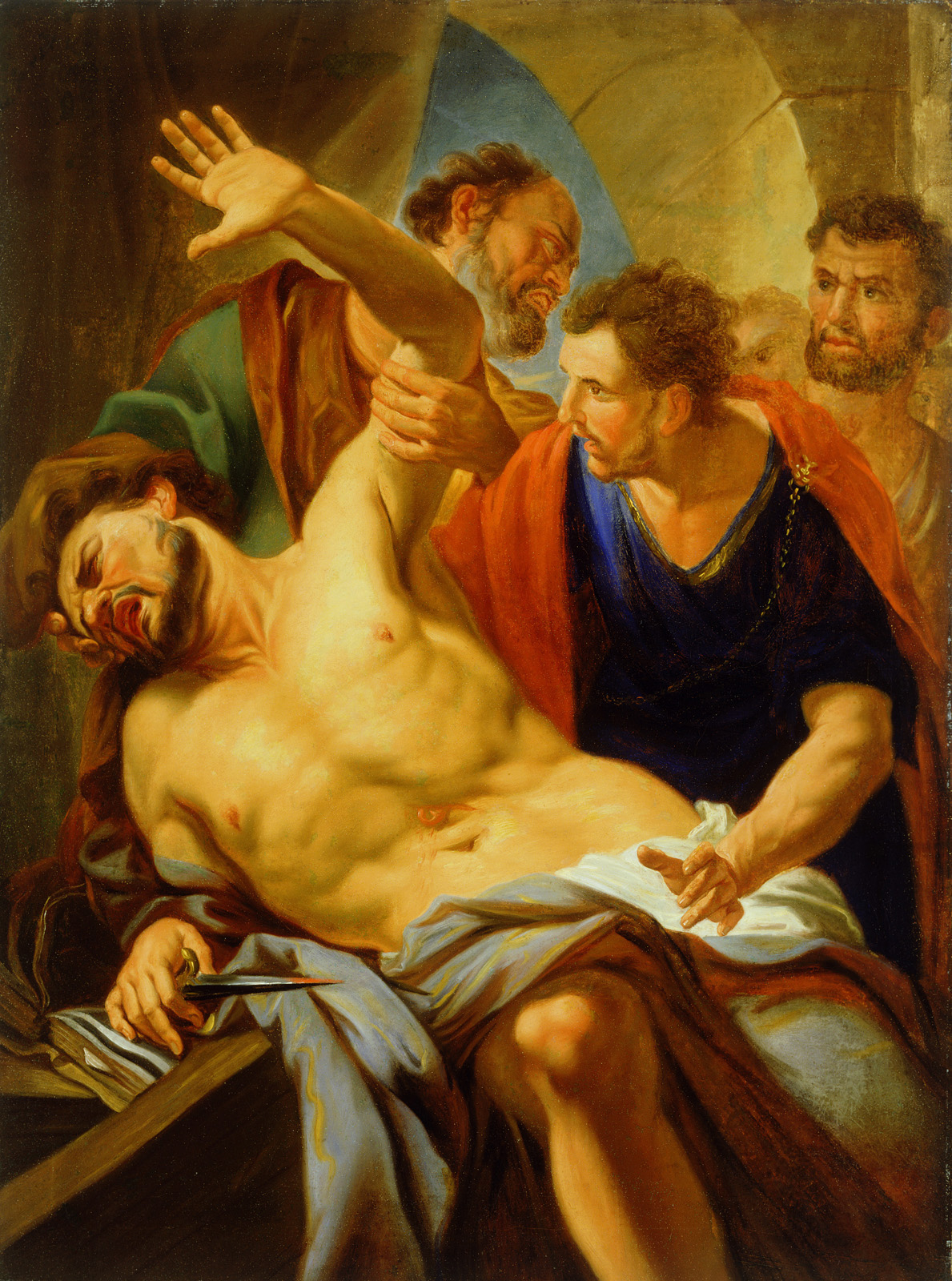
Cato the Younger (Cato Uticensis) was a follower of Pompey and an opponent of Caesar. He was a passionate admirer of stoic philosophy. When Pompey was murdered after his defeat at the battle near Pharsalus, Cato went to Africa and joined Pompey’s followers. In 46 BC the Republicans were defeated in the battle near Thapsus and Cato committed suicide at Utica (he was referred to as Cato Uticensis after the city of Utica, to differentiate him from Cato the Elder – Cato Maior). Plutarch reports that Cato stabbed himself, but the wound was not fatal. He fell from his bed and his servants heard the noise and ran into the room together with Cato’s son and his friends. The doctor wanted to save his life, so he sewed up the wound. When Cato regained consciousness he pushed the doctor away, tore up his intestines and died.
Cato is depicted at the moment when his son, his friends and the doctor run into the room. On the left is an open book, apparently he was rereading Plato’s dialogue Phaedo just before his suicide. Depictions of Cato’s death were very common in Italian Baroque painting, especially in Venice: Langetti painted it seven times, Loth eleven times, Luca Giordano at least four times. The figures in our picture are reminiscent of Venetian models (Loth, Langetti) and also Austrian painters who studied in Venice; however, the colouring is cold and the priming is chalk. The painter has not yet been identified. The question is whether this is an original or perhaps an early 19th century copy of a work which we do not know.
Year of creation
18th Century
Technique
oil, canvas
Dimensions
135,5 x 101 cm
Inventory number
NG S 2527, National Gallery of Slovenia, Ljubljana