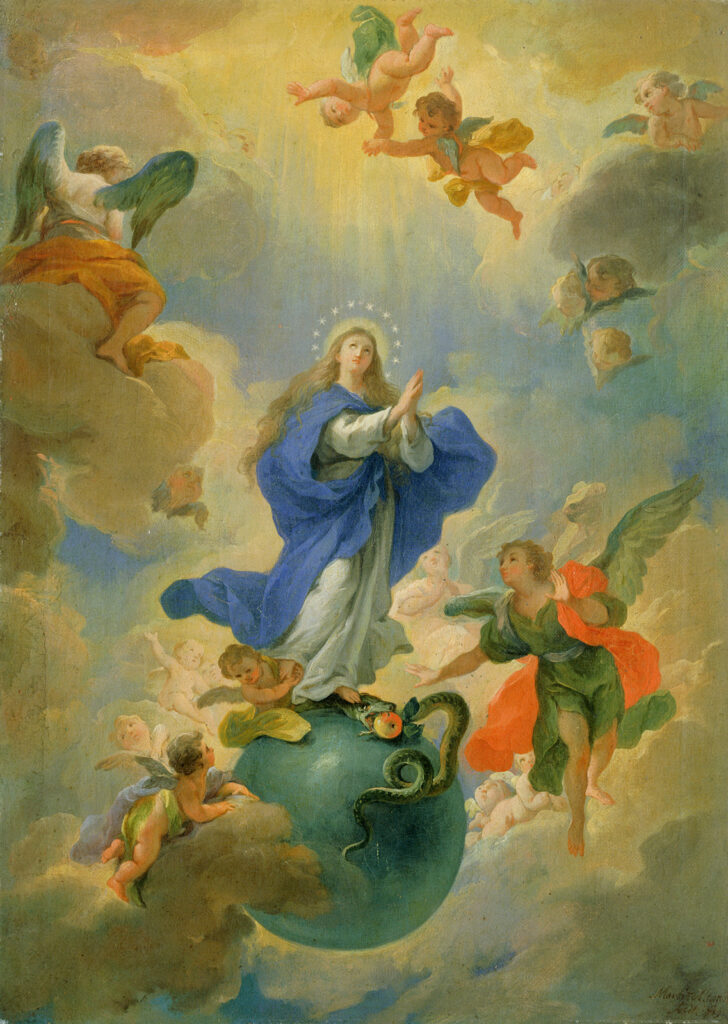
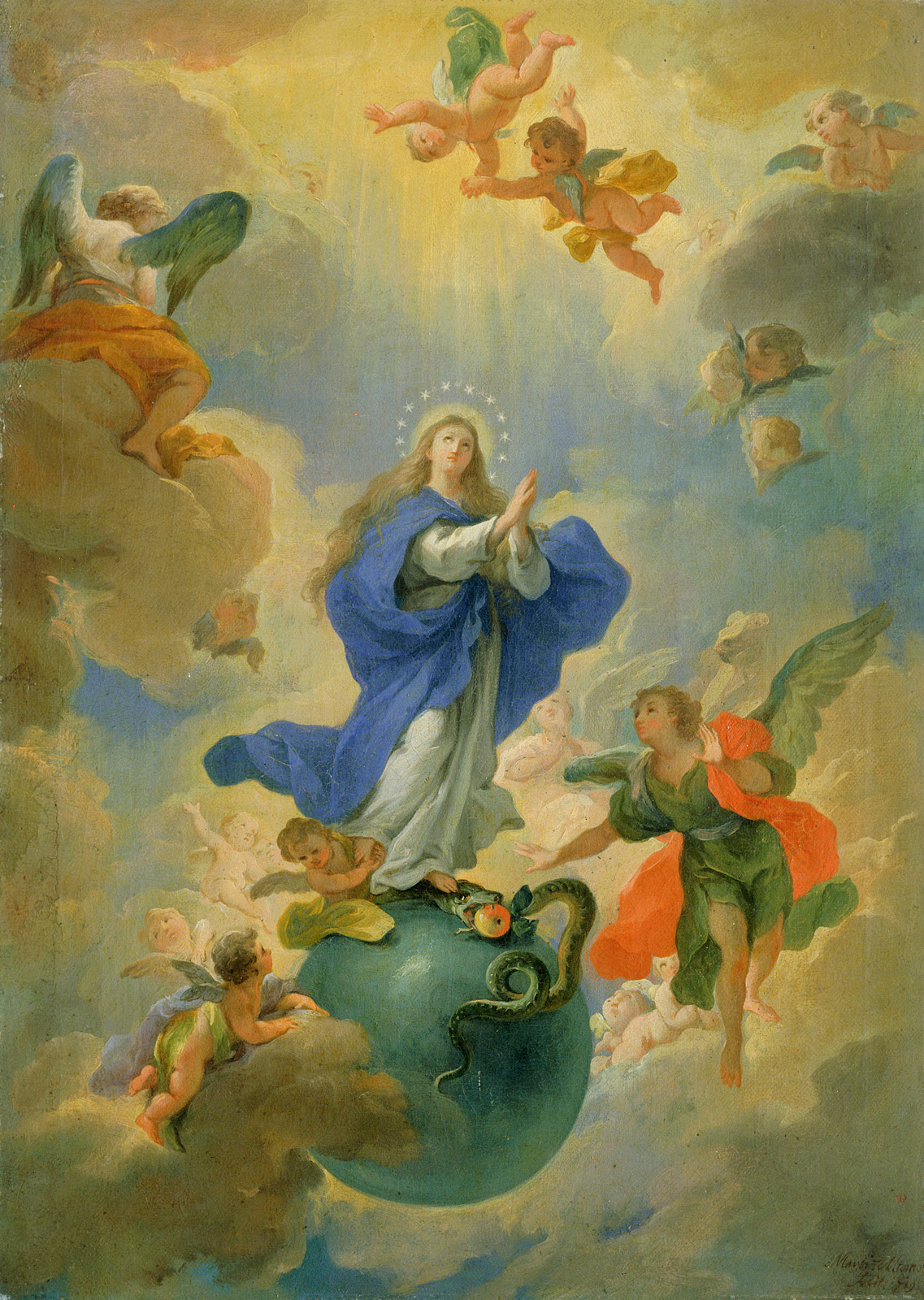
“And there appeared a great wonder in heaven: a woman clothed with the sun and the moon under her feet, and upon her head a crown of twelve stars” (Rev 12,1).
In contrast to frequent portrayals of the Immaculata – i.e. standing on a crescent moon with the earth globe in the clouds, surrounded by angels, with arms folded in prayer or piously crossed on her breast, while her foot crushes the head of the serpent which has the apple of sin in its mouth – Altomonte’s Immaculata is not standing on a crescent moon, but only on the earth globe, and her arms are stretched up to heaven in prayer. This figure of the Virgin Mary has a certain connection with models of the Roman school of the 17th century. The date of the painting – 1719 – sets this work into the time when the artist was completing two big commissions for frescoes and altarpieces in Vienna and in Salzburg and was setting off to work in Upper Austria (at the monasteries of Sankt Florian, Kremsmünster, etc.).
The cadre of the painting, and in particular the illusionistic space between the clouds, the celestial radiance and the flying angels, would indicate that this is an oil sketch for some larger composition, perhaps a fresco or an altarpiece. Two other paintings of the Immaculata by Altomonte are known (in the monastery of Admont, an oil dated 1726, and in the parish church in Sarleinsbach, oil on copper, dated 1728) and also a drawing in the Albertina in Vienna, Inv. No. 27108.