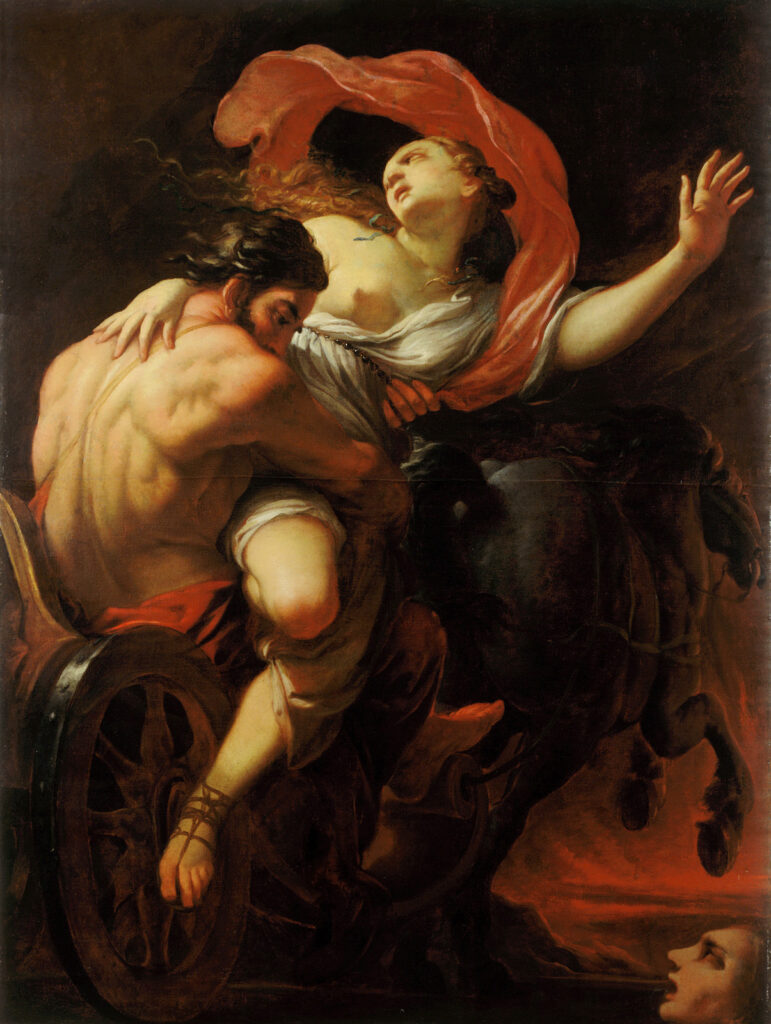
This motif was common in European art from the Renaissance onwards. It originates from Ovid’s Metamorphoses (V, 391–404); Ovid also recapitulated it in the Fasti (IV, 417 to 450), while later it was the main theme of the epic De raptu Proserpinae by Claudius Claudianus (4th–5th century A.D.).
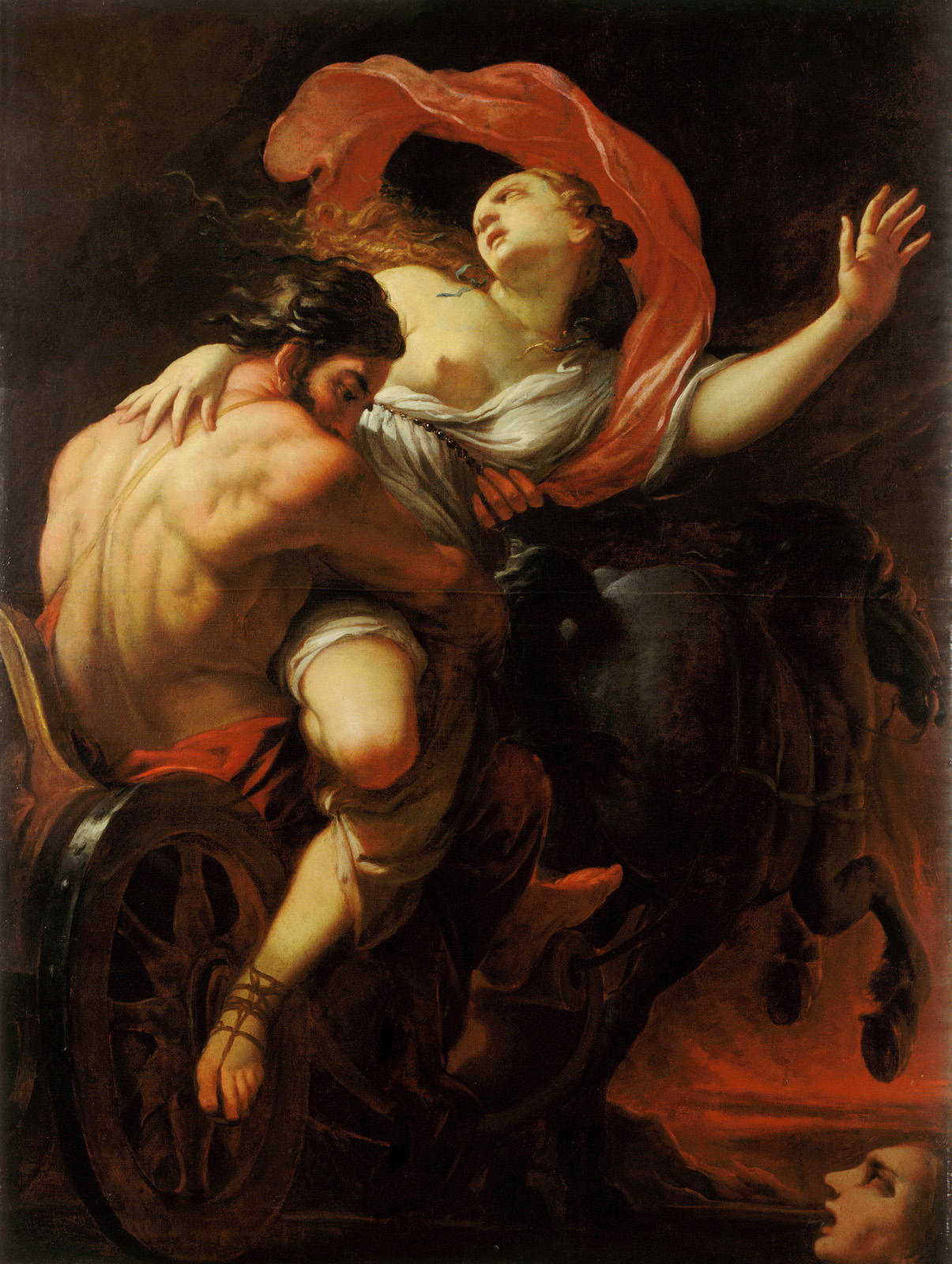
At the time of the Baroque this motif also inspired many composers, among them Claudio Monteverdi (Proserpina rapita, 1630) and Giovanni Battista Lulli/Jean-Baptiste Lully (Proserpina, 1680). Here we see Pluto, the Lord of the Underworld, kidnapping Persephone and taking her off to his underground kingdom on a wagon. At the lower right we see the head of one of Persephone’s friends who is watching the scene in horror.
The characteristically Baroque depiction of the space is typical of Venetian art; the composition is probably modelled on the work of Luca Giordano, the great Neapolitan painter, who lived in Venice on a number of occasions, perhaps from as early as 1650 to 1654. But despite this, our present knowledge of Venetian painting does not permit us to make a definite attribution of this painting, which undoubtedly has considerable decorative value.
Year of creation
2nd Half of 17th Century
Technique
oil, canvas
Dimensions
176,2 x 132 cm
Inventory number
NG S 1959, National Gallery of Slovenia, Ljubljana