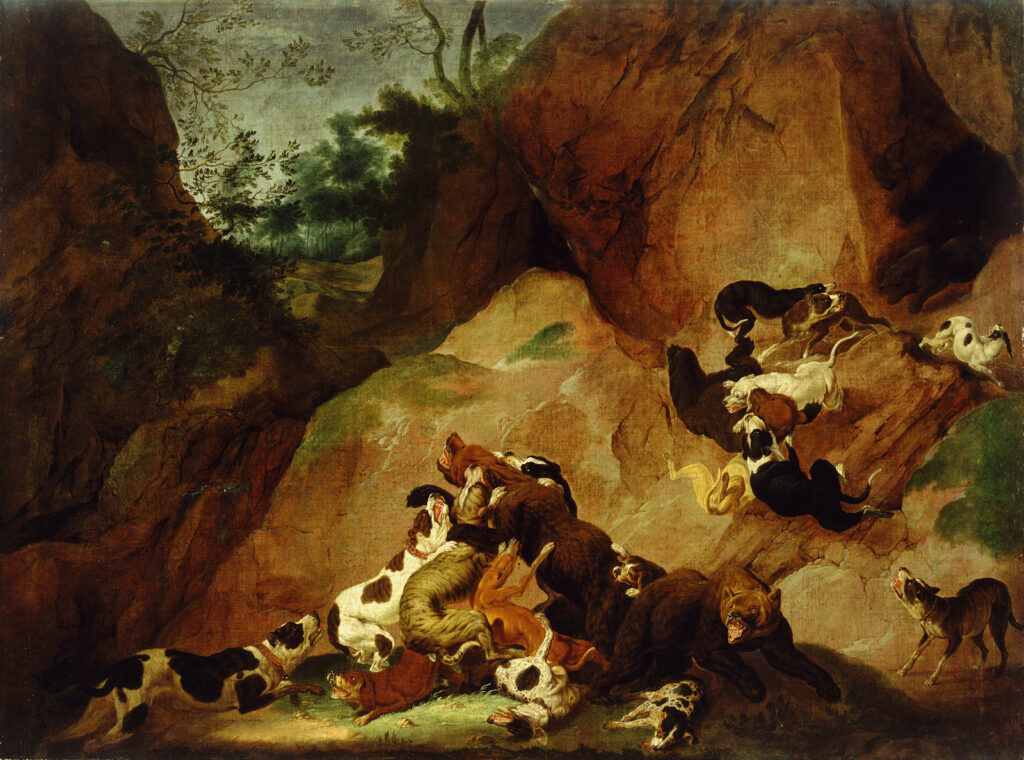

Born ca. 1630 in Danzig, died ca. 1703 in L‘Aquila in the Abruzzi mountains. His father Veit Ruthart was a tailor from Fürth. In 1652 and 1659 the painter was already living in Rome, 1663/64 he was a member of the Antwerp guild, in 1665 and 1667 he is mentioned in Vienna and in Graz, in 1672 in Venice and in Rome, where he entered the Celestine monastery of San Eusebio and took the monastic name of Andreas. From Rome he went to the monastery of Santa Maria di Collemaggio, where he remained for the rest of his life. Ruthart was a very skilled master, a painter of animals; he often depicted them in fierce battle (dogs, deer, bears, wolves and lions). His canvases are sometimes very large; the landscape backgrounds of his scenes reveal a study of the works of Salvatore Rosa and his followers, while the animals show the influence of the Flemish masters (Fyt, Snyders and others). The human figures in Ruthart‘s pictures were often added by other painters. Ruthart‘s works are kept in L‘Aquila, two altarpieces are in the church of San Eusebio in Rome, other works are in the Joanneum museum in Graz, in the Gallery of the Akademie der Bildenden Künste and in the Kunsthistorisches Museum in Vienna and elsewhere.
Lit.: Renate Trnek, Niederländer und Italien: Italianisante Landschafts- und Genremalerei von Niederländem des 17. Jahrhunderts in der Gemäldegalerie der Akademie der bildenden Künste in Wien, Wien 1982, pp. 104-105; Peter Herde, Zur neuzeitlichen Ikonogaphie Papst Cölestins V.: Mattia Preti und Carl Ruthart, Institution und Darstellung, Erich Hubala zum 24. März 1985, Editor Frank Büttner and Christian Lenz, München 1985, pp.173-182.