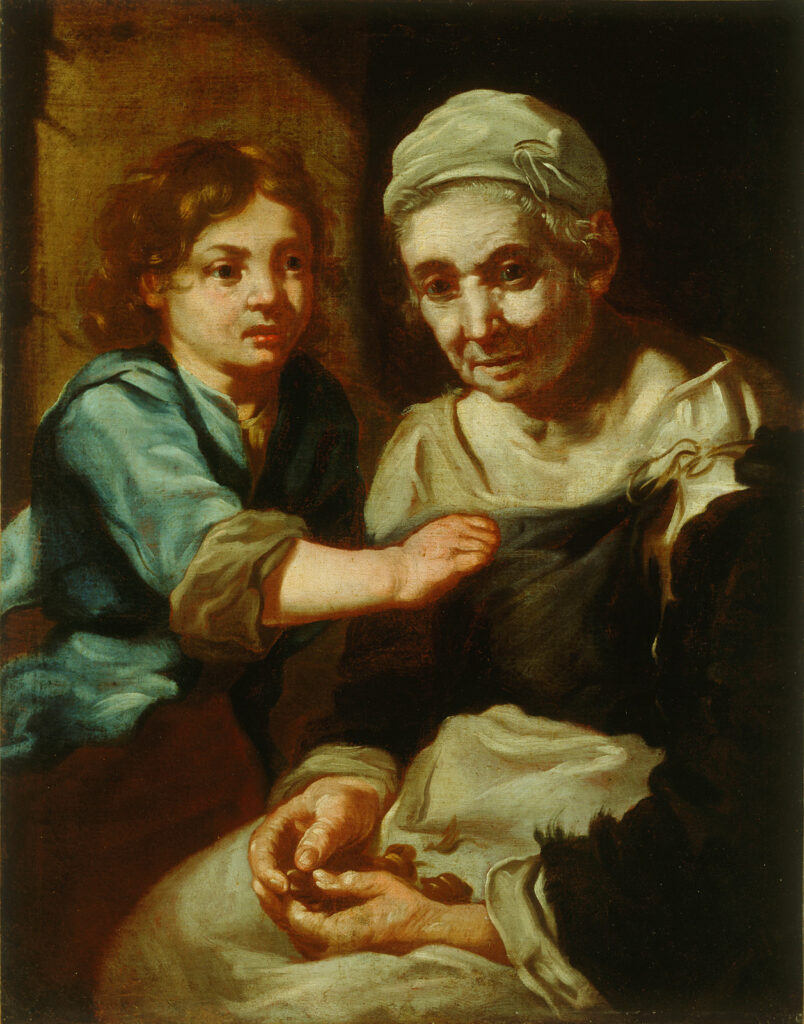

Born 1624 in Helsingor in Denmark, died 1687 in Rome. His father, Caspar Kegelhoff (Keilhau), was a German painter from Meissen, who emigrated to Denmark. He was in all probability the artist’s first teacher, while the second was the Copenhagen painter Morten van Steenwickel, with whom Keilhau studied for six years, and then another two years with Rembrandt in Amsterdam (1642–44). He remained in Holland until 1651. On the way to Italy he stopped in Cologne, Frankfurt and Augsburg, 1651 he arrived in Venice via the Tyrol. In 1654 he was active in Bergamo, in 1656 he arrived in Rome, where he remained until his death. Beside portraits and religious scenes Monsu Bernardo, as he was called in Italy because he was a foreigner, also painted many scenes of folk life, of farmers and simple people. These scenes (most of which have darkened today because of their bitumen priming) were quite important for Italian painting both in Rome and elsewhere on the peninsula. They initiated a new style of realistic painting, whose subject matter, typology and composition can be discerned in the work of many artists of the following generations.
Lit.: Minna Heimbürger, Bernardo Keilhau detto Monsu Bernardo, Roma 1988; Seicento, Vol. I-II, Milano 1989 (biogr. Nicosetta Roio).