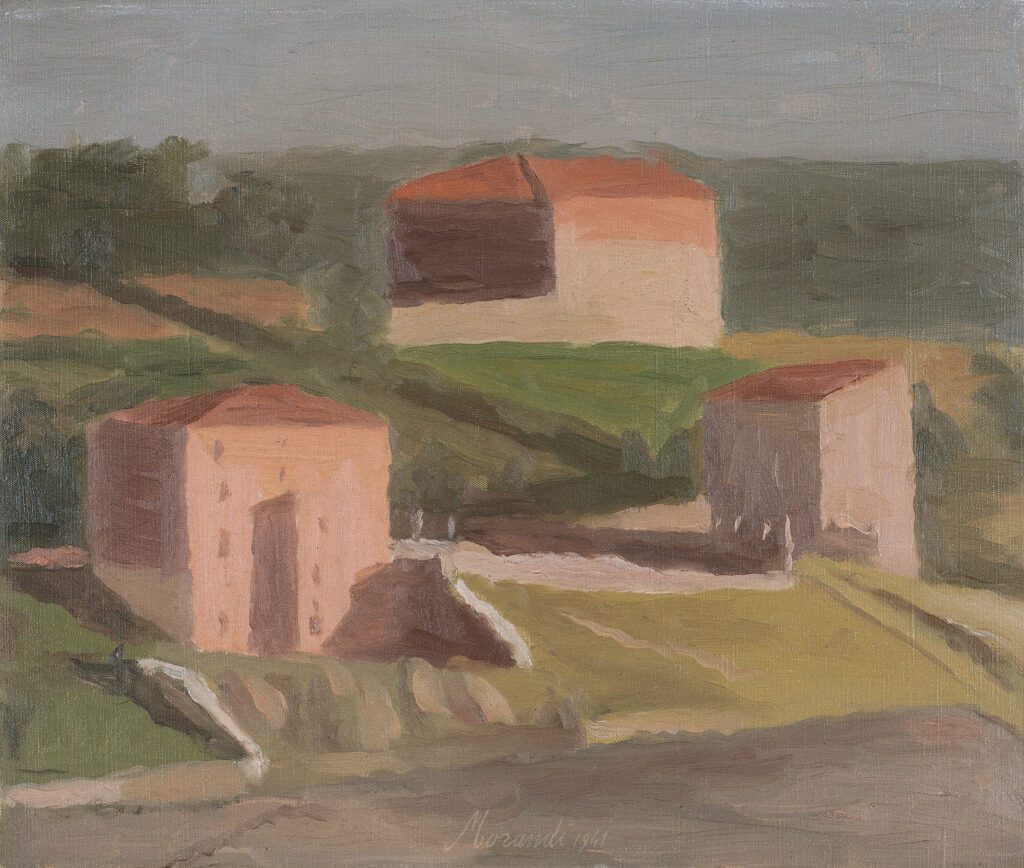

Born 1890 in Bologna, died there in 1964. The artist, who is today considered to be one of the greatest Italian painters, never left his native city, where he studied at the local academy. For some time he was close to Futurism and then to Metaphysical Painting, but he soon developed an individual style which did not significantly change later and which he realised in numerous paintings on canvas and in etchings. With the exception of some rare figural compositions Morandi painted mainly landscapes and in particular still lifes with bottles and old objects, which are depicted with an exceptional feeling for colour and are based on minute variations, which are achieved with extremely sensitive and vibrant brush strokes. The silent world of Morandi’s landscapes and still lifes is permeated with an intense lyricism and an almost ascetic introspection: the strict limitation of motifs, which the painter set into a world in which there is neither time nor development, can be interpreted as the artist’s personal protest against the Fascist dictatorship and against the materialism which marked the cultural life in Italy after 1920.
Lit.: Lamberto Vitali: Morandi: Catalogo generale, Vol. I-II, Milano 1977; Morandi: Acquerelli: Catalogo generale, Editor Marilena Pasquali, Milano 1991; Morandi: Incisioni: Catalogo generale, Editor Michele Cordaro, Milano 1991; Novecento/1, Vol. I-II, Milano 1992 (biogr. Marilena Pasquali); Giorgio Morandi artista d’Europa, Editor Marilena Pasquali, Milano 1992; Novecento/2, Vol. I-II, Milano 1993 (biogr. Marilena Pasquali); Disegno italiano del Novecento, Milano 1993.