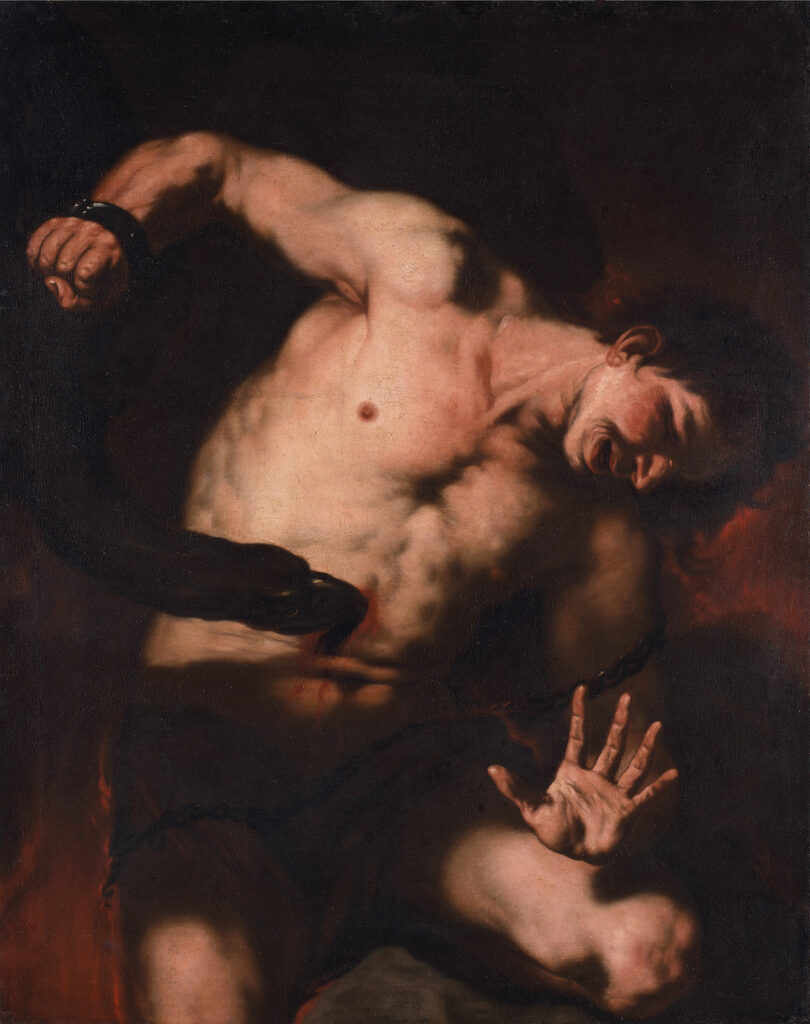

Born 1634 in Naples, where he died in 1705. He studied first with his father Antonio, then with Ribera up to about 1650. Around 1652, when Ribera died, he went to Rome, where he made a close study of the works of Pietro da Cortona. He visited Bologna, Parma and Venice, where he copied Titian, Tintoretto, Veronese and Jacopo Bassano. After the great plague in Naples he returned to his native city in 1656 and entered into competition with Mattia Preti. The artists influenced each other: Giordano adopted Preti’s figures’ austere gestures and dramatic accents. He painted for churches in Venice, Padua and Montecassino, his frescoes in the Medici-Riccardi palace in Florence date from 1682–86. The Spanish King Charles II invited him to Madrid, where he painted in the Royal Palace, in Toledo cathedral and in the Escorial, and he greatly influenced the development of Spanish 18th century painting. In 1702 he returned to Naples. Giordano produced a very large number of paintings and extensive cycles of frescoes. He had an excellent mastery of painting techniques and worked so fast that he was called “fa presto” (works fast — a quick painter). He consolidated the fame of Neapolitan painting and is considered one of the most inventive of the Baroque painters.
Lit.: Oreste Ferrari-Giuseppe Scavizzi, Luca Giordano: L’opera completa, Vol. I-II, Napoli 1992.