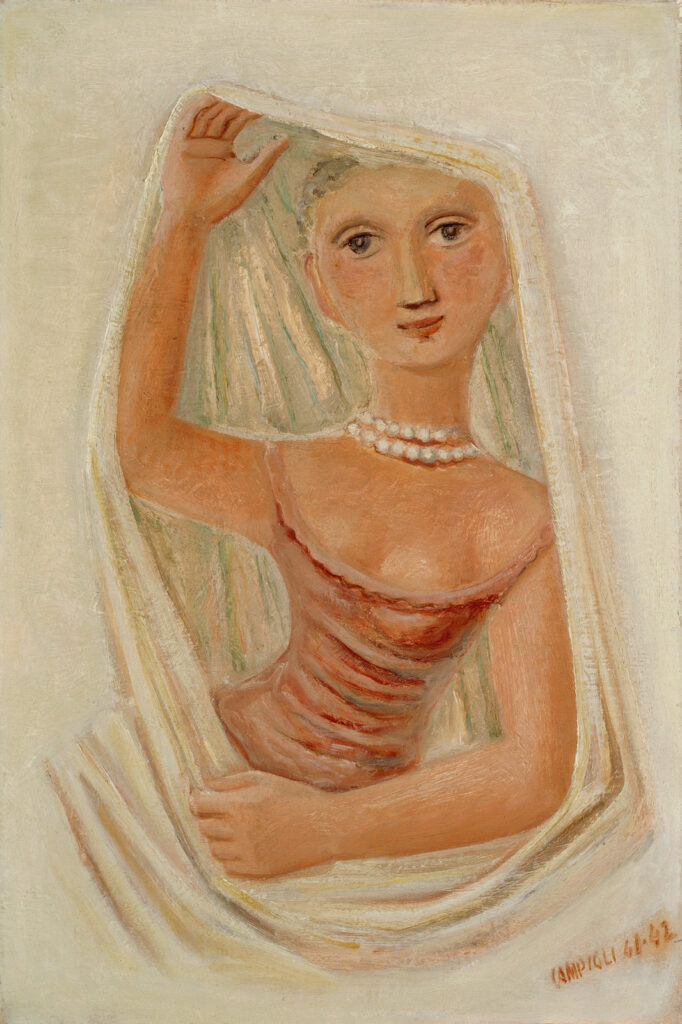

Born 1895 in Berlin, died 1971 in Saint-Tropez (France). He spent his youth in Florence, in 1909 he moved with his family to Milan, where he joined the Futurists. At first he was more attracted by literature than by art. As a journalist for the Corriere della Sera he went to Paris in 1919, where he painted as an autodidact: he studied the work of Pablo Picasso, Fernand Léger, Amédé Ozenfant and Carlo Carrà. Soon he developed a quite individual style in which he expressed an elegant primitivism; this was the result of an amalgam of the compositional schemes of Cubist origin and motifs of Greek antiquity and Etruscan (from 1928 onwards) and Indian art. The feeling of antiquity in his paintings is often still further emphasised by the technical preparation of the canvases so as to make the surface look like stone, giving the impression of a fresco. Campigli painted a large number of paintings, and also frescoes in Padua, Milan and Geneva.
Lit.: Novecento/1, Milano 1992 (biogr. Giuliana Tommasella); Campigli: Prigioniero di vite trascorse, Editor Franco Basile, Bologna 1992; Novecento/2, Vol. I-II, Milano 1993 (biogr. Giuliana Tomasella); Disegno italiano del Novecento, Milano 1993; Massimo Campigli, Editor Bruno Mantura & Patrizia Rosazza Ferarris, Milano 1994 [ex. cat.].